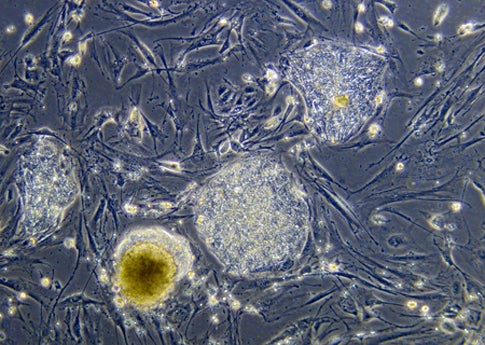
The push-pull between the Obama administration and U.S. District Judge Royce Lamberth over the government's funding of embryonic stem cell research has swung back the other way, at least temporarily lifting the temporary injunction blocking federal funding for embryonic stem cell research that was issued last month.
The lifting of the funding is a victory of sorts for those in the scientific community who support President Obama’s policy, which allows federal funding of embryonic stem cell research on stem cell lines outside of the original 21 allowed under his predecessor’s policy. But the issue is far from settled, and research that has already been suspended by the National Institutes of Health is likely to remain on hold until a final decision is made by the Court of Appeals.
That could take awhile. The three-judge panel was careful to note that their lifting of the funding ban is in no way an endorsement of the administration’s position on the matter but rather a means to provide them with more time to consider all the issues. So while the federal money spigot can once again flow, many projects on hold will likely remain that way.Moreover, the uncertainty that the controversy introduces into the scientific community may make it harder for some projects to drum up private funding, as backers may be apprehensive to sink cash into research that may end up collapsing under a court ruling anyhow.
In the meantime, opponents of the funding have until September 14th to hand in their response to the appeals court, while the government – representing the NIH – has until the September 20th. Neither the Department of Justice nor the NIH chose to comment on the injunction today.
For more, last week's New Yorker has a nice piece on the NIH and the stem cell debate.
138 years of Popular Science at your fingertips.
Each issue has been completely reimagined for your iPad. See our amazing new vision for magazines that goes far beyond the printed page
Stay up to date on the latest news of the future of science and technology from your iPhone or Android phone with full articles, images and offline viewing
Featuring every article from the magazine and website, plus links from around the Web. Also see our PopSci DIY feed
Science is reinventing play, from extreme sports to gamification to ridiculous roller coasters to the playgrounds of tomorrow, and this issue is chock full of fun. Also, on a less fun note: Did global warming destroy my hometown?
They've already strung up stem cell research with red tape, and now they want to swing the corpse back and forth. They need to make up their minds already.
I agree completely with thor- it takes years for scientists to write grants for funding and do experiments, and government flip-flopping can make all those efforts pointless overnight.
Several groups in Japan and the US have managed to make pluripotent stem cells from skin or bone marrow tissue, so soon the use of embryonic cells may be unnecessary anyway. But I bet that won't stop the political wrangling.
word... if we paralyzed all the politicians I am sure this wouldn't be an issue at all.
I feel that I have to clarify a few points about embryonic stem cell research that is almost always overlooked in the popular media:
1. Embryonic stem cells are derived from an embryo, but once these cells are derived they can be grown in the lab - theoretically forever. In fact, most embryonic stem cell research has been performed on cells that were originally obtained nearly 15 years ago. So while these cells did indeed come from an embryo at one point, 15 years is pretty far removed and I think a large majority of Americans would agree that there's an important difference here. If the cells were already obtained, we should make the most of them. That's why conservative politicians such as George W. Bush enacted the rules the way he did.
2. An embryo is not the same as a fetus, and vice versa. When embryonic stem cells are indeed derived from an embryo, its from an embryo that is approximately 5 days after fertilization at a stage called the blastocyst. This is literally a hollow "ball" of cells, containing 50-100 total cells. Smaller than the tip of a needle. There's no resemblance to a human, or anything in the animal kingdom for that matter. Embryonic stem cells are so powerful because they are derived at a stage before any cell fate has been decided. They can become any cell type without restrictions. It's also worth mentioning that 5 days post fertilization is before implantation in the uterus. We're talking very early in development here, long before a woman would know she's pregnant. So any stories equating embryonic stem cells with fetuses, or with abortion, are just outright false. Once the embryo develops more and becomes a fetus, you cannot derive embryonic stem cells anymore because they have developed into something else. Also, its worth mentioning that all embryonic stem cells that have been derived from embryos have been done with embryos that were left over from in vitro fertilization clinics and with the consent of the couple.
3. A lot of comment boards on other sites are filled with people claiming that adult stem cells are better and have resulted in cures, so embryonic stem cell research shouldn't be pursued. This is tremendously stretching the truth. Adult stem cells HAVE proven to be useful in some instances, such as bone marrow stem cells or umbilical cord stem cells being used to treat diseases of the blood system. They have not conclusively been shown to help other systems and in fact these studies have been largely discredited. Diseases/disorders of other systems, such as the nervous system, are reliant on embryonic stem cells because not only are neural stem cells restricted in their number and abilities, would you volunteer to have someone dig around in your brain to find some cells? This post is not meant to say that adult stem cells are not worthwhile. Like any field of study, all options should be explored without exclusion. However, by their very nature in an “adult” tissue, these cells are very restricted in their abilities, and can almost never become cells of another system.
-- This is a direct quote I pulled from another thread. Great post ... I felt it should be repeated here
Chad_Is_Rad,
Very great post. I have not followed this issue much because frankly like most of these things I figured people were over blowing the situation and it really didn't figure it was worth my time to go any further then that. And that is still true for the most part, but it is clear like a lot of things taken up by the press and the radicals, there is far to little understanding of what is really going on.
If we need to use embryonic stem cells for study, and that is a big "if", after all work has been considerable at generating iPS cells from somatic cells, then there are sufficient amount of iPS cells to be gained from placental tissue.
Here's to progress and moving forward. Not backwards.