Ah, death and disease, mankind’s greatest obstacles to reaching its full potential. Picture a future where people’s bodies were healthy enough to withstand famine, drought, and mutant viruses. Imagine where our technology would be if great scientific minds like Albert Einstein or Nikola Tesla were still alive.
Over the last century and more, medical science has certainly tried to help people live longer — if not forever — but as Popular Science has witnessed, the greatest advancements in science have occurred only after some trial and error. Unfortunately for the human subjects of the error.
Click to launch the photo gallery.
Less than a century ago, surgeons were still fighting to legitimize hypnotism as a form of anesthesia. And just twenty years prior, acclaimed physicians were injecting their patients’ spinal cords with cocaine to see how the substance worked as a painkiller.
As the decades unfolded, physicians grew eager to adapt the latest technology for their own use. Electricity powers buildings — can it power dying internal organs? Could that mysterious new element, radium, prolong youth for an additional decade? When technology enabled doctors to probe deeper into neurology and the mind, researchers wondered if they could manipulate human nature by eradicating violence and perversion from people’s biology.
There was only one way to find out if any of these ideas were possible, and that was through testing. Human testing, to be specific. We checked our archives to see what kind of treatments volunteers actually consented to, and well, we’ve got to applaud people for their bravery.
That, or patients just didn’t know better, so we’re thankful we live in the age where people know better than to brush their teeth with radioactive toothpaste.
Click through our gallery to see more examples of strange, now mostly outdated, medical practices. Although most of them are a little creepy, they were all conducted in the name of improving our lives.
Cocaine, the Extraordinary Painkiller: July 1901
After scientists isolated the cocaine alkaloid in 1855, the medical community was eager to adapt it as a form of anesthesia. In 1884, Carl Koller applied it directly to his eyes so that he could poke them with pins (that’s drug use for you.) Dr. James Corning experimented on cocaine by injecting it into the spine tissue of dogs. Since the dogs seemed all right, Dr. Corning tried the same experiment on a man with a weak spinal cord. The subject, who lost sensation in his legs for the next hour, reported no major side effects. Several years later, Dr. Heinrich Quincke, from Germany, decided to study the spinal fluid of patients with diseases like meningitis. Since extracting the fluid directly from a patient’s backbone would be extremely painful, Dr. Quincke tried puncturing it using a syringe filled with cocaine solution. The experiment worked, but scientists around the world adapted Dr. Corning and Dr. Quinke’s methods observed that the majority patients anesthetized with cocaine reported a “frightful headache” lasting for eight days. Read the full story in “Cocaine Analgesia of the Spinal Cord”
Gymnastics for Babies: January 1923
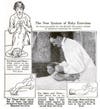
Athletics for infants were all the rage in 1923, when parents of babies as young as two weeks old would subject them to daily gymnastics training. The father of America’s so-called “Strong Baby,” would hold baby Paul Humphrey upside down first by one leg, and then the other. At five months, the baby could hang off of a bar by one arm. “I believe in subjecting the baby’s body to rough use,” the father said. “I don’t believe in fattening a baby. I aim to build pure blood and nerve energy.” Although physicians debated the benefits of such strenuous exercise on a child, Detleff Neumann-Nerode,an acclaimed pediatric physical therapist from Germany, developed a method of infant gymnastics as a means of preventative treatment. Physicians at orthopedic clinics in Europe adapted his exercises for young children with rickets and weak spines. While the illustrations at left might look comical, we can assure you that they’re more effective than holding an infant upside down by one leg. Read the full story in “These Modern Baby Athletes Swim and Climb before They Talk”
Radioactive Drinking Water: June 1923
Radium was discovered by Marie Curie and her husband Pierre in 1898. Before the danger of radioactivity became widely known, manufacturers added radium to everything from toothpaste to food. Although the general medical community warned of radium’s adverse effects, some physicians believed it had potential as “‘the spark of life’ — the mysterious electronic force that drives the life of the world.” They reasoned that while radium itself possesses no healing properties, it stimulates the body’s ability to recover from disease. Physicians interested in radium as a curative substance invented a mechanism (pictured left) designed to make drinking water radioactive. Read the full story in “Will Radium Restore Youth?”
Hypnotism as Anesthesia: April 1928
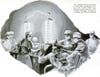
Dr. Harold G. Jones, a surgeon in St. Luke’s Hospital in Chicago, successfully performed a major operation on a patient who agreed to forgo traditional anesthesia for hypnosis. The experiment, the first of its kind to take place in the United States for many years, recruited Dr. Alfred P. Solomon, a hypnotist working in the hospital’s neurological department for the procedure. After ten minutes of instructing her to sleep, the patient lost consciousness, and woke up only when Dr. Solomon clapped his hands and commanded her to arise. Although the medical community did not approve of hypnotism as a form of anesthesia, proponents like Dr. Jones and Dr. Solomon argued that it could benefit patients who suffered severe side effects from regular anesthesia. Despite their efforts, the method never went mainstream, as the risk of a patient waking up during surgery was too high. Read the full story in “Hypnotism Gives Aid to Surgeon”
Ultraviolet Lights Treat Bone Disease: Oct 1928
Although phototherapy is a common skin treatment today, physicians in the 1930s lauded “alpine ray lamps” for the potential to prevent and cure tuberculosis and rickets, a bone disease that affects children. Theoretically, exposure to ultraviolet light should cure the disease, as it is caused by Vitamin D deficiency. Experimenters claimed that fifty English boys had gained an average of four lbs after sitting beneath the lamps for several months, while fifty other boys who weren’t exposed to the fake UV rays gained only two pounds. (Presumably, the light helped them beef up, but wouldn’t anyone gain a little weight by sitting under a lamp all day?) Artificial sunlight lamps, as well all know, have since been relegated for use in tanning salons. Read the full story in “‘Electric Suns’ Fight Disease”
Gland Tampering: July 1930
Do faulty glands cause criminal tendencies? Dr. Ralph A. Reynolds and Dr. L.L. Stanley conducted experimental surgeries on inmates in the San Quentin prison to find out. After the doctors tampered with the endocrine systems of several men and women who displayed physically abnormalities, like enlarged goiters or “lumpy” thyroid glands, the prisoners appeared calmer and quieter than before. Consequently, the two doctors recommended that children who show visible endocrine problems — like obesity — be treated early on to prevent them from becoming criminals. Children with “low, moronic” minds should be segregated in orphanages and schools, and then given gland treatments, so that their moral fiber would improve. Read the full story in “‘Crooks Cured by Surgeon’s Knife”
Voluntary Electrocution: June 1934
To study the effects of electrocution on the human body, researchers in Berlin recruited volunteers who were either really naive, or who possessed masochistic tendencies. After strapping subjects onto devices resembling electric chairs, scientists sent currents between various body parts: between a hand and a foot, between both feet, and close to the heart. Read the full story in “Using Human Beings to Test Electrical Shocks”
Resurrecting the Dead: February 1935
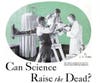
Since the dawn of civilization, mankind has tried in vain to resurrect the dead. In the late 1930s, doctors in America, Russia, and Switzerland attempted experiments that used electricity and mechanical see-saws to revive the recently deceased. In London, researchers tied drowning victims to a swinging board (similar to the one pictured left) in hope that the rocking movements would induce breathing. Dr. Robert E. Cornish, from California, would asphyxiate dogs in his lab to see how best to revive them. His success in reviving them inspired him to seek permission to experiment on the bodies of criminals executed with poisonous gas. After securing the body to a rocking tether-board and strapping electrical heating pads to its limbs, he would inject methylene blue into the veins. Theoretically, the fumes would undo the effects of the poison, which would allow Dr. Cornish to pump oxygen into the corpse’s lungs as he came back to life. Read the full story in “Can Science Raise the Dead?”
Tricking Patients into Recovery: February 1935
After observing patients who complained of illnesses, but were otherwise physically healthy, a group of physicians wondered if they could “trick” these apparently unbalanced patients into getting better. “By removing the mental quirks that cause many physical ills, modern psychiatrists can bring hearing to the deaf, sight to the blind, and relief to the afflicted, we said.” Dr. Frederic Damrau, the article’s author, recalled an incident where a soldier complaining of deafness visited an Army hospital in New York during World War II. After examining his ears, the doctors concluded that the men wasn’t actually deaf, but that his mind had repressed his hearing as a response to the trauma of battle. In an impressively elaborate false setup, the hospital staff hooked the soldier up to an electrical machine, sent an extremely mild current through his body, and called up the man’s wife. Sure enough, the man could hear her voice over the telephone. Read the full story in “Medical Miracle Men Cure the Body Through the Mind”
Fighting Crime with Lobotomies: July 1939
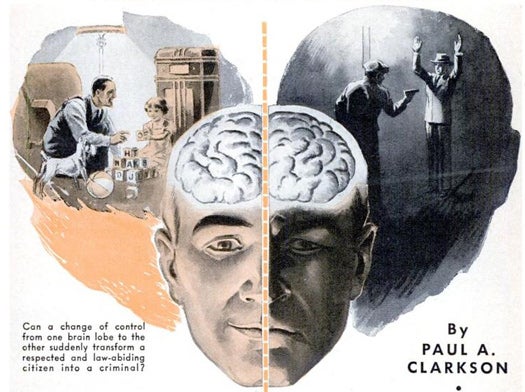
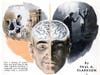
About five years before the practice of lobotomy hit its stride, researchers posited that it could reform adult criminals whose brains were simply wired for violence or perversion. Dr. Carleton Simon, of New York City, theorized that one lobe of the brain is naturally stronger than the other. When the weaker lobe grows to dominate the original strong lobe, however, “Dr. Jekyll becomes Mr. Hyde; the law-abiding citizen becomes a criminal.” Dr. Walter Freeman and Dr. James W. Watts, brain surgeons from Washington D.C., performed more than 48 lobotomies on mentally insane patients. Inserting a surgical instrument through the person’s temple allowed the doctors to slice the brain’s frontal area from its rear area. They would repeat the procedure on the other side of the brain. Patients were noticeably more subdued once they woke up. Although physicians at the time considered the transformation amazing, lobotomies declined during the 1970s after the general public deemed them unethical and unsafe. Read the full story in “Have You A Wrong Way Brain?”
The Coldest Coma: September 1939
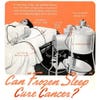
Taking a cue from the animal kingdom, doctors at the Temple University Hospital in Philadelphia tried treating 32 female cancer patients by inducing artificial hibernation. And by “artificial hibernation,” we mean packing the naked patients in ice and blasting them with electric fans before sending them into a five-day coma. Dr. Lawrence W. Smith and Dr. Temple S. Fay reasoned that adjusting the women’s temperatures to below 90 degrees would halt the spread of cancer, the same way refrigeration halts the spread of mold. The women in the experiment woke up refreshed, hungry, and in less pain than before. The doctors observed that tumors shrunk within twenty-four to forty-eight hours. Perhaps if cancer patients were frozen for several days over a period of several months, the tumors would disappear altogether. Although Dr. Smith and Dr. Temple’s method never became standard protocol, researchers today are still experimenting with cryotherapy as a minimally invasive breast cancer treatment. Read the full story in “Can Frozen Sleep Cure Cancer?”