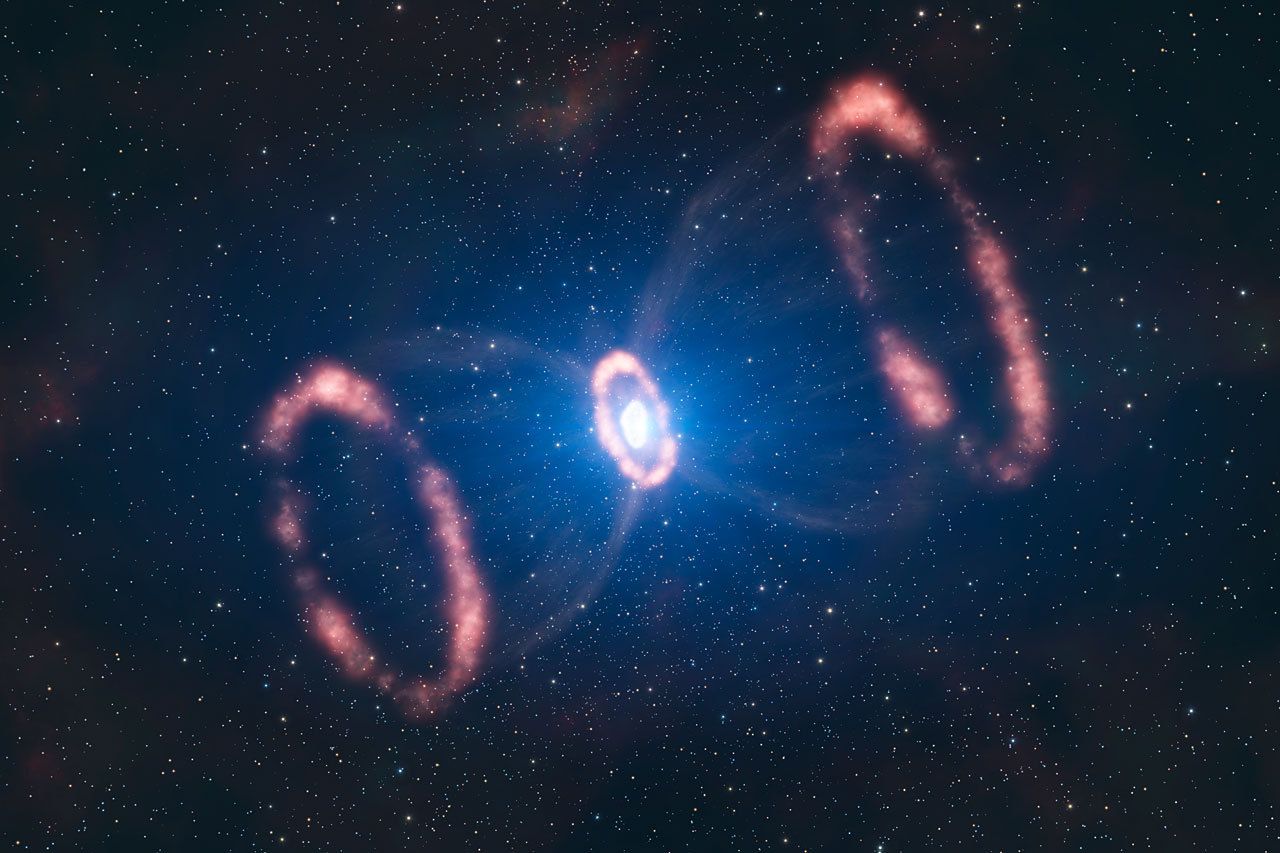
Supernova 3-D An artist's impression shows material being ejected from supernova 1987A, a star that exploded in the nearby Large Magellanic Cloud. A new instrument on the European Southern Observatory's Very Large Telescope allowed astronomers to reconstruct the supernova in 3-D. ESO

A special property of Earth's organic molecules could be caused by supernovae, a new study says — suggesting that life’s building blocks were created not on Earth, but elsewhere in the cosmos.

Many of these building blocks, such as amino acids, sugars and other molecules, are chiral — they come in two identical forms that are mirror opposites. Human hands are the best example of chirality: They are asymmetrical mirror images of each other, so you cannot superimpose them on each other. Imagine using your left hand to shake someone's right hand.

In chemistry, chirality refers to asymmetrical molecules that also cannot be superimposed on each other. They are considered right- or left-handed depending on how their atoms are arranged.

On Earth, life tends to be left-handed (though a recent study suggests its lower forms can be ambidextrous). Left-handedness also seems to prevail throughout the cosmos, according to studies of meteorites. Researchers from Lawrence Livermore National Laboratory believe supernovas are the reason.

When a star collapses, it ejects a slew of particles that include electron antineutrinos, which are right-handed. Nuclear astrophysicist Richard Boyd and his colleagues suggest these particles would interact with right-handed nitrogen atoms inside amino acid molecules.

This interaction would convert the nitrogen into carbon, thereby destroying the righty amino acid molecules. The left-handed nitrogen would be left alone, for the most part, which means left-handed amino acids would be dominant. That could explain their prevalence on Earth and elsewhere in the universe.

Boyd says it might be possible to run experiments using intense neutrino sources, such as the Spallation Neutron Source at Oak Ridge National Laboratory, to test this theory.

If it’s true, it could mean that Earth’s amino acids did not arise on Earth, but elsewhere in the universe. We are all star stuff, indeed.

[Astrobiology via Space.com]

6 Comments

Amazing information! lefty btw :)

George Carlin had it right!

Take that Catholics!!! lol I am so just joking around so please don't take me as some sort of religion hater. In any case I am a lefty too.

Oh, Wow! That's just SINISTER!

Nil Illegitimi Carborundum.

This is just more evidence for my theory. Our entire universe is in a laboratory of an alien scientist in a higher universe. He's triggering supernovae to try and create life...unfortunately, he hasn't seen us yet, and the project is about to be abandoned. When that happens, our universe will be destroyed due to lack of funding.

-IMP ;) :)

> Take that Catholics!!! lol I am so just joking around so please don't take me as some sort of religion hater

Apparently you have no concept of the Catholic view of creation. Evolution is an accepted possibility, if at some point an individual couple became reasoning beings with a soul. Genetics has backed the Church's theory recently by determining that all living humans descended from one female, approx. 200,000 years ago. Just FYI, genetics was discovered by a Catholic monk. Your beef would more appropriately be directed to fundamentalist christians, who believe the bible should be taken literally, and believe in creationism (7 days blah). Another FYI is that 80% of NASA scientists are religious (as opposed to only 20% of journalists). Now let me pose a question that will shake your 'religious' viewpoint - Who lit the Big Bang?


138 years of Popular Science at your fingertips.

Innovation Challenges


Popular Science+ For iPad

Each issue has been completely reimagined for your iPad. See our amazing new vision for magazines that goes far beyond the printed page


Download Our App

Stay up to date on the latest news of the future of science and technology from your iPhone or Android phone with full articles, images and offline viewing


Follow Us On Twitter

Featuring every article from the magazine and website, plus links from around the Web. Also see our PopSci DIY feed


February 2012: The Future of Fun

Science is reinventing play, from extreme sports to gamification to ridiculous roller coasters to the playgrounds of tomorrow, and this issue is chock full of fun. Also, on a less fun note: Did global warming destroy my hometown?


circ-top-header.gif
circ-cover.gif
bmxmag-ps