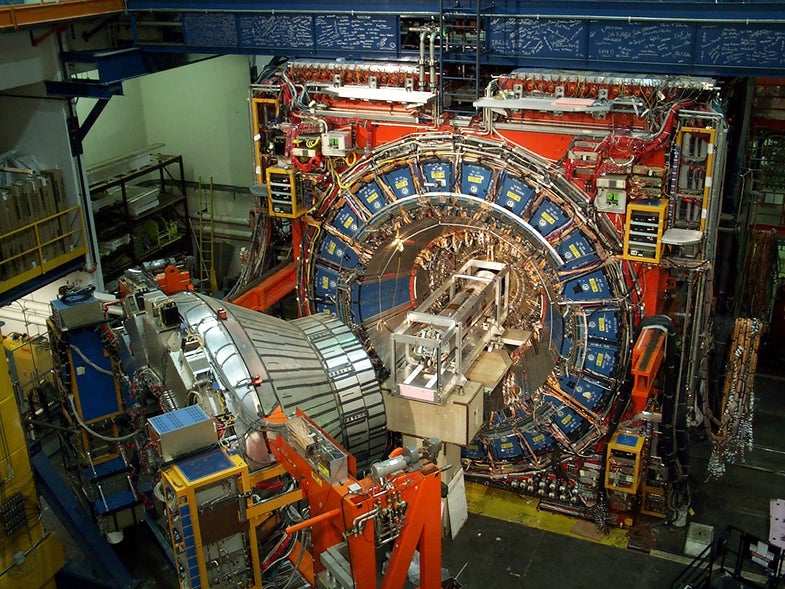
Particle accelerators, which are not renowned for their real-world applications, could in fact be used to produce energy, according to a 34-year-old research paper that resurfaced this week.
It's not exactly intuitive -- accelerators require plenty of power to work -- but one of the founders of Fermilab wrote in 1976 that they could produce more energy than they use, because they're extremely good at fissioning atoms.
At the time, accelerator physicist Robert Wilson was the director of Fermilab, according to Technology Review's arXiv blog. He was building an accelerator called the Energy Doubler/Saver, the first device to use superconducting magnets on a large scale.
Wilson wrote that superconductivity would reduce the power consumption of accelerators.
Wilson's abstract was recently posted to the physics arXiv, a clearinghouse for research papers. Here's a recap:In the Energy Doubler/Saver, protons comprising an energy of 1,000 giga-electron volts would be sent into a block of uranium. Each proton would generate 60,000 neutrons, which would be absorbed by the uranium nuclei to produce plutonium.
When burned in a nuclear reactor, plutonium produces 0.2 GeV of fission energy. So multiply that by 60,000 extra neutrons, and that's 12,000 GeV. Ergo, a single proton could lead to the release of 12,000 GeV of energy.
Now, this is not very much energy -- you would need about 600,000 TeV (tera-electron volts) to power a 10-watt light bulb for one second, and there are 1,000 GeV in every TeV. So you would need lots and lots of protons to make enough plutonium to power a reactor.
What's more, as Tech Review's arXiv blog notes, the calculation leaves out a lot of detail, including how much energy would be lost. It takes about 20 MW of power to produce an 0.2 MW beam in the Energy Doubler, Tech Review says.
Still, the concept is interesting -- as Wilson wrote in the 70s, it might be worthwhile to calculate the cost of making each plutonium proton to see if net energy production would be possible.
It could be handy for new nuclear power plants, as well as spacecraft in need of long-term power supplies. But given current nuclear non-proliferation treaties, it's unlikely that the Large Hadron Collider will be tapped to make a new supply of plutonium anytime soon.
[via Technology Review]
Five amazing, clean technologies that will set us free, in this month's energy-focused issue. Also: how to build a better bomb detector, the robotic toys that are raising your children, a human catapult, the world's smallest arcade, and much more.


Online Content Director: Suzanne LaBarre | Email
Senior Editor: Paul Adams | Email
Associate Editor: Dan Nosowitz | Email
Assistant Editor: Colin Lecher | Email
Assistant Editor: Rose Pastore | Email
Contributing Writers:
Rebecca Boyle | Email
Kelsey D. Atherton | Email
Francie Diep | Email
Shaunacy Ferro | Email
Or... we could use them to create large quantities of anti-matter like in the book Angels and Deamons... :P Either or way it's most likely not gonna happen soon
This is old news. There is a much more practical approach here where the accelerator actually turns the reactor fueled with depleted Uranium or nuclear waste on and off.
Google 091007_chang_virginia_tech.pdf
or
nextbig future molten-salt-based-accelerator-driven
Wasn't there just some bug hubbub about an energy policy or something. I could go on about particle absorption rates and decay rates and Newtonian Physics, but I won't. I would like to, rather, postulate a bit of a mind game. In Star Wars, there is the Imperator class star destroyer, it is said that the ship was conceived to be about 6 miles long, now the Executor class is determined to be about 11-12 times that length. This implies that the Executor class is at least 106km long. So the LHC is "27 kilometres (17 mi) in circumference, as much as 175 metres (574 ft)"(Lhc info from wiki). Original budget about 9 Billion U.S. dollars. Take into account the building and incorporation of a self regulating nuclear reactor, because I am sure not going in there, and then multiply that by the energy output needed to maintain and propel a ship and its crew at near or light speeds. Or heck, to even get it to get it moving. I am in the process of teaching myself the basic theories of Quantum Physics, but as you can imagine it takes a while, to understand some of the theories behind this. But I digress, What would it cost, and what would we need?
Is there anyone out there that reads this that would want to play a mind game, we can pretend to be Einstein. And if that joke is too subtle for you, don't even bother.
It pays to be obvious, especially if you have a reputation for subtlety. ~Asimov
@Sky_Jokiel That movie is scientifically incorrect, calling antimatter "the god particle" for example.
@Myself... I have not read the book... So I can only assume they use the same terms.
Hey – if I was in Bangkok and wanted to make money off plutonium – is Molvania best to ship it to?