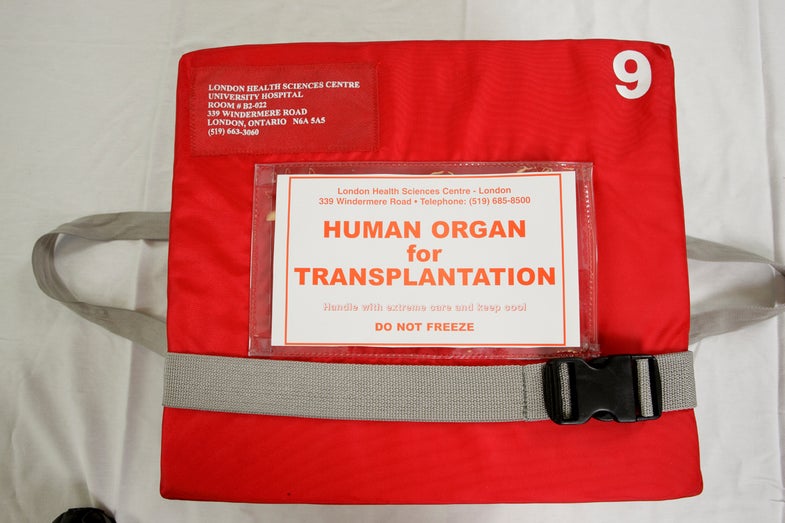
A few transplants out of the 28,000 performed every year involve the same organ spending time in more than two bodies. The most common scenario arises when a patient in the late stages of a disease receives a new liver or kidney as a last-ditch effort to keep him alive. If he dies shortly after, and the new organ wasn’t the cause, re-transplanting may be an option.
There are a few good reasons, however, why donated organs aren’t often re-gifted. If the organ is coming from someone who was so sick that he needed a new organ, it probably lived a pretty rough second life. What’s more, dying involves the entire body shutting down. “The trauma of dying can injure an organ,” says Robert Montgomery, the director of the Comprehensive Transplant Center at Johns Hopkins University. “And then the second person dies, and the organ is taken out again. That’s more injury.” But the main problem with playing hot potato with an organ is the scar tissue that forms on it within weeks after the first surgery. That tissue must be removed before a second transplant, and doing so can injure the organ too much to make it worth re-donating.
But don’t worry: Organs that are suitable for re-transplantation rarely spend much time in the first recipient, which means less time for scar tissue to form. So if you’re getting a third-hand kidney, chances are it’s almost as good as almost new.Have a science question you've always wondered about? Send a tweet to @PopSciFYIGuy or email to fyi@popsci.com
Five amazing, clean technologies that will set us free, in this month's energy-focused issue. Also: how to build a better bomb detector, the robotic toys that are raising your children, a human catapult, the world's smallest arcade, and much more.


Online Content Director: Suzanne LaBarre | Email
Senior Editor: Paul Adams | Email
Associate Editor: Dan Nosowitz | Email
Assistant Editor: Colin Lecher | Email
Assistant Editor: Rose Pastore | Email
Contributing Writers:
Rebecca Boyle | Email
Kelsey D. Atherton | Email
Francie Diep | Email
Shaunacy Ferro | Email
The main reason why I am not an organ donor is, there is a high chance it would go to someone old and/or screwed up his/her organs by a bad life style, instead of giving high priority to younger, more deserving people.
@fb36
lol that's a dumb reason not to be a donor. I mean that doesn't even make any sense.. you could have said "I was too lazy to check the box to be a donor" or something and then at least you would have only sounded like a douche instead of sounding like an idiotic douche
@woothead
Well said.
fb36 - My father was a type A diabetic, diagnosed at age 9 - a result of genetics, not diet. When I was 7, he received the gift of life with a kidney transplant and it gave him 20 more years of life and meeting 2 of his now 4 grandkids. Also, my friend who had chemo as a child that damaged her lungs, just got a double lung transplant and can finally enjoy her 20's. Maybe if you donated your organs they would go to someone who could truly value and appreciate the life they give.
yeah way to be a major dick fb36
Also, organ boards are very selective in who gets organs. Demand exceeds supply, and it is not first come/ first serve. Drug use, alcohol use, age, other health factors, chance of life, and the like are all considered.
So, little girl hit by drunk driver with lacerated heart gets the heart before war hero gandpa at 65, who gets it before obese 45 year old, who gets it before deserving 20 year old HIV carrier, who gets it before Jonzie the town Meth-head.
That does not mean the Jonzie won't get your heart - only the he gets it only if there is no one within range of the life of the organ who is more qualified.