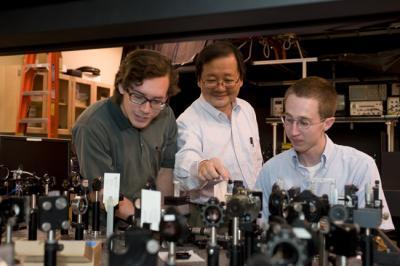
With lackluster battery tech one of the biggest hurdles standing between existing energy economies and those of the green, renewable future, there's a lot of pressure on researchers to come up with the next big battery breakthrough. And pressure, it turns out, might be just the ticket. By exerting the kinds of super-high pressures found deep within the Earth on a unique compound, researchers at Washington State University's Pullman campus have created a novel new material with the capacity to store huge amounts of mechanical energy as potential chemical power.
Calling the material "the most condensed form of energy storage outside of nuclear energy," the researchers created the super-battery inside a diamond anvil cell, a small chamber that can create extremely high pressures within a confined space. The team filled the chamber with xenon difluoride, a white solid usually used to etch silicon conductors.
The science is in the squeezing; under normal atmospheric conditions, the molecules of xenon difluoride keep a respectable distance from one another. But under the intense pressures produced by the diamond anvils the molecules are forced together into metallic 3-D structures. At one million atmospheres -- roughly equivalent to the pressure found halfway to the center of the Earth -- the xenon difluoride is pressed neatly into these structures where the mechanical energy of all that pressure is stored in the chemical bonds between the molecules.And just like that, the material becomes a chemical battery containing the mechanical energy from all that pressure. That raises the possibility of practical applications such as high-energy fuels, high-powered and compact batteries, or semiconductors that can function at very high temperatures.
Five amazing, clean technologies that will set us free, in this month's energy-focused issue. Also: how to build a better bomb detector, the robotic toys that are raising your children, a human catapult, the world's smallest arcade, and much more.


Online Content Director: Suzanne LaBarre | Email
Senior Editor: Paul Adams | Email
Associate Editor: Dan Nosowitz | Email
Assistant Editor: Colin Lecher | Email
Assistant Editor: Rose Pastore | Email
Contributing Writers:
Rebecca Boyle | Email
Kelsey D. Atherton | Email
Francie Diep | Email
Shaunacy Ferro | Email
Now I can finally use all these extra diamonds I have laying around.
What is really good about this is that the synthetic diamond industry is already quite developed. Now all we need to worry about is if the batteries break down really easy. Or if Xenon becomes really rare. Or if they are somehow poisonous.
I wonder if they tried the same process with semiconductors, to make those nigh mythical 3d latice chips?
Yes, you have stored the mechanical energy in the chemical bonds but how do you access that energy and turn it into electricity? The world works on electricity, the tech has little meaning if it cannot be converted efficiently.
This sounds great, but you need a factory to recharge it!
actually i would have to say that the world doesn't revolve around electricity, it's just the highway we use, for instance in order to get the electricity you first need some other energy source, heat in the case of nuclear and coal power plants. this is turned into mechanical energy first and then pure electrical energy. and also much of the world as is still doesn't even use electricity, farmer's still use aqueducts instead of electric pumps and people still use stairs most of the time rather than electric cables and elevators. and the most common example is cars, no matter how hard we try we can't seem to get one that efficiently uses electricity.
to say that the world works on electricity is pompus and really wrong, the world uses all forms of energy we just see electricity because we in the united states and other 1st world countries have access to it in abundance.
pertaining to the article itself this is an extremely good thing, hopefully soon we could have an entire car made to run off this stuff!
The point is how do you access that potential energy stored in chemical bonds and use it to make useful work, be that mechanical, electrical, etc.
Potential energy is stored in many things around us. But if you are unable to convert potential energy into work, you have failed.
So another sci fi cliche, the power crystal may become a technological reality!
what I want to know is if these xenon crystals remain solid, at normal pressure
How much energy did it take to create 1M atmospheres worth of preasure? I'm curious to know what the ratio is for energy in and energy out.
I'm stymied by this concept the same way a couple other people are...how do you USE the energy in the crystal? Do you suspend or "wash" it in a chemical and allow gradual deterioration to occur, creating a slow flow of electrons that can be switched on and off? Does it function under normal pressure? Is it capable of exuding a strong force of energy at once or just containing a large amount? For example, can it power a light bulb for 100 years or can it sustain an entire city for 100 years using the same amount of material?
Most likely, this works with either the piezoelectric effect: http://en.wikipedia.org/wiki/Piezoelectricity
Or as a thermocouple: http://en.wikipedia.org/wiki/Thermocouple
While reading this, it actually seemed it could work with both, which may explain why this 'battery' is so energy dense.
So it seems that the kids in Pullman are good for something else other than consuming 17% of Anheuser Bushch's global beer sales.
If this cube is created in a high pressure environment, would anything happen to it in a low pressure environment?
I'll take a stab at how it works.
Instead of a capacitor energy storage using the dielectric to store electrical potential (by distorting the electron orbits of the dielectric), it could use allotropic phase transformation of the xenon difluoride to store its electromotive potential. The energy density would still be surface area dependant but maybe an order of magnitude higher than a standard capacitor.
Just a guess.
So the unwinding of the molecules put the energy back. Interesting. Talk abut a 'Duh' moment!! Not a new principle. But the material is a quantum flywheel.
Ok, all of you Mr. Wizards out there, what happens as Molecules seperate and become agitatated changing state? In it's simplest form, you get....
That's right..... HEAT!.
Now take a look at your closest nuclear reactor, and how do we convert heat to electricity? S-T-E-A-M.
If that's too Steam-punk for you, try this:
Electicty is generateed by passing wires thru a magnetic field. If you apply this "flywheel" to a rotating vector you get a dynamo!
This isn't rocket science folks. It's chem 101 and bonehead physics.
In other words, yet another completely impractical battery...the latest in a century long line of failure.
Go hydrogen. Go fuel cells.
Any chance this could be the "crystal power" envisioned by Cayce
This could be the battery break through beyond thermal batteries. The energy density of most common batteries is the ball and chain of practical robots, electric cars, laptops, pacemakers, submarines and satellites.
The real answer is the nuclear battery, but we are too scared of anything nuclear since that is what our movies have taught us.
It seems to me that if the compressed xenon becomes a chemical battery, why wouldn't it work in the traditional anode/diode method? Since these would be the most condensed form of power outside of nuclear, what would happen if the battery were to rupture/leak? Would the xenon gently return to gaseous state or would it hyper-expand and "blow up"? So many questions....
How much HEAT is lost squeezing this stuff. Compressing anything produces a great deal of waste heat, put your hand on an air compressor cylinder head while it's running. Sure if you only consider the energy stored in the material it's probably dense but I'll guarantee they wasted 100 times more energy getting it into that state. So at the outset it's only 1% efficient. It's mechanical energy, so getting the energy out will probably eat up another 75% of what's stored there. Sounds like something the government will love, superdense energy at a cool million per kilowatt.
This is basically a compressed spring made of gas. Huh. That seems kind of obvious. I must admit I share the same trepidation as most of the other comments. These "batteries" can contain a lot of energy but how much is wasted getting the energy in and out of it?
Yeah this is nothing revolutionary, nice try. Eventhough if they keep trying they will find sth.
http://hubpages.com/hub/-Octopus-Paul
nothing like telling someone that developed a new material the know universe has never seen before it is "nothing revolutionary".
I wonder if this can be applied in layers and have the piezoelectric effect take place as it expands releasing all that stored energy. (nuclear reactor levels of stored energy, which is amazingly large) Taking chemical energy and turning it into electrical energy.
Also, FYI, there are not many material that act like superconductors at high temps..
P.S. We take mechanical energy (spinning flywheel and turn it into electrical energy, then push that into batteries. These has the possibility to skip a step.
It seems to me that this is an advance as a mechanical force impetus to initialize a larger system, which does make it a capacitor, just not an electrically initialized one. So while it may be true that this is not ALL new science, it will open doors into new types of energy storage, just like it says. I think this might be a great way to charge nanobot work crews.
by compressing the matter, could weight be an issue? last time i checked the more dense a material the heavier. Today's consumer (if this would be applicable to the huge market of electronic devices) desires light weight products.
"The science is in the squeezing"...
hopefully a car getting totaled doesn't release all the "deep earth pressure" in the battery array... X_X
What would be the result if this battery 'broke'?
*BOOM*...or just a *POP*?
Like New said this is a glorified spring...interesting but there isn't nearly enough information given. Does the crystal hold its form if pressure isn't maintained? Can they use any of the extraction ideas listed above? A couple of those are interesting BTW.
That dynamo idea would depend on how strongly ionized the expanding gas was...Of course it could work. If enough energy is already in it to be worth it and if the input efficiency is good. Maybe run a high voltage current through or better yet use a microwave source to fully ionize the already energized atoms as they expand through a nozzle etc. That "one million psi" is an awful lot of force. This article leaves far too many questions. Too many "ifs" to be guessing at.
I'm seeing some rather unrealistic demands here - any practical technology is going to start in the lab. Imagine someone dismissing Benjamin Franklin because his magnetized key can't pull a plow.