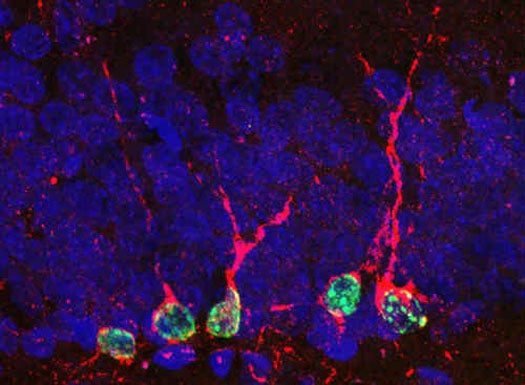
Neurogenesis

Researchers at Texas Southwestern Medical Center have discovered a compound that could potentially render Alzheimer's a thing of the past. After testing 1,000 different molecules on the memory hubs of rats suffering from memory loss, scientists there have come up with a compound that protects memory-forming cells in the hippocampus, which could lead to promising treatments for Alzheimer's and other memory affecting disorders.

Memories are made possible by a process called neurogenesis, which spawns and maintains neurons in the brain's hippocampus region (specifically in the dentate gyrus). These particular neurons are delicate, and even in young healthy brains a 10 percent survival rate is pretty good. Introduce Alzheimer's into the equation, and that survival rate plummets to nearly zero, causing an inability to produce and maintain memories.

But one of the compounds the TSMC researchers found, dubbed P7C3, was found to protect those valuable cells from the ravages of Alzheimer's, strengthening their defenses and keeping them around long enough to become players in the memory production process. The team first tested the compound on rats engineered to have memory problems, then on aging rats whose memory problems had developed naturally. In both cases, P7C3 somehow steeled those memory-forming neurons against memory loss.

P7C3 is also quite easy to administer; it can be taken orally and has no problem crossing the blood-brain barrier that trips up some drugs. That's all great news, but it gets even better. A derivative compound of P7C3 -- called A20 -- seems to be even better at protecting neurons in the hippocampus than its parent compound. More study is obviously needed, but P7C3 and its derivatives might just be the jumping off point for researchers seeking to finally make Alzheimer's little more than a memory.

[io9]

10 Comments

Does this mean that we could have the potential to have 100% percent memory recall. Do you know what this will do to education in America. All you would have to do is read over a book once and remember the whole thing perfectly. I will sign up to be the first human tester.

I'm not sure what it's effect on memory recall will be. I seriously doubt it will give you photographic memory. These compounds just seem to keep your brains cells from dieing not necessarily make them better at networking with each other. That would be cool though.
I'm impressed at the progress we are making in the medical industry. It's strange that I've been expecting these advancements. Like it's perfectly normal now to constantly get better at everything. Sweet time to be alive.

This is already known, but with a compound you might not expect. THC
www.norml.org/index.cfm?Group_ID=6812

Sorry, but most stoners I know cant remember what they were saying at the start of their sencence let alone long term uH what was I saying now? Oh yeah, A_Rock has a point that people with photographic recall don't have any more neurons or healthier neurons they just organize and store infromation in such a way that retrieval is more reliable.

Still, I expect this drug (if it ever came to market) would be banned in college exams and the SAT like provigil was. We soon will have the best drugs ever for intellectual enhancement that you will never be alowed to use. I mean we can't just let anybody become geniuses can we?

Edison, this world would be a lot better without as many dumb people. I say spike the drinking water... Then smoke a bong.

Sadly, making people better thinkers doesn't mean they're going to be thinking better thoughts. Sociopathic people will still be sociopaths, just more efficient sociopaths, racists will still be racist, they'll just be smarter, not more reasonable. It sucks, because it means that those of us who are good people won't be able to make ourselves intellectually stronger because of the risks of the wrong people getting their hands on the stuff.

@phiniusmaster That's a very relevant point. I'm not sure if it's reason enough to not continue advancing. I mean our education system, internet and books have provided the opportunity for plenty of crazy people to be smarter. I know that's not the same thing but it's similar. It seems every technology we make has the ability to do good or bad but as a whole I think most people are reasonable and that's why the benefits always seem to outweigh the ACTUAL (not theoretical) damage caused by advancing our technologies. Does that make sense to everybody?

kabosht9- Yeah let's do it, people who are really smart but not all that motivated. WOW servers would crash from overload and pizza delivery would dominate the job market.

@kabosh Hey, I love the sticky icky as much as the next sane person but I have many a doubt about it's ability to heal braincells. It should still be legal and anyone who thinks otherwise (no offense intended) is being very narrow minded.

Good news...
Ivan Malagurski


138 years of Popular Science at your fingertips.

Innovation Challenges


Popular Science+ For iPad

Each issue has been completely reimagined for your iPad. See our amazing new vision for magazines that goes far beyond the printed page


Download Our App

Stay up to date on the latest news of the future of science and technology from your iPhone or Android phone with full articles, images and offline viewing


Follow Us On Twitter

Featuring every article from the magazine and website, plus links from around the Web. Also see our PopSci DIY feed


February 2012: The Future of Fun

Science is reinventing play, from extreme sports to gamification to ridiculous roller coasters to the playgrounds of tomorrow, and this issue is chock full of fun. Also, on a less fun note: Did global warming destroy my hometown?


circ-top-header.gif
circ-cover.gif
bmxmag-ps