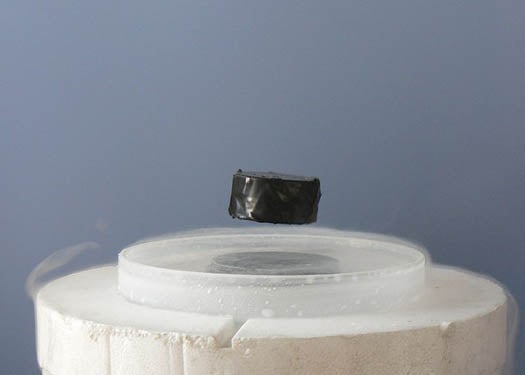
The bright green energy future that surely awaits us exists in concept, but as we all know there are key pieces of technology that we still haven't quite figured out, like higher-capacity battery tech or better biofuel processing methods. Similarly, one of the key technology gaps hampering the U.S. energy grid is a lack of understanding regarding superconductors -- materials that can carry electricity with no energy loss. Now, DOE scientists may have cracked a critical part of the superconductor mystery, opening the door to a grid that can carry electrical current over great distances without drastic energy loss.
Superconductors only work at extremely low temperatures, rendering them practically useless because the energy used to cool them to those temps cancels out the benefit of no energy loss. For decades, researchers have tried to figure out why room-temperature semiconductors won't work. They knew it had something to do with electron behavior during the so-called pseudogap phase, a temp range where superconductivity breaks down.
Now, the researchers think they've figured it out. During the psuedogap phase, electrons undergo a change in copper-oxide semiconductors in which the tunneling ability of electrons is different in different oxygen atoms. To quote the awesomely named Séamus Davis, the project leader and lead author on the Nature article describing the research:"Picture the copper atom at the center of the unit, with one oxygen to the 'north' and one to the 'east,' and this whole unit repeating itself over and over across the copper-oxide layer. In every single copper-oxide unit, the tunneling ability of electrons from the northern oxygen atom was different from that of the eastern oxygen."
That asymmetry is key, and though it doesn't yet provide the key to superconductors, it is a significant start. Asymmetries in liquid crystals gave scientists the tools to manipulate them, and now LCD screens are cheap and ubiquitous. The DOE team hopes this breakthrough in understanding will similarly open the floodgates on superconductor research, culminating in room temperature materials that move power with no loss of energy.
That would not only make energy cheaper, but would make it possible to pipe renewable energy from places that are windy and sunny to places that are not, or to move surplus power over long distances to places that are low on juice so that a natural gas plant doesn't have to kick into action.
[io9]
Five amazing, clean technologies that will set us free, in this month's energy-focused issue. Also: how to build a better bomb detector, the robotic toys that are raising your children, a human catapult, the world's smallest arcade, and much more.


Online Content Director: Suzanne LaBarre | Email
Senior Editor: Paul Adams | Email
Associate Editor: Dan Nosowitz | Email
Assistant Editor: Colin Lecher | Email
Assistant Editor: Rose Pastore | Email
Contributing Writers:
Rebecca Boyle | Email
Kelsey D. Atherton | Email
Francie Diep | Email
Shaunacy Ferro | Email
If they can do this, wouldn't it make way for levitation?
"To quote the awesomely named Séamus Davis, the project leader and lead author on the Nature article describing the research..."
Awesomely named. That single bit completely dumbed down the entire artice. Other than that depressing item, the science itself is fantastic.
Yeah duh James989, um but anyway coming from a science novice this is going to be simply put. If Im reading this arcticle correctly you should be able to take the superconducting material put it in a vacume very the oxygen level on either side of the material and have it levitate?
I mean am I right guys?
Lets hear from some of you doctorites out there :)
@awjanua
uhh.. I think the oxygen stuff he's referring to is the actual structure of the material itself, as in at a molecular level its asymmetrical so its not oxygen or copper really that's special just the fact they have this asymmetrical pattern (which affects the "tunneling" of electrons differently) which is what I'm guessing is common throughout all superconductors hence the whole important discovery "cracking part of superconductor mystery".
If the problem is really cracked this would not only solve the problem for sending electricity over long distances more efficiently, but it also would reduce heat and allow for greater speed in circuits.
For instance one of the main reason they have stopped at about 3 Gigahertz for processors (and gone to multiple cores) is the heat build up.
That heat is generated as the electricity flows through the circuit, sort of like you pulling someone across a rug builds up heat (and more heat the faster you go). Put the person on a slick surface and less heat builds up.
BTW It would also make electric motors more efficient to, so they could run longer on the same batters.
@awjanua
I how do you create a vacuum that contains oxygen. The oxygen would make it not a vacuum.
superconductive motors are only a few percent better than good copper ones. The real advantage is that super conducting motors are 1/3 the size of copper ones.
I responce to the first comment, if I am not mistaken, levitation is possible and used now. Be it with super conducting material or traditional electronics, the only issue now is the incredible amount of power required to attain levitation. Super conducting material means that from the same source of power you would get something like 10 times the out put. So things that were previously too power intensive before become economical today. Electric vehicles with small batteries that can drive for 1000 miles or more and at speeds exceeding gasoline engines. Not to mention Force Fields and Cold Fusion Energy Weapons, and dont forget, the Light Saber...
not only will the electric motors be smaller but the big thing again comes back to heat, you will be able to have much more powerful electric motors without liquid cooling
Most of these comments are laughable LOL.
oh yeah? which ones Mr. Smarty pants, lol
Not to nitpick.. well, okay, to nitpick.
For decades, researchers have tried to figure out why room-temperature semiconductors won't work.
room temperature semiconductors work fine. Word should probably be superconductors. ^^
lol @ corwinb
Superconductors would eliminate the need for all solar and wind power development, since we would have sufficient existing production capability.
The problem would be telluric currents and solar wind storms causing massive problems with reactive load in our transcontinental power grid.
Perhaps these natural induction "problems" could be harnessed to produce true electrical power. With that much induction capability, weather could be altered or controlled.
For now, I squared R losses keep electrical production jobs local and prohibit outsourcing of electrical generation.
Would low to no voltage power lines essentially eliminate the dangers of electrocution since the body's natural insulating properties would block a current that had no force behind it?
where there is current there is voltage end all
cannot achieve no resistance therefore cannot achieve no vlotage
hey popsci are there no research groups woking on monopole magnets, or magnetic tech?
If superconductivity is result of tunneling, those are not symmetric and pulses must come in right frequencies, to cut corners. When atoms are cooled down, they stop moving and electricity can jump over. We think of it like a flow of water, but it should be jumping of potential from one atom to another.
So perhaps instead of trying to purify single material, two components should be used, like meta magnet made out of piezoelectric silica and cooper, mixed to form interference magnetic fields, where electricity can jump between those gaps. Difference is, electric field should be generated inside material, when potential is induced and directed inside magnetic interference fields. If true, it would appear as it has no electric resistance, because each pulse would be generated in a spot and all of them driven in synchronized loops, from one point to another. Even more, if fine tuned to the environment, system could probably produce energy from every motion.