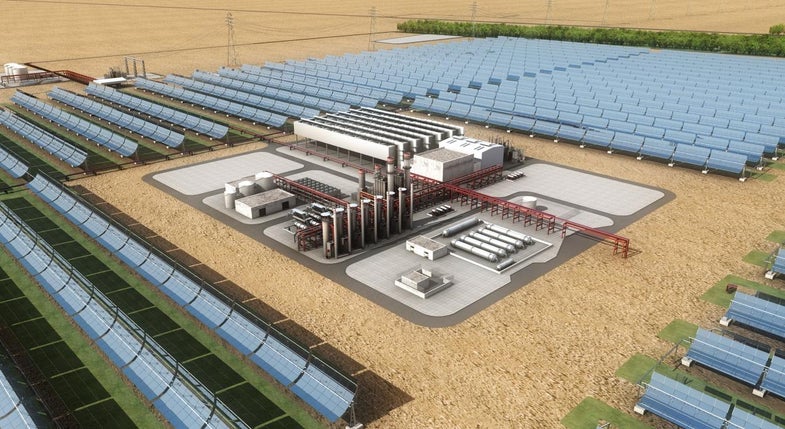
One of the world's hottest, sunniest spots will soon be home to the world's largest concentrated solar power plant, helping an oil-rich emirate achieve its renewable energy goals.
Though the plant will produce 100 MW of electricity, it won't exactly wean Abu Dhabi off its bread and butter. It's a special kind of solar plant that uses oil along with the power of the sun.
Abu Dhabi's state-owned renewable energy firm, Masdar, announced Wednesday that a French oil firm and a Spanish solar firm will build Shams 1 -- named for the Arabic word for sun -- starting later this year. Construction will take about two years.
Shams 1 will produce 100 megawatts and cover one square mile of the desert in Madinat Zayed, about 75 miles southwest of Abu Dhabi. But it's not your typical solar plant. Concentrated solar power plants use mirrors to heat liquid -- in Shams' case, a type of oil -- to then heat water, running a steam generator that produces electricity.
It's better than burning the oil, however. Masdar pointed out that the plant will offset 170,000 tons of carbon dioxide emissions annually, the equivalent of planting 1.5 million trees or removing 150,000 cars from Abu Dhabi roads. Abu Dhabi aims to obtain 7 percent of its electricity from renewable sources by 2020.Santiago Seage, CEO of the Spanish firm Abengoa Solar, says concentrated solar's main advantage is that it is less intermittent. You have a solar field ... but you also have a boiler where you use natural gas to create the steam if the solar resource is not enough," he told AFP.
Which raises the question, if the sun is considered too intermittent a resource in a scorching spot the Arabian Peninsula, will it ever be consistent enough for the United States?
While Abengoa Solar has built four other concentrated-solar plants in Spain (and is building one in the US) Shams 1 is the first such plant to be registered under the United Nations' Clean Development Mechanism, which makes it eligible for carbon credits.
It's also the first commercial-scale solar project in the United Arab Emirates, according to Masdar. Within the next few years, Shams 1 will be followed by Shams 2 and 3.
138 years of Popular Science at your fingertips.
Each issue has been completely reimagined for your iPad. See our amazing new vision for magazines that goes far beyond the printed page
Stay up to date on the latest news of the future of science and technology from your iPhone or Android phone with full articles, images and offline viewing
Featuring every article from the magazine and website, plus links from around the Web. Also see our PopSci DIY feed
Science is reinventing play, from extreme sports to gamification to ridiculous roller coasters to the playgrounds of tomorrow, and this issue is chock full of fun. Also, on a less fun note: Did global warming destroy my hometown?
wow, that is huge and unfortunately doesn't seem to be much power.... 100MW? doesn't nuclear plants produce 800-100MW? And that is 1 a square mile? Man i hope solar power getting much better in future, have a hard time seeing us switch to solar if going to take up half country to do so.
Whats 1 sq mile when you have vast tracts of desert wasteland available? If a Nuclear power plant puts out 800 MW then you would only need a 3mile by 3mile square to surpass that. Denver international airport is 53 sq miles in size, so if you used an equivalent land area for solar its max out put could equal almost seven nuclear power plants. Thats not bad at all.
The Sahara desert is 3.6 million square miles so if you used 1 percent then that would be 36000 sq miles. Thats 4500 nuclear power plants worth of output...just in Africa.
Of course it's not that simple but it's certainly not impossible. Solar can supplement other forms of energy such as tidal, wind, biomass etc. Nuclear can still be used as well, it doesn't have to be eliminated, just used responsibly.
Surplus electrical can spin flywheels or be put into batteries or be used for electrolysis of water to produce hydrogen to be burned at night. Combined with a reduction in consumption this can have powerful effects.
The most important thing though is to limit population growth first, without that none of this matters. If you want to know why then read Jared Diamonds book "Collapse", it can explain it better than I ever could.
Why not just heat the water up in the first place. That's an unnecessary step. -_-
It's way more efficient.
The boiling point of the oil will be higher than water. So if you can heat the oil to say 500 f then you can create superheated steam which works much better in turbines.
100MW is a huge amount of power for solar ... I think the largest solar installation in the US does 10 or 15MW. Nuclear plants go up to 1400MW, but the size is irrelevant, only the cost/MW.
What is the point of making misleading retorical statements like this ??
"it won't exactly wean Abu Dhabi off its bread and butter."
Yes the plant uses oil as a heat transfer agent. So do all of the other solar generators using the same technology, including the ones in the US. Are you trying to imply that there was some conspiracy in the UAE goverment to use this technology cause it requires some infinitesimal amount of oil (which is recycled and reused). Come-on, leave the pontificating to some other outlets.
I'm disappointed by the lack of information in this article. First, is 100 megawatts the _peak_ output of the plant? If so, then the _average_ output must be tiny by comparison. Consider that the rotation of the earth guarantees that the solar plant collects _no_ power for part of every 24 hours.
Second, Abu Dhabi is a tiny country compared to Europe or the USA, therefore the homes and factories that will use the electricity are very close to the solar plant. In large or distant countries, you loose a _huge_ amount of electricity in very long cross-country transmission lines. Therefore, you always put the power plant as close as you can to the consumer.
Third, the drawing of the plant is _deceptive_. I estimate from the trees and the power lines that the area shown is roughly 1/10 of a square mile, or a tenth the size of the actual plant. Go to Google Maps, and draw a square-mile box on top of London, Tokyo, or New York City. Try to guess how much you'd spend to buy that property and put a solar plant there.
I'm sure that buying a square mile of Manhattan real estate is the first place they would look if they didn't slip on a puddle of their own drool first. Try using google earth to draw a square mile box in the desert outside of Vegas, then draw 1 000 more and see if you even cross a road.
This is definitely not applicable everywhere but it could be feasible for hundreds of millions of people worldwide.
"Third, the drawing of the plant is _deceptive_. I estimate from the trees and the power lines that the area shown is roughly 1/10 of a square mile, or a tenth the size of the actual plant. Go to Google Maps, and draw a square-mile box on top of London, Tokyo, or New York City. Try to guess how much you'd spend to buy that property and put a solar plant there"
Imagine the price to build a Nuclear Power Plant. It works both ways.
Besides this works in conjunction with natural gas fired boilers to make it in essence a very low impact Gas Power Plant. Line losses in 2007 in the US were estimated at 6.5%...not a deal breaker. So even if you needed 10 square miles to make up for cloudy days, night and line losses, thats still gives you 5 nuke plants for the area of the Denver airport, but I'm sure it's impossible!
The NextEra Energy SEGS solar facility in the Mojave Desert is much larger than this. They also employ solar thermal (as opposed to photo voltaic) and have a combined output approaching 350 MW. The plant can also supplement steam production from the solar field by the use of gas fired boilers to allow production during periods of cloudy weather.
http://en.wikipedia.org/wiki/Solar_Energy_Generating_Systems
@ lan1108
Oh, I get it. /facepalm myself
Hmmm...
If we could store the superheated oil in a large tank for off-hours, wouldn't that solve the night problem? Transfer the cooled oil into another equally sized tank. Of course the collector grid would need to be twice the size but the benefits should outweigh the extra cost.