Many of life's building blocks, such as amino acids, sugars and other molecules, are chiral -- meaning they come in two identical forms, mirror images of each other. Most life on Earth tends to prefer one side over the other, such as right-handed glucose molecules. But some forms of bacteria are less choosy.
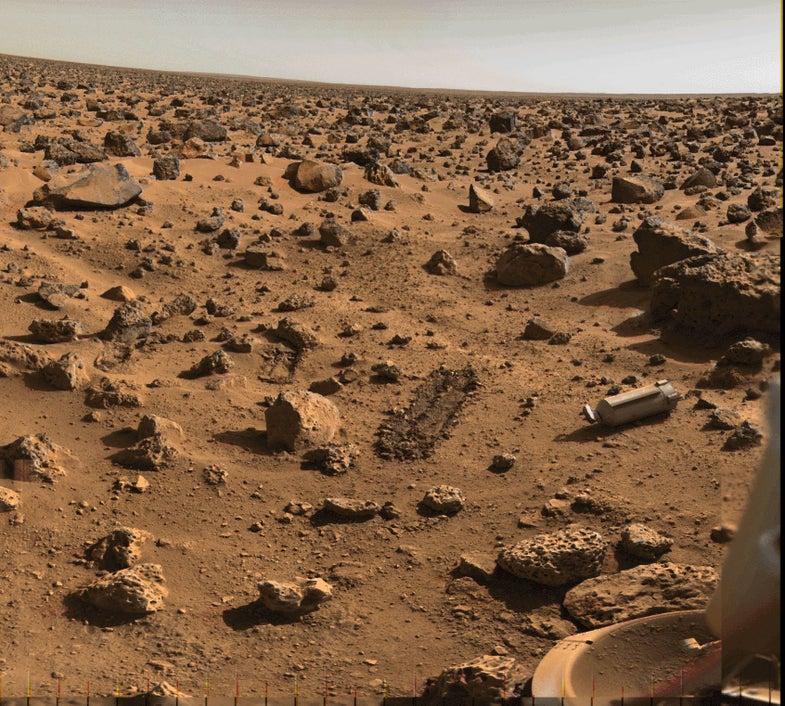
Most life is left-handed, but its lower forms are ambidextrous, according to a new study reported in New Scientist. This might complicate the search for life on other planets, but it could also explain the Viking Mars landers' odd findings four decades ago.
Henry Sun and colleagues at the Desert Research Institute in Las Vegas studied the way in which bacteria munched on two chiral compounds, lactic acid and the amino acid alanine. They preferred the right-handed version of lactic acid and the lefty version of alanine, but given enough time, they were able to adjust and consume the mirror versions, New Scientist reports.
The delayed switch could help scientists find evidence of life on other planets.When the Viking landers touched down on Mars in 1976, they mixed Martian soil with "broths" containing lactic acid, alanine and other nutrients, New Scientist reports. Some gas was released, suggesting something was breaking down a chemical -- a possible sign of life. Follow-up tests found no evidence to support the theory, however.
But future tests that use paired right-handed and left-handed broths could track how quickly each one is consumed, which could show whether life is present and if it prefers lefties to righties.
Five amazing, clean technologies that will set us free, in this month's energy-focused issue. Also: how to build a better bomb detector, the robotic toys that are raising your children, a human catapult, the world's smallest arcade, and much more.


Online Content Director: Suzanne LaBarre | Email
Senior Editor: Paul Adams | Email
Associate Editor: Dan Nosowitz | Email
Assistant Editor: Colin Lecher | Email
Assistant Editor: Rose Pastore | Email
Contributing Writers:
Rebecca Boyle | Email
Kelsey D. Atherton | Email
Francie Diep | Email
Shaunacy Ferro | Email
I was talking with a PhD astrophysicist at a party the other day. He said that the chances of there being life outside of earth, in our galaxy, are very slim. I tend to agree. If there was life it would have found us, or we would have found them (radio waves etc.) At much greater distances the chance improves. The "chemicals evolving to life" theory seems a bit of a stretch for me from the get go. I would like to see it proved. That would be an interesting day for science.
The Universe (or Multi-verse) is a very large place, and the likeliness of life somewhere else in such a large place is very good considering its so big. Just because no contact has been made doesn't mean that none exist, it takes about maybe four years or so at the speed of light just to make it to the nearest solar system, and radio waves travel even slower. This is just what I believe anyway and I'm not trying to say your wrong, I'm just trying to state my opinion.
@Dustmuster- that would be a very interesting day indeed, i hope to see it happen someday. even having that theory conclusively disproven would be interesting.
while agree that the chances of finding INTELLEGENT life in our neck of the galactic woods is pretty slim, for all the reasons you mentioned. i think chances are far better to find microbial life on mars or titan or elsewhere, i also think such a discovery would be almost as signifigant. that is the kind of life scientists look for in our solar system, i don't think anyone thinks we'll find intellegent life at our doorstep, as you said, we likely would have heard from them by now. but of course, that depends on where they are on an evolutionary or technological scale. what if they haven't invented radios yet? or what if they use something completely different that we don't recognize?
whatever we find out there, i am certain that alien life will be ALIEN, and that we will learn a great deal from it.
to me it seems inevitable that life has evolved somewhere else in the universe. in all the vastness of space, could the conditions that brought about life on earth be truly unique?
Actually, despite the expanse of the universe, it highly improbable that another planet exists that contains life. Earth is perfectly positioned to support life, and I personally don't believe that other life exists, or that even another planet with the proper conditions to sustain life exists in the universe.
We only think that Earth is perfectly positioned because the life that evolved for these conditions is us.
Given different positioning and you get different life evolving that is perfectly evolved for those conditions. Even on earth, you have unique life that is perfectly evolved to live at hot vents on the ocean floor. You couldn't live there, but it doesn't mean nothing can.
As for detecting life elsewhere, my question is how. Radio Waves? How long have we used this as a communications method? How much longer will we? To expect to find other intelligent life forms that take a billion years to evolve be at the exact stage we are at is astronomical.
Even we we are already getting rid of radio waves. Now it is cable to telephone lines to communicate and even that has changed from copper to glass. What will we use tomorrow and what are other life forms using?
Contact us! I doubt it, we are way too primitive. They would just observe us to see how different life forms evolve to help them learn something about their own distant evolutionary history. They may not even be able to commuicate because we do not have any of the sensory facilities to communicate with.
Remember, we are but a mere dust spec. Stop thinking that we are the center of the universe. We are nothing in the grand scheme of things. The best thing we can claim is that we haven't killed ourselves off yet.
Actually considering the expanse of the universe it is nearly 100% likely that life does exist somewhere else... especially considering we don't even have an agreed upon way to determine what is and is not life, the likely-hood of us finding it now is quite small, (and if we did find life, who know's if we would recognize it as such).
The universe has no known limits, as far as we can tell it is infinite in space and time, meaning that no matter how small the chances are for chemicals, in a closed experiment, to combine into some sort of building blocks for life, when attempted over and again ad infinitum it is sure to occur.
Those who say its impossible or statistically unlikely don't understand statistics very well in my opinion. Its similar to saying nobody should ever play the lottery because the statistics of any single person winning are so low - sure that may be practical in your own life, nonetheless there are many, many lottery winners each year, and they'd probably tell you where to shove those statistics.
BTW, I don't believe we evolved. Besides, If other "life" came into existence due to it's environment (different then our own), it wouldn't be life because we define life as relative to what is life on earth. (I.e. The difference between plant life and animal life). and I iterate, despite the huge size of the universe, it would be nearly impossible to find another "earth" capable of containing life. There are so many factors that have been fine-tuned that even if they had been off by the slightest degree would have rendered life on earth impossible.
And about the creatures living near the vents on the sea floor, arent they made of cells? And aren't we? The basic operations of life are the same on the cellular level despite the differences in the macroorganism
I'm not worried about whether we're "significant" in the "grand scheme of things" or not. The fact is we're here and we should feel special to be alive and aware of our own existence, whether there are a million civilizations like us or not. I hope we're not alone, my guess is, based on the fact that life can thrive in the harshest conditions here on Earth, that there is at least some form of life nearly everywhere in the universe. Maybe not bipedal mammalians with big egos, but something. What makes microscopic life less "worthy" of recognition? I'm just hoping that within my lifetime we'll discover something else.
@Btreed- We already know of places that can support life, like The moons Europa and Enceladus.
"it wouldn't be life because we define life as relative to what is life on earth. (I.e. The difference between plant life and animal life). " You don't even seem to know there are 3 other kingdoms! LOL!
706 candidate planets from Kepler, what are you going to do if some of them are Earth-like? Go back to the Answers In Genesis website, not Pop Sci.
BTW- The planet Glises 581 d is thought to be in the habitable zone. LOL at Btreed!
really.... Europa can support life? I'd like to see anyone try to survive there outside of a spacesuit. I'd actually like to see any life from earth (read: ANY LIFE AT ALL) try to exist there. (The mean temperature on Europa is below -200 degrees F). Just because there is possibly water on a planet/moon doesn't mean that life can form there.
About Glises 581 d.....and any other planet/moon that appears to be "earth-like" or in a "habitable zone".... I refer you to The Case for a Creator by Lee Strobel, Chapter 7. He presents amazing evidences for the uniqueness of the earth to support life. Read for yourselves.
BTW...I was only saying that there are differences between plant life and animal life. I didn't have to mention all of the kingdoms.
@ btreed- Organisms from earth could live on Europa. There are living organisms in Lake Vostok Antarctica, which is extremely cold. Plus there are probably vents on Europa that would keep areas very warm. "I'd like to see anyone live there without a spacesuit." LOL.
Places that can support life does not argue against a creator, I wouldn't read that book anyway though.
This article doesn't seem to have anything to do with life. Why were the Mars Landers even mentioned if their tests were invalidated later? There's nothing to be explained at all. Talk about the new tests and only relate it to something that's actually relevant.
That said, there are requirements for life that people just seem to ignore. Like it or not, carbon is the only basis on which any complex molecules can be established. Even if complex molecules could be based on another element, other liquids are either too hot for more complex molecules to withstand, or too cold for chemical processes to have any sort of speed whatsoever.
Furthermore, there is really no scientific basis on which to conclude molecules-to-life transition of any kind is even possible. If one merely blends several trillion cells in a large vat, all the ingredients for life are present, but keeping the vat in optimal conditions for any length of time produces nothing but organic soup. The information in those cells is scrambled, and no amount of monkeys on typewriters (i.e., random chance) is going to reproduce the information in the form of even one cell.
bdhoro87: Yes, statistics are a perfectly valid form of estimation. However, if you consider all the factors, you would realize the absurdity of thinking another location exists on which life could thrive. These factors include the star, the planet, and the galaxy.
First, only a few types of galaxies have zones that could support life, and ours is one of them. They must be very large to begin with, and the Milky Way is one of the largest known in the universe. However, even our large, spiral galaxy only has a few very specific areas where a planet would be safe from the rest of the galaxy. Put simply, we have to be between the arms, and not too far away from the center, but not too close either.
Secondly, the star must be a specific type as well. Our sun is a G type star, which makes up less than ten percent of all observed stars in the universe. It is relatively calm and cool, has low amounts of radiation, and ours in particular has a *very* stable energy output.
Thirdly, and most variedly, the planet has an enormous amount of statistics that life depends on. It requires the right atmospheric composition, a strong enough magnetic field to keep it intact, the right amount of surface liquid water, stable temperatures, the right orbit, a sufficiently radioactive core to keep it warm, the right mass, the right rotation and orientation with the sun, and believe it or not, life even depends on THE MOON, and its respective orbit and mass.
With so many conditions present, and such astronomical (pardon the pun) odds against it all coming together like this, it really begs the question: Was it chance, or were we *put* here?
@Inpath: If you know of a faster-than-light communication technology that doesn't need an existing infrastructure through which to propagate (subspace radio?) then please share it. Otherwise, you have no reason to rant about an archaic technology. Radio waves are not as quaint as you might like to think - we communicate with the Mars rovers with radio waves, and it still takes 10 minutes for them to hear us.
Also realize that there are simple facts of physics that are and will be assumed to be universal unless proven otherwise. Radio waves exist, but radio waves with an intelligent source are extremely distinct. This is true for gamma rays, x-rays, and any other conceivable form of communication. It is always distinct from the background, and for the universe, the background is released from stars as random, fluctuating bursts. Intelligent communication over EM frequencies would certainly be stable, and fluctuate with a swift, orderly pattern.
@KillerManxp: This may be nitpicking, but I must point out that Occam's Razor disagrees with theorizing of alternate universes without empirical evidence that leaves no other explanation. As far as we can tell, this is the only universe that exists. While the idea of other universes (with life) may be tantalizing, it is little more than a fairy tale.
To everyone reading this, sorry to have posted a veritable essay. I was feeling especially intellectual this evening. Please don't respond with some cop-out answer along the lines of "Some other form of life wouldn't have our requirements" because as I said somewhere up there, carbon-based life forms are all that can exist, and all we would ever find.
I don't think you can even talk about probabilities about life existing anywhere else if you believe it does. We only know of one place it does......so it's not like you can really have a good idea of what is 'really necessary' for life to exists.
I completely concur, Onihikage.
@dustmuster and most everyone else
read the article what came before dna
(http://)discovermagazine.com/2004/jun/cover/article_view?b_start:int=0&-C=
it may change ur mind about the beginnings of life
@ Onik, Silicon can actually start complex molecules. Come to think of it, many things can form complex molecules. Complex molecules are common in nature.
@Jackson0458: I probably should have worded it differently. What I meant is there are no natural processes which have produced molecules of the type that could be used in a silicon-based lifeform's biological processes.
Let me refer you to the wiki on this subject: http://en.wikipedia.org/wiki/Hypothetical_types_of_biochemistry
We may not be able to observe the whole universe to see if silicon-based life is possible, but we can still study the components necessary for it and deem it highly unlikely as a result. We know the molecular complexity life requires, and silicon just isn't good enough to match carbon as a biological backbone.
I agree with Jackson and Inpath.
Firstly, Enceladus and Europa contain the perfect "petri dishes", if you will for life. By life I mean bacterial or microbial life, not advance complex organisms.
Europa for example is a moon completely covered in ice, and pictures of Europa's surface confirm that the ice sheets on the surface continually move, much like the tectonic plates of the Earth which generates heat. NASA scientists also know that Europa's core is active, which means that is generating heat. Think of the surface as the exoskeleton of the planet, which buffers the interior and prevents radiation from penetrating deeper into the planet.
We know that ENERGY, in any of its forms in an ingredient for organisms, including ourselves. We know that WATER, or perhaps other types of liquid are necessary for life (look at us). And scientists know that where you find those two ingredients, you will most likely find hydrocarbons, again an important ingredient for life here on Earth.
These three factors do not exclude the possibility of, say methane lakes such as Titan has. When it comes to the Galaxy and our Universe, you CANNOT be so narrow-minded. You cannot say with 100% certainty that life cannot exist elsewhere in the universe because it doesn't fit our narrow criteria for carbon-based life...But I can say that life does exist elsewhere because I have proof provided by our own planet. Lake Vostok in the Antartic, bacteria on the sulfur vents, fossilized bacteria on meteorites. What more proof do you need gentlemen? Does ET have to come down in a space ship and waddle over to you? Cuz I can guarantee, if there is intelligent life, they would stay far away from us. We are far to primitive and dangerous to be let loose upon this galaxy.
someone said chemicals to life in here...
no, proteins to life. protein builds protein itself in strands. I could see how that would evolve to life
I guess chemicals to protein work too. but that is too distant in my mind to have the connection
Article was alright, these comments are what I came to read.
Yeah, always a nut in the comments....
Using the history channel as my source, there have already been at least 2 or 3 occurrences of 95% of all life on Earth being extinguished, but somehow life still survived and continued. One such an example is what people call "Snowball Earth" where literally the entire surface of the planet was covered in ice. Sounds like Europa to me..
Also, the Catholic church has already said life existing elsewhere doesn't necessarily defy dogma. If a 2000 yr old church can believe it, so can you.
@ Onihikage and all everyone else who is apparently too smart for their own good...
How can you show the intelligence that you show yet still be so naive to think that we are it? How can you possibly take our infinitesimal knowledge of the universe and think that what our scientists have discovered is it? Yes, here on the third rock from the sun we have carbon based life forms. Yes, that is the "only" life forms that we know of. But seriously? You honestly think that just because that is all we currently know of that this has to be it? What about 100 years ago when DNA "didn't exist"? Did that mean that it was impossible for it to exist ever? Not by any stretch of the imagination. So don’t be so ignorantly narrow minded to think that just because modern science does not know of some thing that it is unequivocally impossible for it to exist now or at any time in the future. Scientists are discovering new things all the time. Are they all world changing events? Not be any means. But meaningful discoveries are made all the time that "disprove" previous notions of what was "the only way". Take some time to actually drop your egos and think about things logically. Just because we think we are the only intelligent life in the universe doesn’t mean we are. All the arguments that other intelligent life forms are either ahead of or behind us in their evolution are quite valid. The chance of life forms on two separate planet’s evolving at the exact same rate as us is very remote. But that remoteness does not rule out any and all possibilities of other life forms. We may not be able to communicate with the other life forms for any one of a million reasons that we cannot even fathom. To say that life as we know it does not likely exist somewhere is one thing. As was said by other poster’s there are only a handful of other planets that we know of that have a chance at supporting life as we know it. But how do we know that carbon based life is the only possible life form in the universe? To be so willfully obtuse goes only to prove your lack of intelligence and cognitive reasoning abilities which lend very little credence to your arguments. Lose you egos and take a moment to contemplate the likelihood that we do not know everything there is to know about the universe. Think outside the box , for just a moment. Again, just because "modern" science does not know of something does not mean that is does not and cannot exist. To think so only proves your ignorance of science and lack of common sense.
Wow.....lots of commenting people since I checked. I guess I could argue against life on other planets again, but I'd get yelled at again. Or something. But I was never afraid of getting yelled at...so.....
Firstly, no one is acting "too good" or "think we're the best and only ones around..." It is perfectly in the field of science to theorize based on scientific facts we have today. Whatever conclusion one arrives at usually does not make one stuckup or prideful.
Secondly, I can see why everyone thinks that life could form on other planets. Given the right ingredients, time, and chance, anything could happen, right? Well, not really.
Let's take the second law of thermodynamics. Basically, as systems age, they lose energy and thus order. In other words, everything you look at had a higher energy and a higher order previously. For instance, a dirty room does not clean itself, contrary to what many boys and girls may wish for.... A system's energy and order may only be increased from an outside system at the cost of energy and order to that system. When you clean up your room, it comes at the expense of lost energy on your part.
Now, the application! Say we have a bunch of chemicals lying around in a container, such as carbon, oxygen, and nitrogen. We also have a strain of DNA equal in mass to the contents of the other container. Which is more orderly? The DNA. The DNA has more energy (in the form of chemical bonds) and order than the random particles of the other container.
The first container represents the universe a couple of billion years after a "big bang." The second container represents the universe after the formation of life. According to the second law of thermodynamics, the change from high disorder, low energy particles to a high order, high energy strand of DNA is IMPOSSIBLE. ONLY if SOMEONE with the ability to chemically make DNA from raw materials could do it....guess what can make DNA? A living cell. Where did the living cell get its DNA? From another living cell. The process to create life comes from life itself.
THUS....time and chance and perfect conditions which support life are not enough to form life. It must be created by intelligence. Hmmm.... where have you heard that before?
knol.google.com/k/bruce-r/the-proof-for-intelligent-design/oq8ir3flazq5/5
I'm gonna disagree Btreed, mostly because not every single particle from the Big Bang was converted into DNA. Also, just because it requires energy for something to happen doesn't mean it won't. There's plenty of energy around the universe to form (basically) "a few bonds" which differentiates the DNA from a random collection of chemicals as you say. I don't know enough about this topic to argue with you, but with the limited knowledge I (think) do have, you are wrong.
Don't claim life occurring as a violation of the laws of thermodynamics, then say an eternal being did it.
I don't know if this will add or take away from my credibility, but I am Catholic but still believe that God could have fashioned all of this according to the laws of physics and chemistry.
I merely used a simplified example. Same as saying an explosion occurs at a brick factory and afterward there is a new building standing there - it ain't gonna happen. Also, I didn't say that "because it requires energy it won't happen." I said that without direction (energy/order) from a OUTSIDE SOURCE, the spontaneous formation of life is impossible because of the second law of thermodynamics. Life occurring, or "existing" is not a violation of the laws of thermodynamics, the spontaneous generation of life without intelligent design is a violation of the laws of thermodynamics. BTW, God created the laws of physics and chemistry, so he doesn't have to follow them (in other words, He is superlative to his creation). I don't believe God created the universe according to the big bang and/or Evolution. I believe He created the universe in the six literal days of creation as set forth in Genesis.
The point of all this is that without God creating it, there is no life on other planets, supportive of life or not.
Two things to consider:
1. Cells need DNA to function, and DNA cannot last outside of the protection of the cell. It will break down outside of it's protection, or some other man-made protection.
2. If eyes and ears evolved, wouldn't there have been some creatures with only one of each, before "thinking" that two would be better? Where are those "transitional" fossils?
Hey that's great and all....but I think we need to conquer our oceans first. Hell, we have so much to explore in them. We can't even patch an oil leak because our ocean techonlogy is shit. So let's go to space...
@Btreed You should not be on a scientific site.
@pmmr Nobody ever "thought" they'd be better and it happened. Organisms evolved two eyes/ears because it was apparently the most efficient way to survive.
Predators (like us) have two eyes on the front of their heads because stereo sight better helps with depth perception, allowing us to survive using accuracy when hunting.
Prey evolved with eyes slightly farther apart toward the sides of their head so they could see a wider area. They don't need accuracy because they just avoid predators and eat plants. Likewise, there are reasons for almost every other evolution in animals. Darwin had it right, survival of the fittest.
@cuddles I agree. However, and this is just a recent thought, we need Vitamin D from the sun to survive. This is the same reason I don't think we should build underground either, although there are plenty of other reasons like easier climate control that would be convenient.
Why should I not be on a scientific site? I hate it when no one explains their opinions....
(sarcastic voice) Hey, wouldn't 8 eyes around the head be the easiest way to survive? Where are they?????
I thought it was obvious, because you clearly have no concept of logic in the context of science.
(sarcastic voice of my own) And idk about the 8 eyes, I guess that's not part of "God's image."
I should have included a serious argument against that though. I would imagine it would require a significant amount more brain power to have more eyes. I really don't know though, apparently they wouldn't help enough for them to multiply above 2 eyed animals.
Whether life would have found us and vise versa just depends. Suppose life on another planet were at the technical stage of our 18th century or earlier. Suppose it were just lower animals or bacteria.
We have been using SETI for just a few years, and are still looking. Any radio signals out there are jumbled with a thousand other signals, and anyone discovering them has to be intently looking, and un-jumbling the signals to try to make sense of them.
@Btreed
"(sarcastic voice) Hey, wouldn't 8 eyes around the head be the easiest way to survive? Where are they?????"
Actually, most species of spiders have 8 eyes, some with the secondary pairs on the sides and/or top of the head. Spiders seem to do quite well for themselves, as there are an estimated 40000 species that we know about right now.
As for the rise of life, it is thermodynamically possible for life to spontaneously arise; all you need is an energy input to drive the endothermic chemical reactions that increase the complexity of the system. In a closed system, this obviously can't happen due to the 2nd law. However, the Earth (and most other systems in the universe) is an open system, so energy inputs are allowed.
@btreed:
You have not thought through your own argument.
In this universe, order arises from disorder all the time: a planet with stratified regions of differing heat, plasticity & composition is much more ordered than a gas cloud. Now the gas cloud won't spontaneously transform into a planet, but the gravity of a passing star can push/pull on the cloud enough to destabilize the cloud form and cause it to condense into a planetary form. With a large enough cloud, the passing star will cause a whole new star and planetary system to emerge - another layer of order altogether.
The 2nd law of thermodynamics only applies to *closed systems*.
The earth is not a closed system, nor is any planet. In some cases this results in a net loss of energy, in others a net gain in energy.
The earth, like any planet in a "habitable zone" gains more energy from its star than it loses to space. This energy makes it possible for chemical bonds to form on a regular basis when those same bonds would be more often severed than created in inter-stellar gas clouds.
It does not take an intelligent designer to create order from disorder. It merely takes energy. When the sun burns its fusion fuel, net entropy increases and net matter decreases (from a universal perspective), but a portion of that changes the surface of the earth such that in the biome, net entropy decreases and net matter increases (I know this last one sounds weird, but it is true. As the energy becomes part of a molecular bond, it becomes part of the molecule and thus "becomes" in an important sense, matter).
As for cells requiring DNA and DNA requiring cells - this is simply untrue. DNA persists after cell death for quite some time, and certain cells exist without DNA - red blood cells for instance.
Also, given the fact that all cellular machinery is driven by RNA, not DNA (the DNA houses the plans, but the RNA performs the construction work), and that RNA is much more easily created at a primitive level, it is easy to imagine a world that operates on RNA with no DNA until a cell environment chemically reduces RNA to DNA and finds that the DNA is an energetic burden but a great failsafe for keeping info vital to the reproduction of the cell.
You are making assertions - cells need DNA but DNA needs cells, among others - that are simply false.
Moreover, you are implying that the alternative to design is random chance. But natural selection is the opposite of random chance. (As has been said by far more knowledgeable people than me.)
Imagine pulling the level on a slot machine where you have to get several million cherries in a row. This is the view of life as random chance. Of course it is unthinkable that complex life could arise this way.
Now tweak the machine so that as soon as a cherry appears in a window you can push a button to "freeze" that window so that future pulls of the level don't spin that window.
You'd hit the jackpot in no time at all.
natural selection isn't quite like that. Instead, certain things have to happen first. So instead of getting to freeze a hundred thousand windows on your first spin (all the ones that came up cherries), natural selection can be even more precisely visualized as a slot machine with a button that will freeze a cherry only if there are no windows to the left of that cherry that are anything other than a cherry.
So the first window on the left can be frozen as soon as you get one cherry (there are now windows to its left, so there can be no windows displaying something other than a cherry to its left). Then, with that window frozen, the next window can be frozen as soon as it comes up cherries. Sometimes you will even get four or five cherries in a row in the left-most spinning windows, though other times you will pull the lever a hundred or a thousand times without getting a single left-most cherry. But even so, a billion years is plenty of time to spin the wheels enough to get all the windows frozen as cherries.
Now, do you think that casinos would let you freeze windows on your slot machines?
No? Why not?
Because it's no longer a game of chance, it's merely waiting for inevitable victory.
This example helps people understand natural selection. When sometime *doesn't work* it doesn't reproduce and another random mutation has a shot at making things happen. But if it *does* reproduce, the very fact that it reproduces keeps many copies of that mutation in the gene pool.
This is NOT random. This is natural selection. And it doesn't require an intelligent designer - it merely requires enough energy and a chemical environment conducive to having many, many reactions occur over time. Very cold environments have fewer reactions per second. Very hot environments disperse reactants as gases, which also reduces the reactions per second. Eventually heat can even strip electrons from the gas (creating a plasma) and preventing all chemical reactions from occurring.
Thus the best place for these things to happen is within energetic, liquid environments where atoms and molecules are in close contact, but still free to move.
But even then, we are only talking "best place," not "only place."
I hope this shows the problems with arguing against increasing order - and thus life - in a universe where "god" or an "intelligent designer" is not affecting the outcome of interactions.
Remember:
First: 2nd law applies to "closed systems" but planets are not closed systems.
Second: Natural Selection is the opposite of random chance.
thanks to quite a number of folks for these ideas, not least Charles, Richard, Christopher & P.J.
--)->
Ooops. I meant "P.Z." of course, not P.J. How silly of me.
--)->
@bicrip Thank you for being smart and saying all the things I was trying to say, but 100x better lol
The slot machine....where did the "freezes" come from? You. Not chance. You "intelligently" "rigged" the chances to favor a particular outcome. That's intelligent design.
Next, where do the red blood cells come from? They didn't spontaneously form, neither do they reproduce. Cells (which HAVE DNA) produce them.
Lastly, think. According to the big bang theory, everything after the explosion was a big MESS. Randomness. That's in a closed system. How did we get the complexity and order of today from that randomness? According to the 2nd law of thermodynamics, that's impossible.
The freezes come from what I said here:
This example helps people understand natural selection. When something *doesn't work* it doesn't reproduce and another random mutation has a shot at making things happen. But if it *does* reproduce, the very fact that it reproduces keeps many copies of that mutation in the gene pool.
....
what I was trying to say, is that if something works, then it reproduces and thus, even though the organism in which it originated will die, the trait stays steady as long as it continues to work -
Take hands. As long as primates with hands do better at taking care of themselves & ultimately reproducing than primates without hands, that trait will STAY AROUND.
This could be imagined as "freezing a pane on a slot machine" - but only if you understand the concept of metaphor.
As for the mess after the big bang, yes the universe is a closed system.
That's when I said that individual planets are open systems that need outside energy to increase local order, I mentioned that in the context of the larger universal system, entropy increases and available energy decreases. The sun produces lots of energy & entropy. Only a small amount of that reaches the surface of the earth, becomes converted into a usable form, and decreases local entropy (while increasing available energy and even mass - see above).
You make a good point about where red blood cells come from, but you fail to appreciate that I was *rebutting* your argument, not making my own.
I did not assert that I have to hand an example of cells arising from an environment without DNA.
You asserted that cells need DNA to survive. I have disproved this with an example with which even you are familiar, as RBCs live on the order of 90 days with no DNA either within the cell or even available to the cell in the liquid environment in which the cell lives. To say, nyah, nyah, red blood cells were created through processes that rely on information stored in DNA is to miss the point entirely. Your assertion is bollox.
If you would like to make a new assertion on the order of: "There is no scientifically documented case of a cell originating without DNA providing the blueprint for its construction," by all means, make that assertion.
But then you are conceding that you were, in fact, wrong, and we would be moving on to a different discussion about a different detail of the history of life. In fact, we would no longer even be discussing evolution. At that point we would be discussing the *origin of life*. Many religious persons are sufficiently ignorant that they believe that evolution by natural selection is a theory of the origin of life. It is not.
Let me repeat:
It is not
Evolution by natural selection presumes that living things exist so that natural selection can act upon them. It seems obvious when phrased that way, but it is nonetheless a point on which many remain uninformed.
Your arguments freely go back and forth between universal, cosmological questions, questions about what constitutes a closed or open system in thermodynamics, origin of life questions and natural selection questions.
I'm happy to answer them as best as I can, but the first step is to know the differences between one field and another, one question and another, and between disproving an assertion and making one.
--)->