Future of the Environment

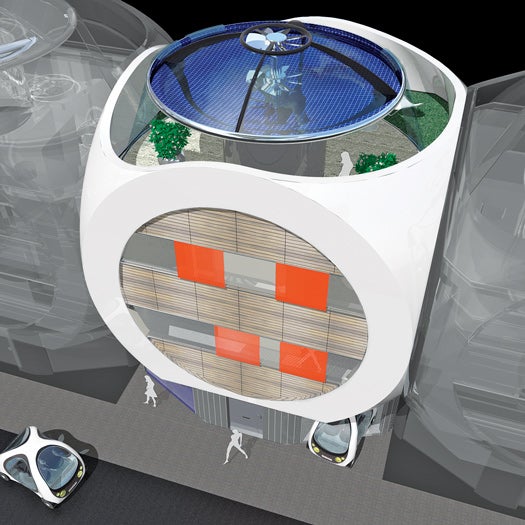
Roll the Dice The building’s designer, Sybarite, hopes to make its design the standard for zero-emissions homes. Courtesy Sybarite House

The Dice House looks like part of a Monopoly set, but the design has real-world ambitions. The 30-by-30-by-30-foot concept home, designed by the British architecture firm Sybarite, improves on standard building tech to erase its carbon footprint.

The centerpiece is a photovoltaic umbrella dome that collects roughly 90 percent of the house’s energy needs. Made of a common plastic, the pillowy dome traps heat like a greenhouse. That hot air warms water in a tank tucked under the roof, turning out a daily average of 80 bath-ready gallons, even on the darkest days of December. At the umbrella’s apex, a generator-equipped turbine produces electricity and, in chilly months, drives heat into the house. Photovoltaic cells studding the 484-square-foot dome floor create additional electricity.

Generating an estimated average of 33 kilowatt-hours per day, the house can power itself and charge a Tesla Roadster. And the building, submitted for a carbon-neutral housing competition, manages to stay comfortable year-round without air conditioning. The roof is covered in plants under the dome. Walls made of structural board stabilize temperatures. Windows circumscribed by a big dot—the “one” side of the die—absorb light from the sun-drenched south. And the compact footprint means less space to heat and cool.

9 Comments

I'm speechless ..

Plastic? I thought big oil was the downfall of mankind?

Great concept but I can see no one paying for it... Maybe you force charitable ORGs like Habitat for Humanity and others to only build these zero footprint concepts then at least our charities will not be adding to the world's pollution problem. Plus people needing charitable homes could use a ZERO utility bill concept like we all could.

Actually ijtbjj, that sounds like a great idea!

I confess to being a bit skeptical. How exactly does the turbine/generator work?

As for the other cold weather performance -- in what locations? In lovely MN, we can have a week or so with the highs being below 0(F). During that time, we also may have a foot or more snow on the roof, which does degrade solar systems ( How easy is it to shovel that dome ?)

Build one in North Dakota and maybe I'll believe it -- after 3 or 4 winters of no external energy input.

Kudos for the comment on charging a Tesla, as opposed to the old standard cell phone.

Actually it is a very large home at a 30 foot square foot print.

So saying people won't pay for it and it will be for charitable housing doesn't make much sense.

I agree that the power generations sound theoretical and we'll have to wait and see if this actually works like they say it will.

My concern is how expensive is this to build? That is a lot of plastic.

And do they have the tech to build it?

At 3 stories tall how is the structural aspect designed?

Y'know...that's not very sensitive to those going through Gambler's Annonymous. I'm just saying...

All these great ideas have been mentioned for years and they all seem well and dandy, till the cost comes in. It doesnt matter how GREEN it is, if it cost mucho GREEN to get it, then whats the point.

The only people who can afford it are people who are rich enough from running companies that polute way more than that house will make up for.

Its like these so called affordable hybrid cars. They start at like $30,000.

C'mon, if people had that much laying around or could get loans for that, they would get a sportier car. It has to be practical people.

Theres nothing practical about saving money on gas by getting a hybrid car or GREEN house, when I have to turn around and spend twice or three times what I saved in payments back to the jerk off banks that gave me the loan at a high interest to begin with.

As for lowering the carbon footprint. it would take thousands, nay millions of these to make a significant impact on the environment. If they coul dmake them in mass production for low income developments, then people who are poor would save money, carbon footprints would be less, the environment would be saved, economy could benefit because more money for buying other useless junk could be spent by those who before couldnt, The builders and inventors would get a small cut and tax break and jobs would be created for building them and maintaining them over time.

I just solved our environment problem, economy problem, dependency on oil problem and affordable housing problems all in one.

Your f'ing welcome.

Seriously though. All these green products and low consumption ideas dont mean anything if no one can afford them.

buying them if you can, doesnt do you any good if its not practical.

Its like buying an electric car. Its only good short range and charges itself from frequent stops.

Well this is all good in city traffic, but most people who live in the city walk to work, or live in apartments. how you gunnah charge your car if you live on the second floor or higher? Or if the nearest outlet is to far.

What if some jerk like me walks buy and un-plugs it?

If you live in San Antonio TX, forget it, traffics combined with long commmutes will leave you stranded. Hybrids are a better option.

O.K. im done. :D

Well I have studied this problem at length for the past ten years,I note that no green solution will succeed without first supplying the world with a low cost green solution which means less than 1 % profit margin as in $1 dollar profit would even be better lets face it if everyone in the world could afford it you would still make 5 to 6 billion dollars. So lets stop looking for the big bucks and clean up the environment first! the next time around when efficiency is improved then get a little profit.


June 2013: American Energy Independence

Five amazing, clean technologies that will set us free, in this month's energy-focused issue. Also: how to build a better bomb detector, the robotic toys that are raising your children, a human catapult, the world's smallest arcade, and much more.


Online Content Director: Suzanne LaBarre | Email
Senior Editor: Paul Adams | Email
Associate Editor: Dan Nosowitz | Email
Assistant Editor: Colin Lecher | Email
Assistant Editor: Rose Pastore | Email

Contributing Writers:
Rebecca Boyle | Email
Kelsey D. Atherton | Email
Francie Diep | Email
Shaunacy Ferro | Email

circ-top-header.gif
circ-cover.gif
bmxmag-ps