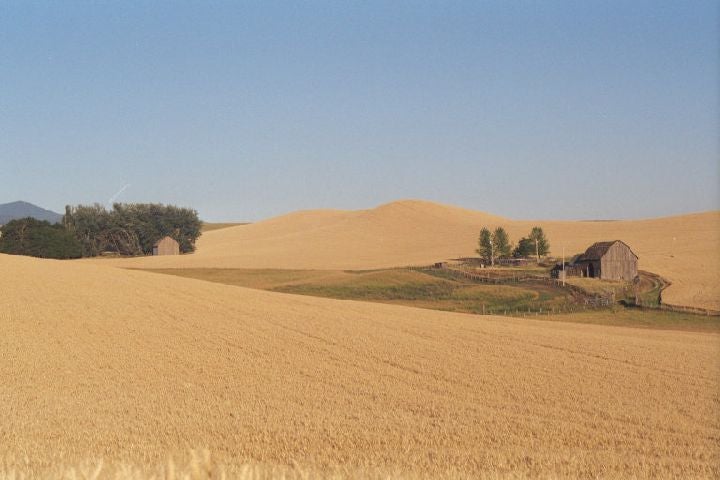
The grain crops that we humans depend on daily to hold body and soul together are annual crops -- they have to be planted every year. They germinate, bear their delicious product, and then die off; the following year, a brand new crop is put in to take their place.
Such annual crops are high in yield, but they require vast amounts of artificial fertilizer, and their impermanence contributes to soil erosion.
Perennial grain crops, if they existed, could require less fuel, less fertilizer, less herbicide and pesticide, and help prevent erosion by remaining deeply rooted in the soil throughout the winter (and indeed for years). Perennials return nutrients to the soil, where annuals require artificial fertilizers to supplement depleted soil, and return nothing. According to a paper in the current issue of Science, perennial grains, currently being researched at a number of universities, including Washington State University (WSU), could become the norm within two decades.
The deeper perennial root system would hold in place topsoil that annuals let erode away at a rate of up to 50 tons per day. It would retain and use water more efficiently than annuals' shallow roots do, and require as little as 3 percent of the fertilizer used by a field of annual grain.According to John Reganold and Jerry Glover of WSU, lead authors of the paper, the perennialization of grain crops would count among the greatest innovations in the history of agriculture, feeding the planet's hungry humans in a much more efficient, future-proof way. The authors are convinced that perennial crops can be created out of annual crops by concerted breeding plans.
To that point, a 2008 study showed that "the molecular difference between perennials and annuals might be rather small, and a change between these life strategies might not require major genetic innovations."
[WSU]
Five amazing, clean technologies that will set us free, in this month's energy-focused issue. Also: how to build a better bomb detector, the robotic toys that are raising your children, a human catapult, the world's smallest arcade, and much more.


Online Content Director: Suzanne LaBarre | Email
Senior Editor: Paul Adams | Email
Associate Editor: Dan Nosowitz | Email
Assistant Editor: Colin Lecher | Email
Assistant Editor: Rose Pastore | Email
Contributing Writers:
Rebecca Boyle | Email
Kelsey D. Atherton | Email
Francie Diep | Email
Shaunacy Ferro | Email
Ok lets do it then...
Just what the world needs -- more health-destroying gluten grain.
TXCHL
What are you? A fertilzer industry lobyist? This is clearly a fantastic possibility, well beyond the simple and direct food volume/practicality benefits.
@ TXCHL,
isn't gluten only dangerous to (the very small number of) people with coeliac disease?
Do a google search of Star Trek's Quadrotriticale.
Waiting for big fertilizer and seed manufacturers to buy any resulting patents and squash it for good. Where's Monsanto on this??
mclean Not all grains are high in gluten. I like high gluten bread. Thin crust pizza is made using high gluten flour and so is that crusty french bread. Too much gluten though will bind you up so bad that you'll remember it the rest of your life. This is more about reducing the total work and energy needed to grow crops, don't you think?
@TXCHLInstructor
I completely agree.
On the other hand,
What about converting bio-waste to fuel? As I understand it, scientists are working on bacteria that can process the stalk and leaves of corn to produce fuel while the corn itself becomes food/feed.
I wonder witch is more efficient? A perennial approach so that the roots and stalk are reused each year and don't need to be regrown? Or an annual approach that takes the waste products and turns them into energy?
And no, I'm not being sarcastic, I really do wonder (don't know) which is better.
Most people simply don't know what real 'food' is. Reference the above comments as evidence.
@blaxpear US patents only last a max of 17 years, which is why there are Big Blox now instead of just Lego, their patent ran out. So either way, it'll come eventually if we keep at it.
Bio-waste is not waste.It is broken down for the enrichment of the soil.
Who needs farms? I just go to McDonald's where they don't need farms for food. Take oil from your car and fry it with some 12 year old frozen meat and maybe some plastic. Enjoy your 'food'
Even the best ideas can be ruined by simple corporate greed and abuse. Check out the comments in the previous articles on here like /2010-05/roundup-resistant-superweeds-invade-us-fields. Monsanto would love to be the ones to discover and fast track this patent. They can sell the seeds and pull annual royalties from farmers every year without ever lifting another finger. Fat corporate profits there... and sue all the other farmers when the GM seed infests the other fields which it has done in the past and will always do. Monsanto does this now. The fact that you can patent a life form is the problem. Make the discovery as free open source to remove the greed and help humanity? Probably not going to happen.
Dr. Vogel developed New Gaines wheat and saved millions of people from starvation. Sports player entertainers are recognized and adored by millions as heroes, yet save no one. Who is your hero?
Yes there would still be waste. Even tho the crop is perennial it does not need its above ground stalk each year. Its just like your lawn. You can burn the grass off and the end of the summer if you want and it will still come back in the spring. But yes, you would only want to take a portion of the "waste" (aka ground cover) since taking all of it will require more nutrients to be replaced. This would be great from the standpoint that you could save on planting and fieldwork each year but it would be difficult to work with if you do crop rotation.
Classic. I open Popsci to read of an incredible innnovation that could prevent the starvation of millions and what do I see? Some clown yoga instructor going on about 'health-destroying gluten'. You new-agers are no better than the dark-agers. You just wear tighter pants.
This is tremendously viable for people in third world countries such as ones in Africa and Asia (though Asians would prefer better rice)
This can't possibly go wrong, like kudzu.
How about a tree that can grow loaves of bread?
Didn't think of that...did you?
I am sure Monsanto and the other biotech giants will nip this at the bud.
we've already got perennial grains. they just aren't mainstream palatable. google "the Land Institute." they already have the grains in the ground. plus, there are far better ways to eat than just than grains. like meat. tastes better; more nutritious; higher calorie yields per acre and energy unity. we could return a lot of these degraded "farm lands" to pasture, and graze a variety of animals on them.