Massive, Cataclysmic Star Death Now Available in 3-D
Massive stars live for a very long time, so when their lives finally do come to an end they like...
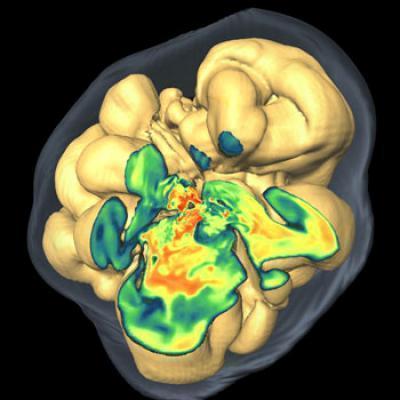
Massive stars live for a very long time, so when their lives finally do come to an end they like to go out with a bang — a bang that can become brighter than the whole galaxy for a time. Astronomers have studied and modeled these supernovae for decades, but for the first time researchers at the Max Planck Institute for Astrophysics have created a 3-D computer sim of a star undergoing core collapse over a timescale of hours after the initial explosion.
This wasn’t just an exercise in modeling one of the more sensational events in the cosmic catalogue. Researchers wanted to know why supernova blasts are uneven, with some elements like nickel asymmetrically blasting outward from the core. The team found significant differences in their 3-D model form their previous work in two dimensions, shedding light on exactly how some metal rich clumps are flung out of the center of the star at much higher velocities than other gases and elements present in the dying star.
The 3-D models could answer a lot questions about how those asymmetries form at the beginning of a supernova event. Future simulations will model the supernova of a wide array of progenitor stars so researchers can try to get a better grasp on what traits are common to all supernovae, as well as what characteristics make them unique.