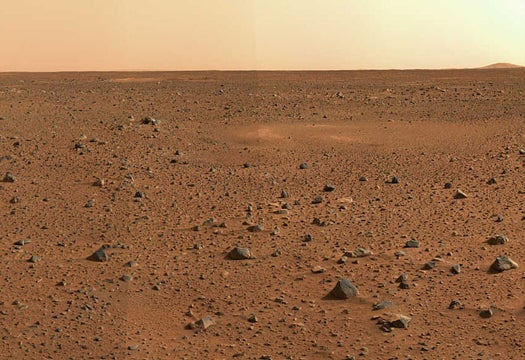
Mars: Harborer of Life?

Relax, David Bowie: in all likelihood there is life on Mars. Unfortunately for those of us hoping to find organic life forms thriving elsewhere in our solar system, there's a reasonably good chance the microbial life we might someday find on Mars was put there by us.

Searching for life -- or signs that it once existed -- on Mars is one of NASA's primary objectives when it comes to exploring the red planet. So when we launch probes at the surface or pack up rovers like Spirit or Opportunity for deployment on the surface, it's protocol to swab everything down so as to keep Mars pristine.

But a recent study coming out of the University of Central Florida showed that some microbial communities common on spacecraft can survive both the sterilization process on Earth and the hostile conditions on Mars. Replicating the Martian environment, the researchers showed during a week-long study that bacteria like E. coli -- a common stowaway on spacecraft -- can likely survive a space launch scenario. If shielded from radiation inside the nooks of a spacecraft or deposited beneath the Martian soil, it could conceivably live there, though it likely wouldn't reproduce.

But E. coli isn't the only candidate. Other common (and often nasty) microbes like acinetobacter, bacilus, streptococcus and staphylococcus might also survive the sterilization process and live on in a Martian environment. Which means we may have already contaminated the Martian surface, and if we haven't, there's a good chance we will as we conduct more exploratory missions there.

But there are two sides to this coin. Though we'd like a pristine Martian environment in which to conduct experiments and search for life organic to that planet, it's somewhat exciting to know that microbial survival is indeed possible on Mars. If we can contaminate it, we can seed it, setting the stage (potentially) for humans to create microbial environments that can persist -- and proliferate -- on Mars. Let's just hope our first contact with life on another planet isn't a nasty case of strep throat.

[Science Daily]

12 Comments

I'm skeptical we're contaminating Mars. I dunno, I'm having trouble because I know they check and double check all the sterilizing they do, plus all the harsh conditions of launch and radiation on the surface, but if UCF did these tests and microbes survived, I guess it's possible..

But if we have, why aren't there tests that have revealed this on Mars already. If they are right on the rovers or near them, that's basically the test area so it'd be the highest chance to find them..right?

In regards to seeding Mars, the tests cited in the article say the microbes couldn't reproduce so..there'd probably have to be more research or genetic engineering done to them for prolonged survival.

Kind of a good point CH.. that the test equipment its self could be called into question.

I would would think that life on mars (or anywhere for that matter) would evolve differently than our own, separating it from earth-born life......

also. this isnt really news.. This same theory was put out some time ago. maybe even on this site

@CoolHand

The current Mars Exploration Rovers (Spirit and Opportunity) were designed mostly to test for conditions that suggest the existence of liquid water. The upcoming Mars Science Laboratory will be bigger and have more tools suitable for testing actual life conditions.

What about the opposite? Can some Martian microbes/viruses that have not been detected by the instruments, attach them selves to something ,come back and survive the trip/sterilization? I believe this is more scary.

What about nearly a year's travel through the cold vacuum of space? Won't freezing and the lack of air pressure kill any biological things?

@vman; if they were coming back, then yes. But they are not. So far nothing we've put on Mars has had the engines or fuel to get off the Martian surface and through the atmosphere, and it won't be happening any time soon. That would be as large an undertaking as launching a craft from Earth, perhaps more so.

I think people are in general denial that life can exist by it self on other planets. Thats why we always try to find an excuse to point to that we are soooo super duper special and lucky here on earth and on earth ONLY. We found life here on in deep caves with out any sun light, found complex organisms living on hydro vents which are so hot its will melt your flesh off your bones in seconds. Yet we are in complete denial about space.

If it's true that our species is alone in the universe, then I'd have to say that the universe aimed rather low and settled for VERY little. I think future generations will laugh at our narrow-mindness and ignorant stupidity.

I say seed mars with life

Seed away! Let's start with the entire staff of Goldman Sachs and anyone who has ever worked for them, all politicians who've taken their money, and Sarah Palin!

@bridgecross: Thanks for the info. Don't we have plans to take back samples any time soon?

@Icezzz The difference between deep lightless caves, thermal vents in the deep ocean, and space is radiation. We've found life can survive at previously thought ridiculous conditions of high and low temperatures on Earth, but radiation is lethal at the levels seen in space on planets without significant atmospheres ala the moon or Mars.

Also, the life forms we've found in random places on Earth are still around all the rest of us life, whereas on other planets there is only barren wasteland. What is it supposed to evolve from to handle those harsh conditions?

In closing, while future generations may look back and think us narrow-minded and ignorantly stupid, I get the joy of looking at your right now and thinking the same thing.

Turns out, earth life did stowaway on Curiosity. The "Seven Seconds of Terror" was not completely as shown: Watch Youtube video, NASA Failed to Prevent Earth Life Contamination of Mars.


June 2013: American Energy Independence

Five amazing, clean technologies that will set us free, in this month's energy-focused issue. Also: how to build a better bomb detector, the robotic toys that are raising your children, a human catapult, the world's smallest arcade, and much more.


Online Content Director: Suzanne LaBarre | Email
Senior Editor: Paul Adams | Email
Associate Editor: Dan Nosowitz | Email
Assistant Editor: Colin Lecher | Email
Assistant Editor: Rose Pastore | Email

Contributing Writers:
Rebecca Boyle | Email
Kelsey D. Atherton | Email
Francie Diep | Email
Shaunacy Ferro | Email

circ-top-header.gif
circ-cover.gif