Hunt for Extraterrestrial Life Guides Next Wave of Space Exploration Missions
A three-part Mars sample-return mission is among the proposed adventures for next-gen robotic explorers
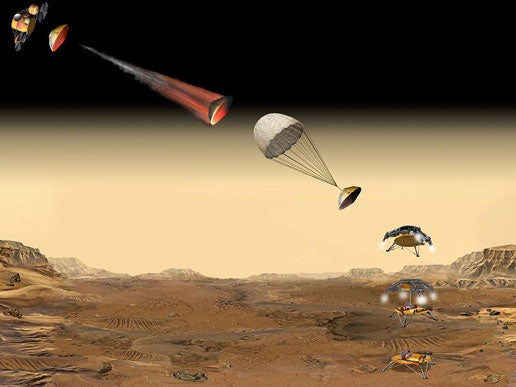
NASA’s search for extraterrestrial life could result in missions such as a balloon or boat-like capsule on Titan, or even a complex three-part Mars mission to return a Martian sample to Earth. Until then, scientists have focused attention on both Earth and Mars regions which could hold organic materials or microfossils.
Extraterrestrial life hunters gathered this week near Houston at what amounts to a biennial Woodstock for astrobiologists, and a NASA teleconference today gave a glimpse into the proceedings. Some of the best and the brightest shared their latest findings and discussed future missions to search for signs of life on Mars, Europa and other exotic solar system destinations.
“One thing emerging in our work is that astrobiology and the search for life is really central to what we should be doing next in the exploration of the solar system,” said Steve Squyres, a planetary scientist and main robot wrangler for NASA’s Mars Exploration Rovers.
Squyres detailed several of the 28 missions under discussion for NASA’s decadal survey recommendations for space exploration. They range from Mercury landers to fly-bys of objects in the deep solar system.
One of the most ambitious and perhaps costliest missions ever planned is a sample return mission to Mars which could retrieve Martian rocks or soil for study back on Earth. The three-part mission would include separate missions for a rover to collect the samples, a lander to pick up the samples and rocket into Mars orbit, and an orbiter to rendezvous with the samples and fly back to Earth — a “hellishly difficult” prospect in Squyre’s words.
Another proposed spacecraft would examine the methane gas in the Martian atmosphere, because the source of such gas might be biological in origin.

Enceladus Spews Ice
A mission to Jupiter’s moon Europa could use ice-penetrating radar to find the liquid ocean suspected to lurk beneath the surface. Saturn’s moon Titan could also see robotic visitors from Earth in the form of a methane-powered balloon, or even a boat-like capsule to sail the methane lakes.
Saturn’s sixth-largest moon, Enceladus, has similarly been tagged for a possible mission to investigate its erupting geysers of water ice. And a comet sample-return mission is also on the table.
Astrobiologists have also made exciting discoveries about how the mineral gypsum can preserve microscopic fossils on Earth, and perhaps also Mars. The drying out of the Mediterranean Sea about six million years ago left huge gypsum deposits containing tiny cyanobacteria, phytoplankton and diatoms, according to Bill Schopf, a paleobiologist at the University of California in Los Angeles. Orbital mapping of Mars recently uncovered gypsum deposits near the north pole and the equatorial region — possible sites for records of any existing or past life.
Sulfate deposits also remain a strong candidate for materials that “might harbor a suite of fossils,” said Jack Farmer, an astrobiologist at Arizona State University in Tempe. The Mars Exploration Rover Opportunity landed near a big sulfate deposit on Mars more than six years ago.
Despite the focus on tiny extraterrestrial organisms, the scientists did take time to address a reporter’s question about the recent remarks of physicist Stephen Hawking. The venerable Hawking had suggested that humans should consider the risks of broadcasting to a possibly hostile and more powerful alien race.
“Whether you [broadcast] intentionally or not, the signals are out there,” Squyres pointed out. In other words, Earth lost its chance to stay silent ever since it began beaming radio and TV transmissions. But at least NASA astrobiologist Mary Voytek put a cheerier face on that prospect by reaffirming the U.S. space agency’s commitment to discovering “any forms of life,” whether big or small.