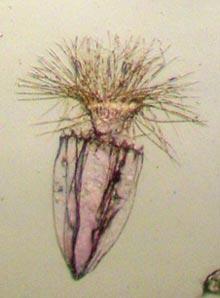
In the 236 years since oxygen was identified as a life-giving necessity, no scientist anywhere has discovered a multicellular animal capable of living without the stuff. Until now. Researchers from the Polytechnic University of Marche in Ancona, Italy*, have discovered three new species that live their entire life in an anoxic pit beneath the Mediterranean Sea. This discovery drastically revises science's understand of where animals can thrive.
Prior to this discovery, the only organisms capable of life in oxygen-free environments were viruses and bacteria.
The organisms themselves, none of which have been named yet, all belong to the phylum Loricifera, measure less than 0.04 inches long, and were found almost 10,000 feet down in sediment previous assumed to contain only viruses and bacteria. This is not the first time that scientists have discovered animals living in an anoxic environment, but all the previously discovered species needed to surface periodically for some O2. That makes these creatures the first animals ever discovered that spend their whole lives without oxygen.
How these animals evolved, and what else might be down in this forbidding environment remains to be seen. University of Marche scientists still have a great deal of analysis to do on these animals, but one thing is for sure: our understanding of animal life will never be the same.
* This post originally identified the researchers as working for Scripps Institution of Oceanography in La Jolla, California.
[Nature]
Five amazing, clean technologies that will set us free, in this month's energy-focused issue. Also: how to build a better bomb detector, the robotic toys that are raising your children, a human catapult, the world's smallest arcade, and much more.


Online Content Director: Suzanne LaBarre | Email
Senior Editor: Paul Adams | Email
Associate Editor: Dan Nosowitz | Email
Assistant Editor: Colin Lecher | Email
Assistant Editor: Rose Pastore | Email
Contributing Writers:
Rebecca Boyle | Email
Kelsey D. Atherton | Email
Francie Diep | Email
Shaunacy Ferro | Email
And the universe just got a little larger...
ho-ly crap...they've been here all along...
So what do they run on?
So little aliens were here all along :)
Ivan Malagurski
So there's more hope for Titan.
I would like to draw your attention on the fact that, contrarily to what reported in this feed, this important discovery, published on BMC Biology, is authored by a team of Italian and Danish researchers leaded by Roberto Danovaro from the Polytechnic University of Marche (Ancona, Italy), and NOT by a team from the Scripps Institution of Oceanography in La Jolla, California. From this latter institution is Lisa Levin, who made an interesting commentary on this discovery (also published in BMC Biology). Another intriguing commentary authored by Marek Mentel and William Martin (Germany) is also available on BMC Biology.
On behalf of the authors of this discovery
Antonio Pusceddu
S c o t t says, “Time and tide wait for no man.” I think ” F a t e and l o v e wait for no one!” So I recently joined a nice platform
*****www.SeekInterracial----com ***** to find my true LOVE….Im lucky!! It is destined that you can also meet your right babe…..GO and have a try…..
This does increase the pool of worlds and ecosystems to investigate for future xenobiology discoveries.
Hello,
M
How are you doing? Hope you are alright.
Last week, I bought Many items.
it is very cheap and I get it in 5 days. The quality is very good.
The site also sell Sneakers, handbag, purse, jeans, sunglass, hat and so on.
I never forget to share good things with friends.
So,if you are interested in it, you can have a look.
I think you will get some surprise.
This is their : www.newgoing.com
life will take on any form that's convenient, so I'm no surprised.
I am so sick of the new going idiots. can't PopSci delete these comments?
Why do we have to put up with their spam?
Hell give me a log on, I will delete their crap for you. I love this site and visit constantly.
PopSci is our source for future tech and they are messing with it.
Don't we have some hackers that visit here?
Take 'em down already!!
YES!!!!!!
This is great news. More hope for the moons around Saturn and Jupiter which are covered by surface ice but underneath may have water due to volcanic vents which can support life since life has been found in volcanic vents under the Artic and now this as well? This discovery changes a lot. Literally. We could have life all over our solar system and every other solar system if more events such as this are discovered.
I have lived in Fresno, Ca without oxygen for 20 years. I can tell you from experience this does not mean these organisms have any degree of intelligence.
haven't mussels been discovered living near undersea hot vents where there is no free oxygen? They get the energy from their food by 'oxidizing' them using metals other then O2.
if they are small then they must be inside us already...?ponder upon this subject
People should really stop being surprised by things like this. I'm fine with people being happy with finally finding it, but with how big this universe is and how relatively young our scientific knowledge is, we should not be surprised by things like this. The universe has had so many years to create itself, and we think that because we discovered some of it on our planet that we know it all. I'm not saying we haven't come far, but we have a ways to go, telescopes are still dictating how much we can learn about things. Heres a question for you, look at the moon. What does it feel like? You can't tell me because there are just some things we won't learn until we further our explorations past our current limits. We are infants so just keep on learning and expect the unexpected.
30bcf4e2
I am sort of surprised, as i knew we would eventually discovr something like this, but, how did they come upon finding this???
@ Voices1776
Yes, i see spam all the time on sites like this. They should at leasy have a report abuse button or something...
Very nice post....
Enjoyed reading alot,Like to read more from your side.
The aliens live on Earth.