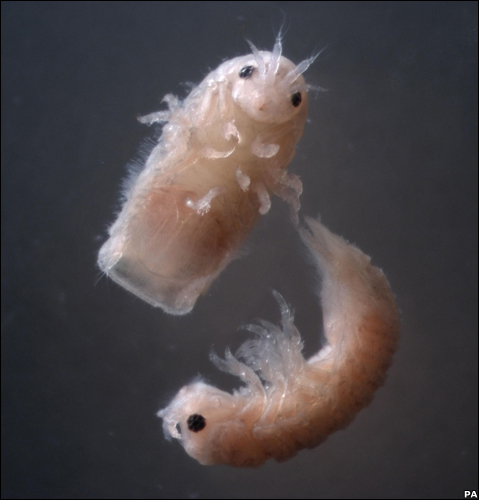
Gribbles via BBC

They don't exactly look like the saviors of our energy economy, but that's exactly what some researchers think they could be. Gribbles -- tiny crustacean pests with a knack for digesting wood -- have long been considered a marine parasite for the destruction they cause to wooden hulls and piers. But the enzymes gribbles use in to break wood fibers down into sugars could make them the next biofuels breakthrough.

Essentially, gribbles are blessed with a digestive process unparalleled (to our knowledge) by other wood-consuming insects and animals. Their digestive enzymes can break down woody cellulose and even lignin -- the normally indigestible part of woody plants -- creating sugars that are more or less ideal for fermenting into alcohol-based fuels.

A biofuel factory based on the gribble's digestive biology could yield energy-dense sugars for biofuel production in an efficient manner. But of course there's a give-and-take in the equation that involves feeding woody plant materials -- like trees -- into the process as fuel. But by pushing forward with more efficient means to convert woody cellulose into fuels -- and perhaps by engineering woodier trees -- we reduce the amount of organic matter we need to feed in to get the combustible stuff out.

The gribble -- thorn in the side of harbormasters, plague of the age of sail -- might just be good for something after all.

[Times Online]

11 Comments

Hmmm... I had never before considered a wood based refugium for my aquarium. Would this work, or would I have trouble with gribbles?

I still think Hydrogen is the way to go. Its not so hard to make, the materials required are plenty, and doesn't pollute. Only water vapor is produced, or so I hear. I.E: You could use solar panels to charge the water to create Hydrogen which is pretty efficient.

@omarascoustic

Hydrogen isn't really a fuel in the way you've described it. If you use solar panels to create hydrogen, you're really using the hydrogen as a battery. Since you're paying several conversion costs (light to electricity is less than 10% efficient, electricity to hydrogen is decently efficient, then hydrogen to whatever form you're consuming it in...)

If you use enzymes to convert starch to sugar, you get pretty high efficiency. Fermentation to turn sugar to alcohol is again rather efficient - heat is applied to make it go more quickly. Distilling is relatively low energy cost until the last 5% purity - if we were to use 95% pure alcohol as fuel, we'd be much better off than using 100% pure alcohol, at least in terms of energy cost to create the fuel.

"I still think Hydrogen is the way to go. Its not so hard to make, the materials required are plenty, and doesn't pollute."

Electrolyzers are expensive and almost invariably use one of the scarcest elements in existance, platinum.

Large scale leakage of elemental hydrogen, which is hard to avoid, could potentially be a severe environmental problem in its own right. Nobody has bothered to look at it very closely but it is known that it would reduce the prevalence of hydroxyl radicals in the atmosphere and lengthen the residence time of methane by some amount, which is a much more powerful greenhouse gas than CO2 per unit weight. Hydrogen gas can be split by UV in the stratosphere, forming hydrogen radicals(I.e. atomic hydrogen) that may cause ozone depletion.

The cheap way to produce hydrogen is steam reforming and water gas shift of fossil fuels, especially coal and natural gas. This is where nearly all the hydrogen gas used for Haber-Boosch and petroleum refining comes from.

Storage and transmission of hydrogen is capital intensive and consumes large amounts of energy(especially compressing it or cooling it to liquid temperatures).

Practically useful hydrogen fuel cells use either high temperature(which is problematic as it requires intricate thermal regulation and insulation to maintain the temperature of the fuel cell within a reasonable band, even when the vehicle is parked) or several ounces of scarce platinum per car(it's not going to stay it's current low price of $1500/ounce if there is wide-scale adoption of PEM fuel cells).

Hydrogen ICE engines would be simpler and cheaper to produce but less efficient and would produce hydrogen cyanide and nitric acid pollution.

The best round trip efficiency you could realistically hope for(electrolysis->compression->transmission in pipeline->(more compression)->generation of electricity in a fuel cell) is about 1/3.

"You could use solar panels to charge the water to create Hydrogen which is pretty efficient."

Solar panels currently consume large amounts of scarce transition elements, particularly indium, and they need to come down in cost by a factor of ~10 to compete directly with other sources of electricity generation.

Cool!

Cyback... Ahhh, but if the popular science article that portends the new type of solar panel which uses no rare elements and is near 20% efficent then producing hydrogen becomes far less costly, and why would you need to liquify it? Hydrogen gas can be compressed for use in vehicals and the only thing that would need to be modified in say a propane filling station would be the delivery method to prevent leakage. And I for one would love to see a vehical that does not polute at all, unless you consider water a pollutant.

Rather than harvesting wood from forests, where else do we find it? Sawdust, waste wood in manufacturing, paper. Lots and lots and lots of paper. Cellulose in switchgrass.

We could use that and hardly touch environmental resources.

Would wood really be necessary? How about hemp??

Or kudzu, which is so prolific (a vine can grow a foot in 24 hours) that shortages would be unlikely. And it could be cultivated in a way that could allow us to simultaneously combat desertification.

Sincerely,
My Tachyonic Auntie Persephone

Hydrogen gas can be compressed for use in vehicals and the only thing that would need to be modified in say a propane filling station would be the delivery method to prevent leakage

my understanding is that the problem of leakage has to do with the fact that hydrogen is an extremely small element that can slip through between the molecules of whatever you are using to contain it.

Um, why are we discussing Hydrogen fuel? Isn't this article about the pros and cons of gribbles instead of the problems and benefits of Hydrogen?
I think that gribbles have a cool name.

No! Back to Hydrogen! And debates about the existence of God!

Perhaps PopSci should do an entire issue on Science and Religion. It would seem to captivate the attention of many, myself included. And for me to enjoy the issue, it must be strewn with the typos we see in this blog, such as the above: "But the enzymes gribbles use in..."

Did these people go to college?


138 years of Popular Science at your fingertips.

Innovation Challenges


Popular Science+ For iPad

Each issue has been completely reimagined for your iPad. See our amazing new vision for magazines that goes far beyond the printed page


Download Our App

Stay up to date on the latest news of the future of science and technology from your iPhone or Android phone with full articles, images and offline viewing


Follow Us On Twitter

Featuring every article from the magazine and website, plus links from around the Web. Also see our PopSci DIY feed


February 2012: The Future of Fun

Science is reinventing play, from extreme sports to gamification to ridiculous roller coasters to the playgrounds of tomorrow, and this issue is chock full of fun. Also, on a less fun note: Did global warming destroy my hometown?


circ-top-header.gif
circ-cover.gif
bmxmag-ps