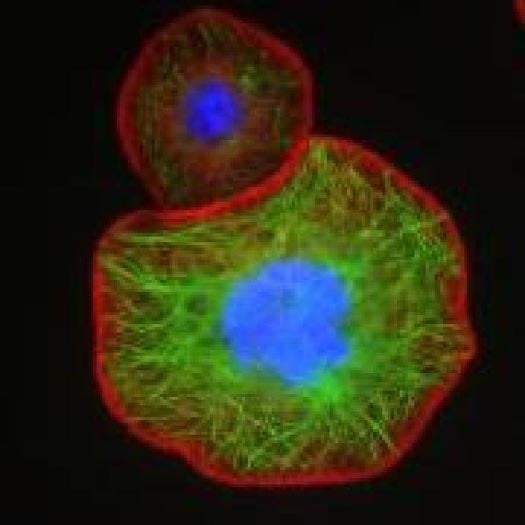
RNAi, also known as "gene silencing," is a cellular mechanism that blocks the production of proteins, and has tantalized doctors as a potential medicine for a number of years now. However, by placing payloads of RNA in a polymer nanobot, scientists have finally shown that this technique can work against tumors in human patients.
Specially constructed molecules could potentially block the expression of genes critical to the reproduction of viruses and the spread of cancer. But until now, doctors had been unable to direct those molecules to the right cellular nuclei. Scientists from the California Institute of Technology solved this problem by placing the RNA molecules in a specialized polymer robot with a chemical sensor. When the environment of a cancerous cell triggered the chemical sensor, the robot releases the RNA.
The trial involved three people with melanomas who received the RNA-load nanoparticles intravenously four times, for 30 minutes, over three weeks. At the end of that time, samples taken from the melanomas showed both the presence of the RNA, and a reduction in tumor gene expression.
This technology still has a long way to go before it becomes a routine medical treatment. However, by targeting the epigenome, the expression of genes, as opposed to DNA itself, it has much more practical potential than genetic therapy. Plus, since RNAi can work against any transcription, RNAi nanobots could potentially disable both DNA viruses, like smallox, and RNA viruses, like SARS.
[Reuters]
Five amazing, clean technologies that will set us free, in this month's energy-focused issue. Also: how to build a better bomb detector, the robotic toys that are raising your children, a human catapult, the world's smallest arcade, and much more.


Online Content Director: Suzanne LaBarre | Email
Senior Editor: Paul Adams | Email
Associate Editor: Dan Nosowitz | Email
Assistant Editor: Colin Lecher | Email
Assistant Editor: Rose Pastore | Email
Contributing Writers:
Rebecca Boyle | Email
Kelsey D. Atherton | Email
Francie Diep | Email
Shaunacy Ferro | Email
You said it Patrick. This is a great idea. I'm glad medical science is making some pushes back against the (what seems to threaten everyone) cancer of today. Hope it works out. It seems much more promising than our current destructive treatments of cancer.
Nice writing there. Except for the fact that RNAis don't directly effect the epigenome in anyway. HurrrDurrr there stuart fox.
Yeah, this is good news for me at least. Due to a genetic condition, I have ultra-low blood pressure (I'll put it this way, I eat more salt in a meal than the average person does over a few days and my blood pressure is still well below the recommended amount) linked to some other symptoms, basically making it impossible for me to have a stroke or heart attack. That leaves cancer as the biggest threat should I die of natural causes, and considering that I have red hair, I'm almost guaranteed skin cancer 1-2 times in my life. For that reason, any medical advance in the area would be good, not just for me, but my entire family as we all have red hair...
Absolutely amazing dude. Wow.
Lou
www.privacy-online.eu.tc
As someone who lost a sibling to cancer, I'm all for this kind of biomedical engineering. Truly awesome. We just need to also think of ways to prevent future bio-terrorists from using the same concepts to hurt people instead of helping them. I just hope we never stop progress because of the potential bad future scenarios. Just like the computer anti-virus industry today, this may become another necessary cat-and-mouse game that we'll have to play due to all the knuckleheads out there.
"...can't wait till they have pills with nano bots that can destroy almost all major diseases!..."
Yeah, great. And during defeating cancer, we go after killing the aging itself as well, since cancer is part of aging. Keep on supporting DeGrey's SENS (sens dot org). At least I don't like suffering or dying.
This is great news to people like me. I had a skin cancer removed about 11 years ago, though fortunately it had squamous and basal cells, not any melanoma. However, I have what I suspect is *another* one developing. Further, both my Father and his Father died of cancer (at 58 and 50, respectively), and both Grandmothers had it, one of whom survives, the other long dead, though not of cancer, which she apparently beat. And the disease is pretty widespread throughout both branches of my family.
About the only "good" thing about someone getting struck with terminal cancer is that loved ones have time to begin adjusting. On the other hand, for the doomed person, a near-instantly fatal heart attack or stroke is far preferable.
I read recently that with certain types of skin cancer -- not melanoma -- whose tumors are below a certain size (2.4 centimeters, or just under 1 inch) have responded well to adhesive strips (what we Americans call "band-aids," though that's a trademarked name) with a medication. I'm *hoping* the medicos can use one of those on me if the growth does turn out to be cancerous. Sure beats getting it cut off (though cutting beats the possible alternative, even without melanoma, for sure).
Encouraging article. . . .