Although some of us feel like we've heard this story before
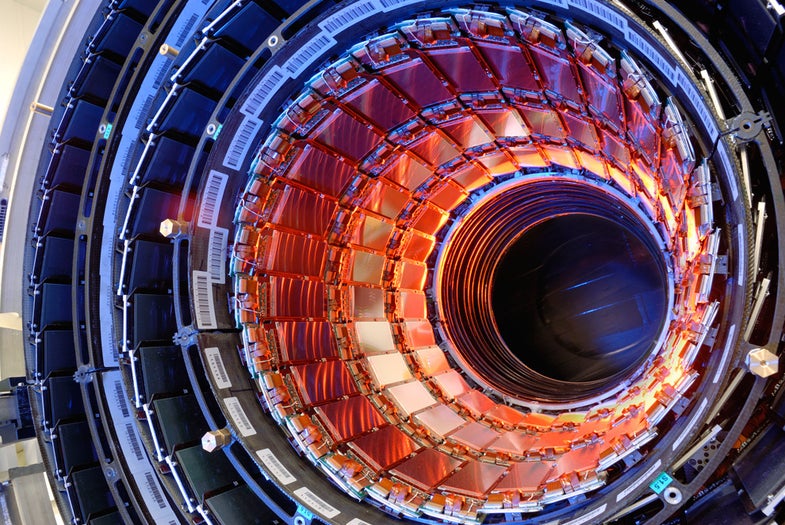
The Large Hadron Collider's Compact Muon Solenoid courtesy CERN

The Large Hadron Collider has been coming along in fits and starts, but the European Organization for Nuclear Research plans to begin colliding the highest energy proton beams ever conjured tomorrow, heralding a new era of science and discovery. If it works, that is.

The LHC has been set back by mechanical failure and even breakdown-by-baguette after a bird dropped a bread crust into an exterior piece of machinery. But the world's largest and most expensive science experiment has been revving up to 3.5 trillion electron volts with no problems over the last ten days with no real problems, hurtling hundreds of billions of protons around the 17-mile underground tunnel at unprecedented speeds.

If the first beam collisions at that energy don't happen tomorrow, it will likely be a matter of finesse rather than failure; it could take up to a few days for the researchers to coax the massive machine into precision cooperation.

Of course, the real question is: will researchers at the LHC find the Higgs boson -- the hypothetical "god particle" that researchers hope will shed light on some of the universe's greatest mysteries. The short answer is: Not tomorrow. Or the next day. It will likely be months before the huge amounts of data can be analyzed and solid scientific discoveries can be made. But researchers hope to have a better grasp on dark matter, dark energy and some of astrophysics's other unknowns by the end of the year.

[AP]

27 Comments

Second Paragraph needs revision: ...up to 3.5 electron volts with no problems over the last ten days with no real problems...

Other than that I can't wait to hear about their findings.

Welp, here's to you, Europe. Nice knowing you.

--GTO--

"Try to imagine all life as you know it stopping instantaneously and every molecule in your body exploding at the speed of light"

THE LHC is NO more likely to create a blackhole than the millions of collisions of same dynamics that happen in the upper atmosphere everyday.......some people really need to come back to reality and leave sci-fi alone.

and if you don't beleive what i just said GO LOOK IT UP FROM CREDIBLE SOURCES.

Ah, finaly,
let's hope spaceball 2000 isn't right.
www.jorgnsn.com/spaceball2000.php

I can understand interest to learn about the unknown. I can also understand human nature to think that if you study something long enough you are the expert and no other input is required.

However when assessing risks and a risk you wish to take or not take, familiarity with the subject is not requisite. Indeed there is evidence to suggest that decisions of which risks are reasonable are better made from outsiders.

So it is particularly troublesome to me that any opposition to the seeming cowboy safety analysis that is offered for the CERN collider is met with ridicule and these people are called nuts. Not to say that there are some in opposition from which it is difficult to understand what they are saying. However it is also true that when dealing with the considerable unknowns related to dark energy and a "god" particle these highly educated physicists may be in no better shape to judge these risks than the common man.

I do fear for our safety with the CERN collider. The fears I have are not only black holes but other unknown particle or particle energy reactions that we are unable to characterize at this time? I suggest that a go slow approach would be better for this science. I also suggest there are other ways to get much of the same data. It is more expensive and takes more time, but can be safer. These are would be measurements over longer periods of time using slower particles. The CERN collider could be operated at lower states of power for years to achieve much of the same results.

SO at the risk of being labeled a CERN nut I propose the outlandish idea that the CERN collider safety should be PROVEN to be 99.999% safe and not based on supposition. This proposal will be rejected however by the elite as they know full well they have no way to prove to a quantifiable amount the safety of the CERN collider anymore than they can predict the outcome of the experiments.

So will I ask then if we are all ignorant about the true safety of the CERN device, are we all now in a state of bliss?

^really? I believe most people called 'nuts' are called that because of the level of ignorance they portray.

It is better to make an informed opinion then ramble on about 'safety' when you have absolutely no idea on what said item is for/capable of/ etc. Personaly, I only like criticisms only if it's constructive. What I'm getting from your post, is that any criticism is constructive.

Also, often, to prove it safe you have to use it. I value your opinion but there are holes in your assessments. There are calculated risks in scientific experiments and I'm in no doubt that they know them.

To add. IMO outside opinions that lack technological information can ONLY form suitable opinions on the morality and ethics of the experiment, item, etc.

It's beautiful.

The LHC concerns are a bit of a "quantum triviality" in a dry humor sense...Sorry to have bastardized the use of the term at an attempt at levity.

The real concern is ensuring that the work done with the LHC have far more computational horse power to crunch that data...

As jaded and cynical as I often find myself being, even I think the magnitude of construction and the price tag of this incredible hardware had a few bits/means of risk assessment thrown into the mix...

The real quantum leap for this important work is going to be the number crunching...

Wikipedia blurb: Data produced by LHC as well as LHC-related simulation will produce a total data output of 15 petabytes per year (approx. 500 Mb/s)

Godspeed to all involved with the LHC!

Didn't Drs. Spengler and Stantz warn to never cross the beams?

I suspect bad things will occur tomorrow and--oh my, The Big Bang Theory is on!

They should wait a couple of years, say until 2012, before they try this. Just so doomsday theorists won't be worried.

this is like nerd Super-bowl for me it's string theory vs. common scene, who will win?

Careful of a resonance cascade scenario....

In response to "TX77092"

First off I would like to say that I've been an avid reader of this site, as well as many others that provide interesting tech tid-bits over the past several years.

I have never bothered creating an account before to comment, but its people such as "TX77092" that absolutely drive me insane. As Meshca said "What I'm getting from your post, is that any criticism is constructive."

"TX77092", criticism is constructive when it is infromed and the reasoning behind it is based on first principles. You must build an arguement from known facts or observation. The 'nuts' you have referred to have not done so, and yet you take their warnings as credible reasons to, "suggest that a go slow approach would be better for this science."

Previously I was unaware that the same results could be gained from a slower, lower energy experiment that runs longer. Please provide a valid link to the source of this information. It really would be helpful to me, and probably the scientists running these experiments.

It seems that you have extremely limited knowledge in physics and have attempted to take on an arguement from a philosophical stand point. I'd like to thank other posters for already poking holes in your errored logic, and won't further harp on that.

You say,

"However it is also true that when dealing with the considerable unknowns related to dark energy and a "god" particle these highly educated physicists may be in no better shape to judge these risks than the common man."

The obvious problem with the common man judging these risks is that the common man has no idea what is being explored in the first place. The common man is unaware that the calorie we eat is different than the calorie standard used in physics. The common man is also unaware of the significance of the energies being used and the speeds being reached in this experiment. The common man worries when numbers are "BIG" compared to everyday experienced orders of magnitude. The common man had no idea what is being tested, and can not make an informed decision. The common physics undergrad cannot make an informed decision on this subject either. Depending on the specialty, its not likely that the common physics graduate student would have a valid opion either. Experts in the field are credible since they actually understand what is being done. Not in certainty, but more than is possible from any other individual.

You would not let unqualified people teach you. Do not let unqualified people misinform you. If you want to make an informed decision or warn people of the possible risks, do some research before hand, provide some links, and think it over.

This is an opinion piece, I can't stand listening to some of the physics comments on here...

Tomorrow might be one of the greatest days for Physicist if everything go smooth and if the data they collect comes as per their imagination. Then lot of mysteries are solved as they say.I wish scientist reaches their ambitions.And i wish the results be for the goodness of huminity.My concern is -Won't there be any effect which scientist might not have taken into account for earlier- say creation of black holes? Certian risk are there surely. I hope this risk won't have place in the upcoming experiments.

People worried about black holes being created just slay me.... are they doing fusion experiments, or fission experiments at the LHC? I mean, our atomic weapons are fusion bombs... ignited by fission bombs... and they have a LOT more mass to start with, and none, that I know of, have yet created black holes....

So why would a few molecules or atoms smashed together at near light speed be able to create a singularity?

Just sounds rather retarded, but then, I wasn't asked my opinion.

@PhysMajor--

It could be that "TX77092" is simply stating a thought out theory that he constructed in his own mind. Maybe the process could be done at a slower rate, but even if it was you'd still have very different results (most likely to be much smaller and much harder to read), but they'd still be results of the same "type". The results with faster particles would no doubt cause a larger collision force, but the result of such would be much easier to examine.

Truth be told, however, no one in the world could possibly determine the exact result of such an experiment, or else it's not experimenting anything. Anything could happen if/when the beam suddenly clashes. It could be that they fuse, and suddenly we have a new element, never before encountered. It could be that it creates a mini-black hole. It could be anything. Scientist can theorize all they want, but no "expirement" is going to go exactly as planned without hard earned proof, which then isn't much of an experiment.

But I am also running on my own thought process here; I haven't actually studied too much of what they are really doing.

@podbog--

I don't entirely understand the process, but I don't believe it's either. I think that they are trying to simply make the beams collide into each other to create a small, confined explosion, then they want to study this explosion. I don't think that it will actually fuse anything together, and since they are looking for a collision, I doubt it is splitting anything. Of course, I have NOT studied anything about this in depth. I am only giving a theory based on my own thoughts and understanding. I have nothing concrete to back this up, so if I were you, I'd look around a site that actually explains what they are doing. Wikipedia might be able to give you some info.

My comment was more of a light joke, but on a serious note, get off of your high white horse.

I dont know what will happen at CERN, but I am profoundly interested. If I did not, I would not read PopSci or New Scientist or any of the other numerous scientific publications that peruse.

--GTO--

IDC I just hope it'd work

@GTO. personally, I laughed when you gave Europe a farewell.

It is interesting to see how my comments to ask them to PROVE to 99.99999% accuracy as is required in commercial power is not addressed by my detractors.

They have concluded that I have limited physics knowledge, there are unspecified "holes" in my statements, and also determined that only the elitist can assess our safety. All I am asking is to have the collider subjected to a higher standard than other experiments that are reaching less far into the unknown.

This is how dangerous experiments are done. Naysayers gang up on any detractors with statements that show that the detractor is not god, is not perfect, so the "expert gods" should be listened to.

Maybe the CERN will not turn out bad, but this attitude will result in bad things for humanity. Not all experiments should be performed.

Next they'll try splitting the atom! What maniacs!

@GTO I enjoy humour, like your earlier post, just not nonsense like TX77092

@tx77092.. besides your absolute love for CERN judging from your comments in the past I feel you are drawing misinformed conclusions from both CERN & LHC and the comments in response to yours.

You make the assumption that these well specialized, intelligent scientists perceive themselves superior to others. Don't confuse this with having their input be superior to others, because it is. Why? They are more qualified to discuss LHC activities. The only way you can tell if they are indeed elitists is if you know each one personally, regardless this is not considered a defining(or one that mater's) trait of a scientist

I loosely agree not all experiments should be pursued. But the accusations against CERN's LHC are just too out there to even consider. And without direct knowledge from past experiments, you can only hypothesize the most likely outcome. If I can put this analogy correctly..Take portable sundials for example, you can use them to plan a battle to within 15 minutes of the actual recorded time theoretically, but you cannot pinpoint the exact time. Will you abandon sundials all together if you currently did not have any other method that accurate to tell time?

I do agree I didn't address your 99.99% issue so I'll try to loosely cover it since I have no time or want to research what I want to say. I also want to mention I don't really understand what you're asking.

I have had an internship at a very respected engineering military company. Safety was important and risk was calculated, however it was the company's will, not the public's. Also, it is impossible to 'test' for that high of safety factor, accuracy, or risk. You can form theories/hypotheses(?) as proof. Therefore it depends what kind of proof you personally need and what proof the people funding the project, and the people who oversee the safety aspects of it.

Think of FDA approving pharmaceutical drugs, they require a anti-depressant to list suicide as a side-effect if there was at least one incident of an attempted(or informed)one. However, you do not have to prove the drug caused it because there are too many factors and may never be enough data on even if you create more studies. You also wont get your drug denied commercialization if this happens. It's a known risk, but it's an extremely minor one that doesn't have to be 'proven' any further.

If the above makes sense, apply it to the LHC, the risks to human lives, earth, etc that are most likely to happen are probably taken care off, the risks that might 'doom humanity' are romanticized by the media and the general UNINFORMED public. There is not a single issue of the LHC that I've heard that is a viable threat to more then the people operating the lab.

Micro black holes? they can happen, they do happen, they DO NOT have a long lifespan or a significant lifespan, consider math in this, when a number is so close to 0 it is considered to be 0.

"If any of the models are right, the accelerator should create a black hole anywhere from every second to every day, each roughly possessing 5,000 times the mass of a proton and each a thousandth of a proton in size or smaller, Landsberg said.

Still, any fears that such black holes will consume the Earth are groundless, Landsberg said.

For one thing, theoretical physicist Stephen Hawking calculated all black holes should emit radiation, and that tiny black holes should lose more mass than they absorb, evaporating within a billionth of a trillionth of a trillionth of a second, "before they could gobble up any significant amount of matter," Landsberg said."

""Still, let's assume that even if Hawking is a genius, he's wrong, and that such black holes are more stable," Landsberg said. Nearly all of the black holes will be traveling fast enough from the accelerator to escape Earth's gravity. "Even if you produced 10 million black holes a year, only 10 would basically get trapped, orbiting around its center," Landsberg said.

However, such trapped black holes are so tiny, they could pass through a block of iron the distance from the Earth to the Moon and not hit anything. They would each take about 100 hours to gobble up one proton.

At that rate, even if one did not take into account the fact that each black hole would slow down every time it gobbled up a proton, and thus suck down matter at an even slower rate, "about 100 protons would be destroyed every year by such a black hole, so it would take much more than the age of universe to destroy even one milligram of Earth material," Landsberg concluded. "It's quite hard to destroy the Earth."

Taken directly from: livescience.com/environment/060919_black_holes.html

"The upcoming experiments at the Large Hadron Collider have sparked fears among the public that the LHC particle collisions might produce doomsday phenomena, involving the production of stable microscopic black holes or the creation of hypothetical particles called strangelets.[55] Two CERN-commissioned safety reviews have examined these concerns and concluded that the experiments at the LHC present no danger and that there is no reason for concern,[56][57][58] a conclusion expressly endorsed by the American Physical Society.[59]"

Taken from Wiki of all places.. (has sources 56,57,58)

What else is rumored this thing could create...

Do you specifically need 20 neighbors to go and 'inspect' the LHC and access its danger to humankind?

...wow I wanted to write 2 sentences.

You know what I fear the problem is? It's not 99.999% proof that it's safe. It's the .001% possibility that people look for.. and when they find it, they talk about that information as if it were 99.999%. So no offense to you TX77092 but keep on looking, you won't find it from 99% of the commentators and popsci employees that have an informed opinion on this site. Try the Lifeboat Foundation.


June 2013: American Energy Independence

Five amazing, clean technologies that will set us free, in this month's energy-focused issue. Also: how to build a better bomb detector, the robotic toys that are raising your children, a human catapult, the world's smallest arcade, and much more.


Online Content Director: Suzanne LaBarre | Email
Senior Editor: Paul Adams | Email
Associate Editor: Dan Nosowitz | Email
Assistant Editor: Colin Lecher | Email
Assistant Editor: Rose Pastore | Email

Contributing Writers:

Kelsey D. Atherton | Email
Francie Diep | Email
Shaunacy Ferro | Email

circ-top-header.gif
circ-cover.gif