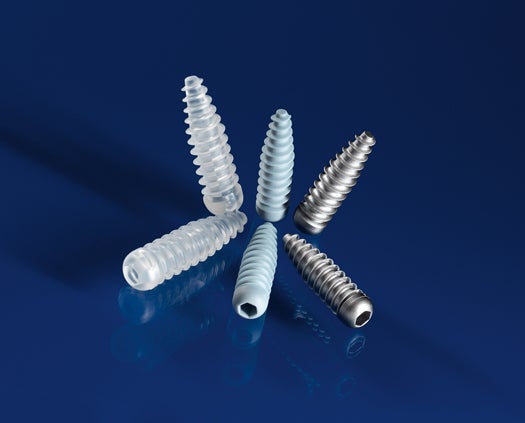
Medical Screws The new composite screw is in the middle, with the titanium screw on the right and the older polylactic acid screw on the left. via The Fraunhofer Institute

The screws used by doctors to repair broken bones and torn ligaments enable recovery from a wide range of injuries. Unfortunately, they also leave holes in bones, require secondary surgery for removal, and make going through airport security a real pain. But by crafting the screws from a special designed composite of polymer and mineral, researchers at Germany's Fraunhofer Institute have managed to solve all those problems in one fell swoop.

The researchers make the screws from a combination of polylactic acid, a biodegradable polymer already used to make surgical implants, and hydroxyapatite, the mineral that forms 50 percent of natural bone.

Like existing screws, the polylactic acid dissolves harmlessly in the body, saving patients the second surgery required for the removal of the older, stainless steel screws. Also, unlike regular polylactic acid screws, which leave gaping holes in bone, the hydroyxapatite interacts with the surrounding tissue to promote bone growth that naturally fills in the holes made by the screws.

And that's not all! Manufacturing the screws out of the hydroxyapatite composite also simplifies production. Molding a pure polylactic acid screw requires temperatures around 2552 degrees Fahrenheit. By comparison, the mold for the hydroxyapitate composite screw only needs to reach 284 degrees, saving time, money, and energy.

Cheaper, healthier, and more energy efficient? Wow, Chalk one up for German engineering.

[CNET]

8 Comments

John Wayne Bobbit, your device is here!

nonsquid:

They already fixed that with Elmer's Glue.

I wonder, do they make self tapping screws, too?

So titanium in the photo caption and stainless steel in the article. Which is it? I know they use both for implant purposes.

This is not really news. A surgical supply company in the U.S., W. Lorenz Surgical, has been making these for a decade now, as part of its LactoSorb line. Someone needs to call the patent office, I smell a lawsuit coming.

Um, 2552 degrees F looks like an error - sounds closer to a temperature appropriate for manufacturing one of the metal screws. PLA is processed (extrusion, injection moulding etc) at fairly normal commodity plastic processing temperatures, which is in fact one of the reasons it's becoming so popular - when it can be substituted, you don't have to change too much when you switch to PLA instead of PET or whatever for your widget manufacturing operation...

I really wish this article had been posted last week, before i had my sholder bolted back together.

Wow! That is incredible! A screw that is made of a similar material to bone and is then replaced by bone, why hasn't anyone thought of that before??!!! Oh wait, it's been around for decades, first commercialised by the British and now every single major orthopaedic company has one....

Great news! I personally experienced a broken ankle that required pins. These screws were then removed twelve months later. This meant another round of surgery and just as long to recover. Not all bone surgery must have the screws removed, but where it is somewhere like the ankle the screws were actually felt and caused the ankle to seize with the screws still in place.

www.jobs4medical.co.uk


July 2013: The Future Of Flight

The incredible innovations, like drone swarms and perpetual flight, bringing aviation into the world of tomorrow. Plus: today's greatest sci-fi writers predict the future, the science behind the summer's biggest blockbusters, a Doctor Who-themed DIY 'bot, the organs you can do without, and much more.


Online Content Director: Suzanne LaBarre | Email
Senior Editor: Paul Adams | Email
Associate Editor: Dan Nosowitz | Email
Assistant Editor: Colin Lecher | Email
Assistant Editor: Rose Pastore | Email

Contributing Writers:

Kelsey D. Atherton | Email
Francie Diep | Email
Shaunacy Ferro | Email

circ-top-header.gif
circ-cover.gif