New observatory spots where stars come from
cosmic telephoto
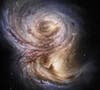
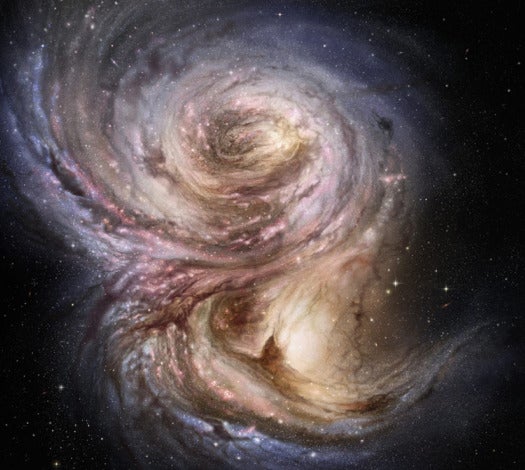
Sharpest Image Yet of Star-Birthing Factories About 10 billion light-years away, SMMJ2135-0102 appears in such great detail because of a cosmic alignment that allowed researchers to capture it 16 times larger than it usually appears. M. Kornmesser/ESO

Using a little astrophysical magic and the Atacama Pathfinder Experiment Telescope in northern Chile, astronomers at Durham University in England captured the best view yet of individual star nurseries in a galaxy a full 10 billion light-years from Earth. And all they had to do was bend a little light.

The star birth region above -- SMMJ2135-0102, for those of you keeping cosmic score -- is about 300 light-years across and contains concentrations of stars 100 times greater than similar regions in our own galaxy. Follow up snapshots taken with the Submillimeter Array in Hawaii further sharpened the view, revealing four star-forming factories in the galaxy.

But while images of the far cosmos are nearly always visually appealing, this one is especially intriguing because of the way it was captured. This faraway galaxy normally couldn't be seen in such dramatic detail, but as chance would have it a huge cluster of nearer galaxies drifted into our line of sight to SMMJ2135-0102. Because massive bodies -- like huge clusters of galaxies -- bend light, the further galaxy appeared 16 times larger to telescopes here on Earth.

This view shows the nursery at its star-birthing peak when the universe was about 3 billion years old. And it's true what they say: the miracle of birth is a beautiful sight to behold.
[Discovery News]

18 Comments

The thing that really makes my head spin is the fact that the images we are seeing are 10 Billion years old, I'd love to see what this universe looks like today...for all we know this universe may not even exist anymore.

I wonder what our region of space looks like to astronomers standing on a planet in SMMJ2135-0102.

Is it me or does that galaxie look like 2 galaxies after the have collided but not congealed into 1 cohesive galaxy?

yes caradoc, looks like 2 distinct nuculi with opposite spin wandering into each other at around a 40 degree angle. But, note the alignment of the center structure much like a column. BUT one arm is going right while the other goes left.
I cant tell if its over/under, flat ect.
It could be pulling the remnants out of an old galaxy crash.
Or the Pic could be just a composit illsuion. DURN!!!!!
Durn you 2D!!!! Durn you to hell!

Yes ajohnson1986, definite proof that the world is more than 6,000 years old. (no sarcasm)

These images inspire so many philosophical thoughts. They are just simply amazing

I've heard that this image is only an artists impression. Could we have some confirmation please Popsci?

We will all be there someday.

Yup - a collision. And the two parties involved are still waiting for a settlement from Galaxywide Insurance...
Beautiful photo! (and my new wallpaper!)

I just wonder, the space is without any boundaries and light is still travelling, universe is still expanding.the space where lingt has not yet reached is still unknown to us.the space where universe is still to reach is still there.what is the space called which is still to come in future?

When I google SMMJ2135-0102 the first result is the site that provides this image, astro.dur.ac.uk/~ams/Nature/ , and the caption is "Artist impression of the galaxy". You should make this clear in the article!

@jordan314 I totally agree...artistic impressions look really great, but are not the actual data. Hubble images of Pluto are a great example of this disparity...

What a magnificent spectacle. It's raging out there.

@ Ananta: it's called empty space, a void. 15 billion years ago the universe exploded into existence, creating light and matter. unfortunately, in the initial moment of creation, matter expanded more quickly than light (which has a definite speed), light is gradually catching up. there for the space beyond the access of light is matter in utter darkness lacking all energy, and the space beyond matter is void, simply empty.

How do we know this is creating stars? Seems like a big hypothesis to me. We definitly do not know hor sure how stars are made. If we don't know for sure, then it shouldn't be stated as fact.

But it is amazing what we can see from a little telescope on a little planet, in a small solar system. I am in awe...

"Astronomers at Durham University in England captured the best view yet of individual star nurseries in a galaxy a full 10 billion light-years from Earth" -this quote form the article says the finding of star nurseries 10 billion light years, means the universe is older than 15 billion years. If the said space is called empty-does there exist time and space at all? And also does dark matter and dark energy exist there? If the said space is void, can't we say that it is absolutely still, therefore time doesn't exist there.In this sense, the said space has no birth and no death.

Here is my question, if,"THE BIG BANG" created the known universe, what was it that exploded and what set it off?


June 2013: American Energy Independence

Five amazing, clean technologies that will set us free, in this month's energy-focused issue. Also: how to build a better bomb detector, the robotic toys that are raising your children, a human catapult, the world's smallest arcade, and much more.


Online Content Director: Suzanne LaBarre | Email
Senior Editor: Paul Adams | Email
Associate Editor: Dan Nosowitz | Email
Assistant Editor: Colin Lecher | Email
Assistant Editor: Rose Pastore | Email

Contributing Writers:
Rebecca Boyle | Email
Kelsey D. Atherton | Email
Francie Diep | Email
Shaunacy Ferro | Email

circ-top-header.gif
circ-cover.gif
bmxmag-ps