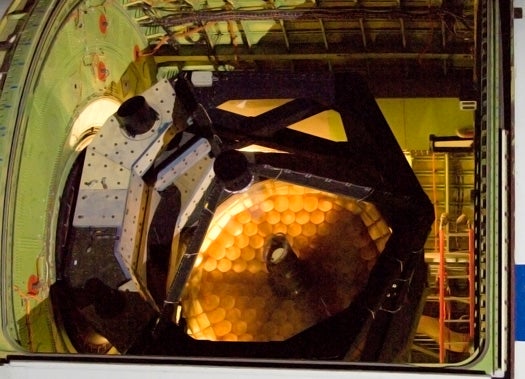
In the movies, opening the door on a plane at 45,000 feet is disastrous. But this spring it will be standard procedure on one 747—one carrying a telescope high enough to capture the cosmos better than ever before.
Built into the tail end of a Boeing 747, the Stratospheric Observatory for Infrared Astronomy (SOFIA) will soar above the atmospheric water vapor that blocks most infrared light from ground observatories, to shoot detailed images of star-forming nebulae, planets’ atmospheres and clouds of organic molecules. The 2.5-meter mobile telescope—operated by NASA and Germany’s space agency—will best the Hubble and Spitzer space telescopes by scanning the widest range of light of any scope, from ultraviolet to the far infrared. And because SOFIA is easier to design and maintain than a space telescope, it could be built and operated for a third of the cost.Stargazing from a flying plane is no easy feat, but the scope’s non-pressurized, cooled compartment should smooth the transition to similar stratospheric conditions. And since test flights in 2007 (which earned SOFIA a Popular Science Best of What’s New award that year), engineers added a collar around the scope to cut turbulence. NASA’s pilots will fly the plane, but the telescope’s controls are integrated with autopilot to capture steady images. “Although we changed the plane to fly the telescope,” says SOFIA astronomer Dana Backman, “when we’re observing, the scope actually flies the plane.”
Five amazing, clean technologies that will set us free, in this month's energy-focused issue. Also: how to build a better bomb detector, the robotic toys that are raising your children, a human catapult, the world's smallest arcade, and much more.


Online Content Director: Suzanne LaBarre | Email
Senior Editor: Paul Adams | Email
Associate Editor: Dan Nosowitz | Email
Assistant Editor: Colin Lecher | Email
Assistant Editor: Rose Pastore | Email
Contributing Writers:
Kelsey D. Atherton | Email
Francie Diep | Email
Shaunacy Ferro | Email
This may sound stupid but how much helium would it take to get one of these bad boys floating. If only there was a way that telescopes could become lighter. Or are telescopes always going to be heavy because the need of a thicker glass?...
Sorry for the, probably dumb, question, just needed to know.
@Victor1283
Since Sofia's website states the telescope weighs 20000 kg, it would take 3.26 metric tons of helium gas to lift the telescope. (About the weight of 1200 red clay bricks.)
Sources:
www.sofia.usra.edu/observatory/telescope/sci_tele_character.html
www.newton.dep.anl.gov/askasci/phy99/phy99471.htm
He=4.002602 grams/mol.
of gas, 1mol=22.4 liters at standard atp
1000 liter = 1 cubic meter
3.26 metric tons = 3,260,000g
3260000g/4.002602g/mol = 814,470.187 moles
814470.187mol * 22.4liter/mol = 18,244,132.192 liters
18244132.192 liters / 1000L/m^3= 18,244.132 cubic meters
18,244 cubic meters of uncompressed helium. To store that would require a cube about 26m (~85 feet) on a side.
So, for a picture, the telescope would need to be suspended by a box of helium roughly the size of a cubic 8-story office building.
For a better perspective, look at how large zeplin envelopes were compared to their cabins. It takes a ton of helium to generate lift.
Let's see now...
Molecular weight of Helium is 4 atomic units
Therefore 1 mole of He weighs 4 grams
3.26 metric tons = 3,260 Kg = 3,260,000 g
3260000 / 4 = 815,000 moles
1 mole = 22.4 litres at Std Temperature + Pressure
815,000 x 22.4 = 18,256,000 litres
= 18,256 cubic metres
Volume of a sphere = 4/3 x pi x r^2, pi = 3.1416
r^2 = 18,256 / 4/3 x pi = 18,256 / 4.1888 = 4358.3
r = 66 metre radius (132m diameter) spherical balloon
BUT: that is at sea level. Helium balloons expand by large factors when they get up into the stratosphere and the pressure drops a great deal. So Helium doesn't cut it. Neither would hydrogen, and that's the lightest gas there is but it is only half the density (as a gas) that Helium is.
The point is, while helium balloons do have their advantages, they are actually quite tricky to launch and need ideal conditions to do so. A telescope mounted inside a commercial aircraft built to fly in most weathers would not be so dependent on a perfect day. It would also be a lot easier to move around, obviously; it could be observing phenomena from the skies over New Zealand with just a few days notice. I would also have more confidence that a 747 would safely return a multi-million dollar telescope to the ground, rather than a balloon. SOFIA is a great idea, and a really cool way to reuse an old plane.
Another little trick about balloons is that they typically sit above the thing they are lifting. Therefore this telescope that you are envisioning would not only have to have the ability to see infrared and ultraviolet and all that jazz, it must also have the ability to see through weather balloons. :)
I know it could look out the sides, but I imagine the direction that this telescope will be pointing is mostly up.
The only way to get it on top would be to add something heavier to the bottom of the balloon, thereby doubling it's weight that needs to be lifted. ugh.
Actually, a significant portion of the weight of Sofia derives from the stability required aboard the aircraft platform. Not an enormous chunk, but significant nonetheless. It is yet an excellent idea...
As for balloons, they are used with fantastic success for solar observations (Google the Sunrise balloon mission).
The payload was on the order of 6000 lbs. There is a plethora of balloon missions this year and in the years to come.
The images (not yet publicly available) are, to anyone but a jaded goldfish, truly stunning. The pointing stability requirements for a balloon mission are far less challenging than for an airplane platform, which requires far more sophistication with active optics, image processing, structural stability, and control gain. Balloon missions do require a great deal of planning. The airplane platform would seem to offer a more fleet, and therefore possibly more economical, alternative for some missions. These and other aircraft missions are part of a growing and important part of science. On the balloon side, superpressure balloons promise to field missions for months at a time continuously, limited only by launch conditions and overflight restrictions. This is a fundamentally different capability than an airplane can offer. In addition, the altitude ranges available via balloon offer access to science that would otherwise only be accessible from orbit due to aerosol and backscatter pollution down low. The Sofia system will not be able to do this science.
As for the obstruction that a balloon would seem to present for astronomical or solar observations, keep in mind that the flight train between the actual balloon and the payload can be long. A typical field of view could extend from the horizon to perhaps 60 degrees, and possibly more. Notice that Sofia cannot make observations directly vertically, and most really couldn't care less.
This isn't the first time a telescope has been put in a 747. If I'm not mistaken it's been around for a while now.
It's an amazing idea though. I can't find where it has been done before.
Daniel.
www.scrabblecheat.org
@blaxpear, The SOPHIA project started in 1996 so maybe you are thinking of the same one?
www.faqmyjob.co.uk | www.proviser.com | www.faqmyjob.com | www.conakat.com
Cool , the telescope has his own plane. I wonder if the take pictures of only the stars or if it's being used for also spying. Could be a very useful tool ...
| Written by Dimitri from Eat Healthier Foods |
This isn't the first time a telescope has been put in a 747. If I'm not mistaken it's been around for a while now....
Jeff
http://burnwiigames.org/
The airplane platform would seem to offer a more fleet, and therefore possibly more economical, alternative for some missions. These and other aircraft missions are part of a growing and important part of science. On the balloon side, superpressure balloons promise to field missions for months at a time continuously, limited only by launch conditions and overflight restrictions.
http://www.checkshinglessymptoms.com
Thanks for the great posting and tips.Your blog is super healthy.
http://rent-holidayvilla.com/