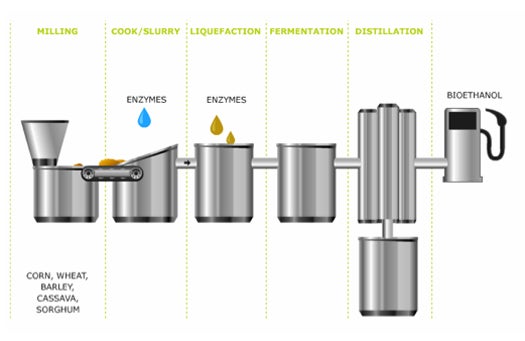
Producing a biofuel cheap enough to compete at the pump with oil has remained as elusive as a ghost on the walls of Elsinore castle. But this week, two Danish companies announced they had developed enzymes capable of breaking down cellulose into ethanol cheaply enough to produce $2-a-gallon gas.
The two companies, Genencor and Novozyme, both announced different cost-cutting enzymes at the 15th Annual National Ethanol Conference in Orlando, Florida. Obviously, the exact recipe of either enzyme remains a proprietary secret, but the fact that both multiple companies came out with cost-cutting enzymes at the same time represents a larger shift towards affordability in the ethanol market.
One of the major complaints about alternative energy is that their high price wards off consumers who can't afford to switch, and unnecessarily punishes those who do. By lowering production costs, this advance could help make biofuels as affordable as they are sustainable.
Five amazing, clean technologies that will set us free, in this month's energy-focused issue. Also: how to build a better bomb detector, the robotic toys that are raising your children, a human catapult, the world's smallest arcade, and much more.


Online Content Director: Suzanne LaBarre | Email
Senior Editor: Paul Adams | Email
Associate Editor: Dan Nosowitz | Email
Assistant Editor: Colin Lecher | Email
Assistant Editor: Rose Pastore | Email
Contributing Writers:
Rebecca Boyle | Email
Kelsey D. Atherton | Email
Francie Diep | Email
Shaunacy Ferro | Email
chalk one up for switchgrass.
but TWO Danish companies were able to come up with this solution? does the US have *any* scientists who don't work for Apple?
mclean
Isn't it great that the Republicans and American corporations don't control everyone. They've turned us American's into wimpy punks that can't stand up to them, but at least there are our ancestors who still have their balls and push on past them.
Hopefully the new enzymes will be ready and available by summer. When I'm mowing the grass I can just dump the grass in a bucket presto chango dump the gas back in the mower and keep going. I know not that simple but still cool.
I suppose the comment above means republicans are in it for big oil and will stop anyone from stopping big oil? If it makes you feel any better Obama gave 2 billion in tax dollars to start a new oil drilling rig off of the pristine coast of Brazil, coincidentally of course coowned by a billionaire huge democrat contributor. Coincidentally of course. Here's another one, one of the UN's biggest promoters for cap and trade in fact made mountains of money off of, you guessed it oil. I'm thinking that the plan is up the price of oil, blame it on cap and trade, then also sell carbon credits with cap and trade :double, triple, quadruple your money for the same amount of limited resource. That's a nice trick, I guess they didn't get to be billionaires by being stupid.
So unfortunately their is no clean or green party dems, repubs, and every other party in the western world all has big money everything's fingers in them. Don't just blame one party it's all of them. Parties are a necessary evil I suppose, just don't forget the word that comes after necessary.
It is still ethanol though, and last I heard the mixed ethanol at the pump was slightly better than 1/3 the efficiency of the regular unleaded. Meaning, until the price is somewhere around 1/3 of regular gas, it still isnt economical.
Though they could always try to lure the uninformed.
I can't say that I support this technology. While the accomplishments of the Danish researchers is notable, it is not beneficial to society as a whole because their method of fuel production competes with the food supply. Whenever wheat is taken out of the food supply to fill up your gas tank its going to cause the price of all wheat-related products like bread, to increase. Thats not acceptable because inflation is already causing havoc on food prices and food supplies are shrinking relative to population growth. This method of fuel production is trading one evil for another, and that doesn't do anyone a bit of good.
What we need is fuel that does not compete with any existing markets. I'm just speculating here but can't algae be a food/energy source for some other kind of bacteria? And isn't algae fairly easy to produce in mass quantities, and such production has little--if any--impact on other markets? Algae is a better energy source than wheat.
My guess is that this tech would ramp up production enough to delas the pinch of post-peak oil declining. The barrels of oil it saves will actually be barrels of oil replaced due to reduced production.
As is, biofuel is not a renewable or unlimited resource. It takes land, a limited resouce, and transforms it into energy. At best, land is a solar plant turning CO2 to solid state energy. At worst, it merely transforms fertilizer into fuel.
How many acres will it take to fill up a car for a year? See what I mean? Yes, using biofuel to transform current bio-waste into fuel is great, but will not scale to the level of a replacement fuel source.
And to powq33's point, ethanol doesn't have the same energy density as gasoline. While it burns cleaner, it also burns faster which means you'll be filling up more frequently which means even more pressure on the food supply.
Switchgrass is an option too, but I'm not sure it's plentiful enough to meet the energy demands of the US in a meaningful way.
lawsonrw,
The story clearly states "enzymes capable of breaking down cellulose into ethanol".
The use of cellulose would imply the use of food production by products. Like the stalks the head of wheat grew on, rather than the wheat itself. This may in fact lower the price of items like wheat now because the field of wheat will produce to income streams for the farmer, one from food, and one from biofuel production.
@lawsonrw:
your point, while a good one, assumes that agriculture is already devoted to producing food. However, corn is the bumper crop of the US Midwest and most of it is wasted. it's super-refined into fructose, re-engineered into plastics, and the rest is fed to cattle.
crops like switchgrass and sugarcane also drastically reduce the land required (compared to corn). and genetically engineered versions would only improve the situation.
----
as for everyone else: flex-fuel vehicles only use 85% ethanol, and while it is a higher-octane fuel (fewer mpg), combining it with even basic hybrid engine technology puts it on par with most standard vehicles, and drastically cuts down on carbon emissions and carcinogenic exhaust.
To people who complain about corn maybe being used for biofuel and driving up food prices: Most corn in the US is used to make corn syrup. This is less tasty, less healthy, and more expensive than cane sugar. The government imposes heavy taxes on the importation of cane sugar to protect corn farmers. If the corn farmers started making biofuel we could stop protecting them from cane sugar and have cheaper, more healthy, and better tasting food.
powq33- you seem to be one of the uninformed. I'm not sure where you're getting your number but 1/3 the amount of energy of gas? Thats pretty low. It seems like "the uninformed" lower the energy content of ethanol every day. It sure seems it would be difficult for the Indy racecars to reach the speeds and torque they do on ethanol (yes, Indy uses 100% ethanol in their cars) if it only contained 1/3 the energy of gasoline. The truth is that ethanol contains less btu's per gallon than gasoline. However, it has a better octane rating. So by modifying your engine (like the engine maker Ricardo is) you can use higher compression ratio's to get closer to a diesel like efficiency. The fact that ethanol works in engines fine tuned to gasoline is nice, but calibrate that engine to run on ethanol and you've got more hp and torque. Maybe its not the fuel thats inferior, its the engine.
Switchgrass can grow on marginal land not useful for other types of farming. Think of it as a weed rather than a crop. This enzyme and others like them have been being developed to turn waste cellulose into fuel. It won't compete with food, we can already turn corn and sugar into ethanol easily, moon shiners have been doing it for a long time. Picture your old christmas trees, grass clippings, tree trimmings, leftover unrecyclable paper products etc. all being turned into fuel.
The breakthrough isn't the enzyme's we've had those since armed forces slogging through the jungle had their clothes rot off of them and they discovered the causal enzyme. The breakthrough is the price, producing those enzymes have always been too expensive.
Attaboy ajohnson1986! you tell 'em... it's gasoline that is a poor quality mixture of stuff that the oil companies threw together to get rid of their waste products while Rockefeller demonized the moonshiners that were providing sustainable fuel from waste crops...Henry Ford spoke out about big oil first! Please read David Blume's "Alcohol CAN Be a GAS" it is eye opening, just 30 years late...
One thing to remember is ethanol creates more ozone precursors when burned than gasoline (green.autoblog.com/2009/12/16/burning-ethanol-creates-more-ozone-than-gasoline-worse-in-winte/) .As well,using so-called "waste" plants like switchgrass overlooks the fact that even weeds serve to revitalize the soil when they decompose in place.
I think the future of biofuels is in algae,which can yield jet fuel/diesel/gasoline which can be used in unmodified engines.All that is needed is ample sunlight and ideally a source of CO2,such as a powerplant exhaust.See blog.valcent.net/?tag=algae-for-biofuel
i agree that algae does hold great promise, and will hold great promise for a while.....but the most favorable numbers I saw last for production costs of algae oil was around $30 a gallon. The problem is separating out that algae from the water in a cost effective way. If a better way to extract the algae from the water can be found it would be great. But until that day comes there is ethanol, right now. As for the study about the ethanol creating more ozone precursors I remember reading that it was creating aldehyde's which shouldn't be making it past the catalytic converter in large amounts unless it is broken. Also, according to the study the amount of ozone related particles create by the ethanol were 7 parts per BILLION higher in warm weather and 39 part per BILLION higher in cold weather. Thats pretty small. Also, compare one health hazard to the laundry list of hazardous chemicals that make up the chemical soup that is gasoline. I'll list a few, benzene, toluene, xylene, and about 150 others. I'll take 7 ppb exhaust any day over that.
Sorry to rain on your parade,ajohnson1986,but check out this story I just found: www.sciencedaily.com/releases/2005/07/050705231841.htm
that would be horrible news Newbeak5 if it wasn't so outdated already. Since his original paper was shown to use data from the 70's, and some wild assumptions (like factoring in the sunlight used to grow the corn as an input energy) and the fact that he's a Professor of Insect Ecology, no experience what-so-ever in biofuels until he wrote his wildy discredited paper, I'm not too worried about my parade. Any current papers show the energy balance to be in favor of ethanol to the tone of 1.67 units of energy produced for every 1 unit input. This has been confirmed by both the USDA and Argonne national labs. There have also been confirmations of a net energy gain published by Iowa State University and Minnesota State University. Basically every other study except Pimentel's shows a net gain.
There's another potential biofuel crop that no one in the comments has mentioned - hemp. Hemp can be grown on land where food crops can't, so it would provide no competition. (And for the record, I am talking about industrial hemp, not marijuana.)
At least one of these Danish companies clearly stated that its technology would require the use of the corn's grain along with its stover (woody waste,) to make ethanol. So, their technology still involves turning food into fuel, to the detriment of the world hunger problem - one billion people hungry, at latest UN count. Neither fuel nor plastic should be made from food until there are NO hungry people on our planet. Plastic can be made biodegradable without making it out of food. See: earthnurture.com