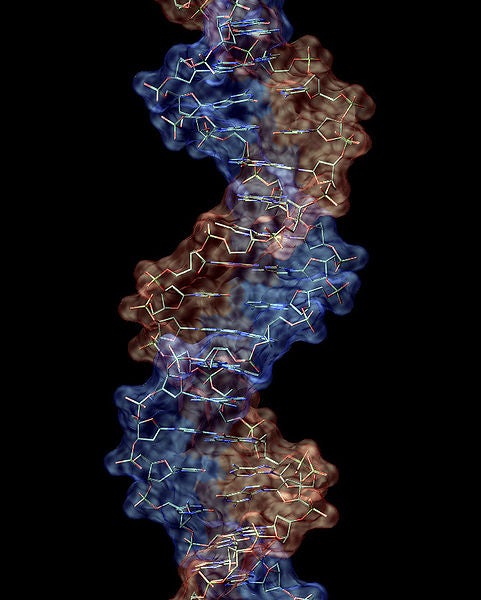
Much like your four-year-old nephew, RNA can only read three-letter combinations. Called codons, these three DNA-base-pair groups form the phrases that RNA translates into the 21 amino acids that underlie all life. But now, University of Cambridge researcher Jason Chin has engineered more literate RNA, capable of reading codons composed of four base pairs. This expands the possible number of codons from 64 to 320, and opens the door for a whole new line of artificial amino acids.
So far, Li and his team have only assigned amino acid identity to two of the 265 new codons. However, when integrated into protein comprised of naturally occurring amino acids, the artificial acids bonded to the natural amino acids as if they had come from one of the 64 original codons.
By expanding the vocabulary of DNA, Li and his team also expand the range of possible compounds a cell could produce. Want your genetically engineered bacteria to start churning out new polymers or species drugs? Modifying the size of its amino acid library could allow it to do so at far less trouble and cost.
Five amazing, clean technologies that will set us free, in this month's energy-focused issue. Also: how to build a better bomb detector, the robotic toys that are raising your children, a human catapult, the world's smallest arcade, and much more.


Online Content Director: Suzanne LaBarre | Email
Senior Editor: Paul Adams | Email
Associate Editor: Dan Nosowitz | Email
Assistant Editor: Colin Lecher | Email
Assistant Editor: Rose Pastore | Email
Contributing Writers:
Rebecca Boyle | Email
Kelsey D. Atherton | Email
Francie Diep | Email
Shaunacy Ferro | Email
This is the coolest thing invented since mass producable graphene! Lets throw it in something and see how well it adapts to the new options.
Actually... Ribosomes read the RNA. mRNA to be specific. Thought you people would want to know.
RE: dontbother
Yeah, I was sitting here thinking "Awesome, but why doesn't this article make any sense?"
Ribosomes!
to put the complete science in, Ribosomes do not read the RNA.
The DNA is translated into an RNA complamentery strand. Ribosomes then recieve that RNA, and facilitate the reading of that RNA strand by the mRNA.
mRNA are strands of RNA with amino acids attached. There are specific mRNA that carry a certain one of the 20 amino acids. The mRNA each have three codons sticking out. The RNA from the DNA is read by the mRNA getting matched up properly, 3 nucleotides at a time, and delivering their amino acid. A chain of amino acids arise as mRNA reads the RNA strand one codon at a time.
search on youtube for a complete explanation, since they don't like links here.
My comments are the following: Sweet! Useless at the moment, but potentially a very big thing, once we figure out what to do with it. biofactories with synthetics could prove quite useful, as cell as the most readily available molecular construction devices.
My question is this, how do the potential number of differentiable codons go from 64 to 320? A codon is made of a line of three nucleotides, that can each be A C T or G. Four possibilities for each nucleotide. 4 * 4 * 4 = 64 possible codons.
With the addition of a fourth nucleotide, 4*4*4*4 goes to 256, not 320. Is there additional distinction added with the fourth nucleotide of which I am unaware?
320 = 256 + 64. That implies that 3-codons and 4-codons can coexist, but I'm having trouble imagining how any such genetic code could be "read" reliably. How could it be determined if GATTACA is GAT + TACA or GATT + ACA?
Pharma is still getting their money. Drugs will still be unaffordable.
@brian144
DNA is translated by RNA polymerase into single stranded mRNA (messenger RNA) and tRNA (transfer RNA) "reads" the codons.
Re:brian144
I'm sorry but I going to have to say that both you and popsci are wrong on this one.
mRNA is complimentary to DNA. It is the "Code" that the Ribosomes use to make proteins. When the mRNA gets to the ribosome, the ribosome "reads" the first "codon" mRNA. Then, tRNA, the type of RNA that holds one of the 20 amino acids, comes to the ribosome and binds to the mRNA - the tRNA that comes to the ribosome has a complimentary "codon" to the one on the mRNA. Then the ribosome "reads" the next "codon" and a new tRNA comes with a second amino acid. The two amino acids are bound together through dehydration synthesis and the resulting strand is disconnected form the first tRNA (and is still bound to the second one) The first tRNA then leaves and the Ribosome moves down the mRNA by one "codon". This process is then repeated until the Ribosome encounters one of the 3 stop "codons".
Quite correct, sorry. the tRNA facilitates the reading and carrying of amino acids. mRNA is the result of transcription. Sorry for the mistype.
and @old-scratch, your sad notion that pharmacies gain patents to completely gouge customers is well, sad.
The reality of the situation is that, about 10 years of work goes into a drug. Developing it, testing it, getting it certified, and getting a patent is INCREADIBLY long, arduous, and expensive, because our government makes sure drugs are held to a high standard. As a result, once a company spends 10 years and often tens or hundreds of millions of dollars to get from scratch to the market, they get about 7 years of exclusive manufacturing rights in order to regain how much they invested in the drug.
The cost of manufacturing the drugs is paultry, which is why medicine is (relatively) cheap. The cost of developing, refining, and certifying it however, necessitates the giant prices while the patent holds. So take your pick, you can have expensive patented drugs, or you can buy snake oil at every market. take your pick.
Third option though is to refuse to help the company recooperate their loss, but then pharmesudical research would become unprofitable, no one would do it, and many diseases, aches, and pains will go without relief. Try being a bit more open minded than "I want this, I want it cheap, I'm getting ripped-off"
@ZenSkeptic
you might be right, the guy could have added the current three codon codes to the four codons codes for 320, but I agree that that seems impossible. An extra marker of some sort would have to be added so that four-codon and three-codon are not misread. It seems to me impossible, or imprctical for both kinds to coexist in a cell.
256 new codons in a 4-bp environment would not be able to coexist with the 64 codons we learned about in high school. this does not mean that 4-bp codons cannot coexist, but full use of that codespace would be genetically impossible. However, certain 4-bp settings are highly usable by taking advantage of the degeneracy of DNA and using lower frequency combinations of high degeneracy amino acids. this would produce a slight error margin, but the errors would be minimal. Good Candidates for conversion include: TAAN, TGAN, TAGN, AGNN, CGNN, CTNN, CCNN, etc. However, for lower errors and higher degeneracy, AGNN, CGNN, CTNN, CCNN should only include AGXN, CGXN, CTXN, CCXN with X being either R or Y. R is either A or G, whilst Y is either C or T, at least when refering to DNA.
320 = 256 + 64
is achieved by the coexistence of two ribosomes the old 3-Codon and the new ribosome called Q1.
So some junk will be produced when mRNA codons are mismatched to the wrong ribosome. But with some clever resequencing this can be overcome as well.
The cost of manufacturing the drugs is paultry, which is why medicine is (relatively) cheap. The cost of developing, refining, and certifying it however, necessitates the giant prices while the patent holds. So take your pick, you can have expensive patented drugs, or you can buy snake oil at every market. take your pick.
www.promdresspicture.com
C'est la meilleure chose inventée depuis graphène producable de masse! Permet de le jeter dans quelque chose et voir comment il s'adapte aux nouvelles options.
www.autonewstoday.net
Oikeastaan ... Ribosomit lukea RNA. mRNA erityiseksi. Luulit ihmiset haluavat tietää.
www.auto-update.biz
www.auto-update.org
www.AUTO-VEHICLE.NET
www.thaicarnews.com