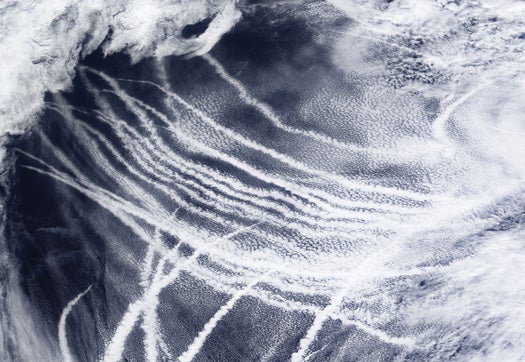
The International Maritime Organization, which oversees the shipping industry, will begin enforcing rules this July that mandate cleaner fuel to cut air pollution and acid rain. Ironically, this eco-motivated change will undo one of our strongest, if accidental, defenses against climate change.
The regulations call for reducing the sulfur in shipping fuel—which is basically unrefined petroleum sludge—from 4.5 to 0.5 percent by 2020. Scientists project that this switch will cut sulfur-pollution-related premature deaths from 87,000 worldwide per year to 46,000. But the sulfate aerosols spewing from supertanker smokestacks also produce planet-cooling clouds called ship tracks, which form when water droplets coalesce around sulfate particles. These clouds, which are big enough to be seen from orbit, reflect sunlight back into space, preventing the equivalent of up to 40 percent of the warming caused by human-produced carbon dioxide. “The IMO has done a good job addressing air-quality issues,” says Daniel Lack, an atmospheric scientist at NOAA. “But there’s a climate impact that wasn’t necessarily considered.”Worse, the fuel switch won’t improve ships’ carbon emissions—if the industry were a country, it would be the sixth-largest CO2 emitter. The IMO plans to regulate CO2, but until then, it might be best to leave well enough alone.
138 years of Popular Science at your fingertips.
Each issue has been completely reimagined for your iPad. See our amazing new vision for magazines that goes far beyond the printed page
Stay up to date on the latest news of the future of science and technology from your iPhone or Android phone with full articles, images and offline viewing
Featuring every article from the magazine and website, plus links from around the Web. Also see our PopSci DIY feed
Science is reinventing play, from extreme sports to gamification to ridiculous roller coasters to the playgrounds of tomorrow, and this issue is chock full of fun. Also, on a less fun note: Did global warming destroy my hometown?
In 2000, over 400,000 people died globally from drowning. By the logic of the International Maritime Association, shouldn't we then limit the amount of water in the environment so fewer people die?
Of course my point here is to illustrate that you simply cannot adequately protect all of the people all of the time, and governments and organization which attempt to do so run the risk of various unintended consequences, such as economic and environmental damage and infringement of personal freedoms.
Perhaps those with breathing problems should avoid the shipping lanes and take measures to protect themselves, just as we would expect a person who doesn't know how to swim to wear a life preserver. In other words, exercise a little personal responsibility and quit expecting the government to save you. You may just save a lot more than your physical safety.
And as an added bonus, the people that don't exercise a little personal responsibility are helping to solve the growing probelm of overpopulation!
something to consider in terms of global climate change. We call the gases in the atmosphere that trap heat, "Greenhouse gases". These things are gases like CO2 and CH4. But consider the name "Greenhouse gases". What is the function of a greenhouse? what can countries with warm, humid climates do year-round? They can grow lots of crops because the warmer climate is better for plants, and you can't complain that warmer climates are uninhabitable for humans, because people manage to live in deserts, where it's plenty warm.
If the planet were to get warmer, life would continue without problems, it's just a bunch of hype that the media, and government, has made to make a profit.
though I see nothing wrong with reducing emissions, and consumption, I just don't think we should take rash actions, and further damage the economy with harsh regulations.
The problem with climate change is that plants and animals often have limited ranges. They can change their range over time and they do, but with the speed of the climate change a number of species could be lost with the shift of conditions that support their life. So, yes, life would continue and a balance would come, but there is the danger of significant biodiversity loss with climate change.
This would be a huge mistake, because global warming became an issue after sulfur was removed from our car emissions. This solved the acid rain crisis, but caused the global warming crisis and carbonic acid crisis in exchange. The data on global warming due to deforestation verses removal of sulfur, favors sulfur. There were two eras of massive deforestation that of Europe after the middle ages, and the settlement of the Americas. Both deforestations are neglected in the records of global warming, so it must be concluded that deforestation is a week cause of global warming.
The way we caused global warming is absolute proof that we can solve it, by temporarily putting the sulfur back in the atmosphere until new alternate fuels are developed. But, put the sulfur back in a smart, networked GPS precision way. I would put the sulfur back in aircraft contrails with networked downloads and GPS timing. This puts it in the atmosphere with the best size particulate to protect melting glaciers, without using additional fuel, carbon emissions, and outrageous costs. It can also be used to make long term cool spots in the path of hurricanes to redirect them, reduce the size and impact of them on large cities. Close to cities with large numbers of flights and population we can use hydrogen instead of sulfur to increase the vapor clouds of contrails to cool with out increasing acid rain.
ahah! I just got done writing a problem/solution paper on overpopulation. I missed that solution though...
Sad.