It has long been thought that prions can't evolve. Turns out they can
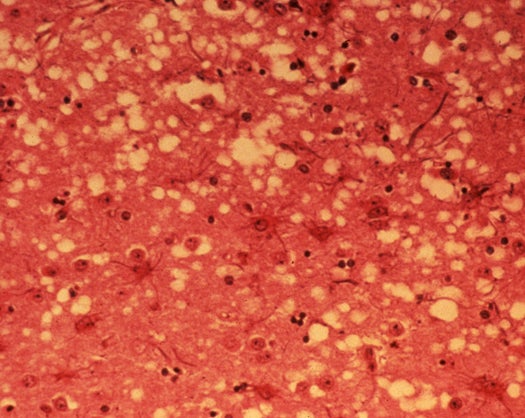
Mad Cow Disease Bovine Spongiform Encephalopathy causes tiny holes to form in the gray matter. It's enough to drive anyone mad. Public Health Image Library, APHIS

Scientists from the Scripps Research Institute have discovered that prions -- tiny infectious bits of protein that can cause deadly neurodegenerative disease -- are capable of evolution. While that might not seem groundbreaking, here's the thing: while prions evolve by Darwinian, naturally selective processes, they are completely devoid of DNA and RNA.

Mammals produce the normal protein cousins of infectious prions as part of normal cell development, but during infection, misfolded or warped proteins can convert normal host prion protein into its own toxic, misfolded form. When this happens enough times, massive tissue and cell damage can occur. Infectious prions are linked to a number of fatal and untreatable diseases in humans and other animals, including mad cow disease and its rare human equivalent.

While prions have no nucleic acid genome component -- DNA or RNA -- they can reproduce. But previously it was thought that they could not evolve akin to other organisms like bacteria and viruses. As it turns out, the Scripps Florida team found that multiple mutations at the protein level can bring about such naturally selective adaptations as drug resistance, the characteristic that makes some viruses so difficult to effectively eradicate (see: malaria).

But while the idea of drug-resistant prions sounds universally bad, the findings also bear a silver lining: by zeroing in on non-infectious, normal prion protein, researchers might be able to leverage this characteristic into better therapeutics for existing untreatable prion-caused diseases. Since infectious prions need their normal cousins to feed their own replication and evolution, therapies that limit the supply of normal prion proteins could essentially starve the degenerative cycle that makes those illnesses so effective at killing their hosts.

[Science Daily]

11 Comments

check out this research group you can help if you have a computer www.rosetta@home

....ooooooo..... zombies

Ed Gehrman,
The comments I made were not spam. I'd like them posted please.
Ed

My understanding was that prions are mostly found in animal brain tissue from animals that have been cannibalizing each other. Mad cow disease (bovine spongiform encephalopathy or BSE) was suspected to have been caused from cows being fed cows.

But I did, after a little homework, find that people can just be born with affect genes that mutate into prions.

Creepy still, I found a web site that proposes human cannibals could hold a clue to prions due to their immunity to BSE.

www.nhs.uk/news/2009/11November/Pages/brain-eating-cannibals-CJD-mad-cow-disease.aspx

Ben tebrik ve teşekkür ederim başarılar dilerim sistem gerçekten güzel ve yararlı bilgiler var

Apparently, since nothing in biology makes sense except in the light of evolution, we will make sure that we apply it to every aspect of biology. There is certainly merit to seeking variations of normal proteins that are resistant to the misfolding process of prion creation, but why must we describe prion mutation in terms of Darwinian evolution? At the very least, since they lack genetic material, wouldn't these changes be more akin to a blending of Lamarck's inheritance of acquired characteristics, with Neo-Darwinian evolution? Selection for more aggressive forms is apparent, but the differences in prion activity seem to stem from acquired traits, certainly not genetic traits (prions have no nucleic acid!)
Also, it seems like we should think more about the mechanism here:

"In the first part of the study, Weissmann and his colleagues transferred prion populations from infected brain cells to culture cells. When transplanted, cell-adapted prions developed and out-competed their brain-adapted counterparts, confirming prions' ability to adapt to new surroundings, a hallmark of Darwinian evolution. When returned to brain, brain-adapted prions again took over the population." (from the linked ScienceDaily article)

Perhaps the reason that cell adapted prions out-competed in cell cultures is because after a native protein in the cell culture is mis-folded, it can mis-fold its peers faster than the brain protein. Likewise, a brain derived prion, in its native environment (the brain) can find more proteins of its own ilk to deform.

I just feel that our culture and the scientific community are too quick to jump on the "Darwinism" bandwagon. It's good to find support for a solid theory, but does it do the theory any good to be buttressed by loose ideas without good mechanisms proposed? To support a paradigm with poor evidence is evidence of a poor paradigm.

billdale

from Los Angeles, CA

A recent study shows that radiation from cell phones can protect the brains of lab animals from the effects of Alzheimer's disease. I hope they try some out-of-the-box solutions to the bad prions-- perhaps the same radiation frequency, other frequencies, or perhaps magnetic fields that have been shown to alleviate the effects of depression.

Cell phone radiation was suspected of causing brain tumors, but no study has ever shown that to be the case. Millions of people use cell phones... in a large population, you'll always find some cases of brain tumors. Those that use cell phones and that get brain tumors, particularly those that have tumors on the same side of the brain as they hold their cell phones, can be expected to try to blame their tumors on their radiation exposure, but anecdotal information like this can be very misleading. We should not assume that anything "natural" is always better than something that is not-- we should let evidence tell us what is good and what is not.

Another article appearing currently in PS shows that there is a difference between organic chicken feed and ordinary chicken feed in its effect on the chicken's cholesterol... we cannot assume that even though there is a difference, that the organic feed is better-- we need to actually see what the differences are, and which ones prove to have the healthiest effects on our livestock, and on our own health.

Malaria isn't caused by a virus - it is caused by protozoans (4? species of the genus Plasmodium).

"In the first part of the study, Weissmann and his colleagues transferred prion populations from infected brain cells to culture cells. When transplanted, cell-adapted prions developed and out-competed their brain-adapted counterparts, confirming prions' ability to adapt to new surroundings, a hallmark of Darwinian evolution. When returned to brain, brain-adapted prions again took over the population." (from the linked ScienceDaily article)
www.promdresspicture.com

«Dans la première partie de l'étude, Weissmann et ses collègues transférés populations prion à partir de cellules cérébrales infectées à des cellules en culture. Lorsque transplantés, les cellules adaptées prions développés et hors compétition de leurs homologues des cerveaux adaptés, confirmant la capacité des prions à s'adapter aux nouvelles environnement, une caractéristique de l'évolution darwinienne. Lorsque retourné le cerveau, le cerveau adapté prions encore une fois pris sur la population. " (À partir de l'article lié ScienceDaily)

www.autonewstoday.net

Ymmärrykseni on, että prionit myydään lähinnä eläinten aivokudokseen eläimistä, jotka on cannibalizing toisiaan. Hullun lehmän tauti (BSE eli BSE) epäiltiin johtuneen lehmistä ruokitaan lehmiä.

www.hotcarz.net
www.PARKCARZ.COM
www.thaicarnews.com


138 years of Popular Science at your fingertips.

Innovation Challenges


Popular Science+ For iPad

Each issue has been completely reimagined for your iPad. See our amazing new vision for magazines that goes far beyond the printed page


Download Our App

Stay up to date on the latest news of the future of science and technology from your iPhone or Android phone with full articles, images and offline viewing


Follow Us On Twitter

Featuring every article from the magazine and website, plus links from around the Web. Also see our PopSci DIY feed


February 2012: The Future of Fun

Science is reinventing play, from extreme sports to gamification to ridiculous roller coasters to the playgrounds of tomorrow, and this issue is chock full of fun. Also, on a less fun note: Did global warming destroy my hometown?


circ-top-header.gif
circ-cover.gif