The World's Largest Solar Powered Office Building (For Now)

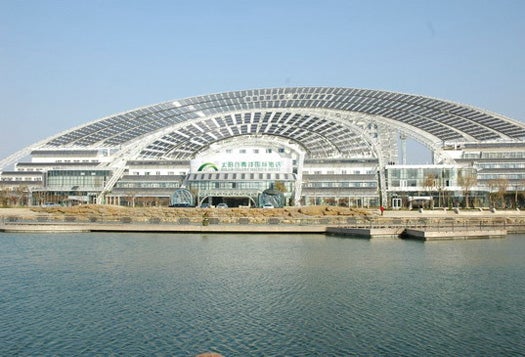
China, constantly straddling the line between super-polluter and clean tech pioneer, has unveiled what for the time being is the world’s largest solar-powered office building . The fan-like roof of the 800,000 square-foot facility located in Dezhou in Shangdong Province was cleverly designed to resemble an ancient sun dial, though rather than ticking off the passing hours, the building houses exhibition centers, research facilities, meeting and convention spaces and a hotel, all of which are powered by the hundreds of solar panels adorning its roof.

A lack of fossil fuel burning indeed makes the building decidedly green, but it’s architecture hides several other energy- and resource-saving innovations like advanced wall insulation and roofing that help trim 30% its energy consumption compared to the national average. And while massive, the external structure actually uses 1% of the steel that the People’s Republic poured into the Bird’s Nest for the 2008 Summer Olympic Games.

Masdar City's Energy-Positive Solar HQ:
Of course, it would be folly to think that China will hold the title of “world’s largest solar powered building” for long with Abu Dhabi just getting underway on its much-ballyhooed Masdar City in February. The centerpiece of the $22 billion development–the world’s first sustainable city–will be a 1.4 million square-foot solar building that is energy positive; that is, it will actually produce more power than it needs.

That’s all assuming, of course, Abu Dhabi doesn’t go broke in the meantime. Masdar City won’t be complete until 2016, but Masdar’s solar HQ is part of phase one of the process and should be complete by the end of next year.

[China.org, Metaefficient]

17 Comments

Masdar city--22 billion square feet!? and energy positive? Crazy.

The solar powered building in Masdar City at 1.4 million square feet and $22 billion seems extremely pricey. That's over $15,000 a square foot just for construction. I think $22 billion is the cost of the entire Masdar City project and the solar powered building itself is $300 million of it.

China should start spending there own money on projects for the rich instead of having other countries pay for it.

USA should play catchup and build The World's Largest Solar Powered prison facility =)).

What do you mean catch-up? Where are all the highways/paved roads in China? Did I miss something? When did the US fall behind China?

And China is still considered a developing nation?? What the Hell is America considered with its low grade fossil technology? America should get its head out of the WAR bank vault and spend that war money on catching up to the rest of the world's advanced technologies. Oslo already has 4G communications and we are barely into 1G. The Bush war administration really got this country dumbed down to a third-world status. Great going, you stupid war mongering bastard.

I still cannot figure out why desert areas are used and developed into Solar farms

www.youtube.com/watch?v=YFvWgAAgOO0

@laurenra7. a fine editorial eye you have. indeed, the development is $22 billion overall, not the building alone.

@JamesDavis

My apologies but you are aware that 1G means first generation as in first generation analog cellular technology from the seventies, and eighties.... I believe you mean we are just barely obtaining 4G as in fourth generation technology...even so we have still had 3G access for about 10 years now. That and finally last time I checked cellular technology is not government controlled so I don't understand your erroneous blame on Bush. Im not saying I supported the guy just he is not to blame for this.

This is a great step forward for China, I would like to see the US follow suit. I remember an article from pop-sci a few months ago in regards to highway windmills sidewalks that generate electricity from the energy of walking wave farms and the such.

lol political talk rofl

it looks like the solar panel buildings in appleseed

@ James

You should also take note that China has only a few places where G3 can be obtained, where in the us G3 is in pretty wide usage, even in the country. If you go to farm areas in China you would have to use a satellite phone in order to get coverage.

Actually Justin, there is government regulation in cellular development. However, it is mostly for the benefit of advancement, not as James suggests. Example. With the Sprint-Nextel merger the FCC and DoJ set conditions requiring new wireless technologies be deployed within a certain time frame. I will agree that the US wireless infrastructure is moving along just fine. Granted, it's profit driven, but money makes the world go 'round.

O ya. How can you spend that much money on a sun dial that doesn't work?

thanks great pst

Solar cells do not and have never produced more energy than it took to create them. I wish someone would talk to real engineers that work at PV production companies. They seem to know that creating PV cells takes a lot of energy. More than will ever be produced by the cells. Places that have hydroelectric are good places to put PV plants but energy was needed to obtain all the raw materials (fossil fuels). Energy is only being transferred by using PV cells.

There is always a down side to building such a large space. I cannot imagine the production costs and the energy used to build this amazing piece of architecture. Is it sustainable and worthwhile this will remain to be seen? The technology is current, but as with everything humans produce, we abuse it and often cause the redundancy that in turn promotes further exploration and research for improved materials.

www.appliedworkplace.co.uk


138 years of Popular Science at your fingertips.

Innovation Challenges


Popular Science+ For iPad

Each issue has been completely reimagined for your iPad. See our amazing new vision for magazines that goes far beyond the printed page


Download Our App

Stay up to date on the latest news of the future of science and technology from your iPhone or Android phone with full articles, images and offline viewing


Follow Us On Twitter

Featuring every article from the magazine and website, plus links from around the Web. Also see our PopSci DIY feed


February 2012: The Future of Fun

Science is reinventing play, from extreme sports to gamification to ridiculous roller coasters to the playgrounds of tomorrow, and this issue is chock full of fun. Also, on a less fun note: Did global warming destroy my hometown?


circ-top-header.gif
circ-cover.gif
bmxmag-ps