Simple organisms pave the way to the hydrogen-fueled future
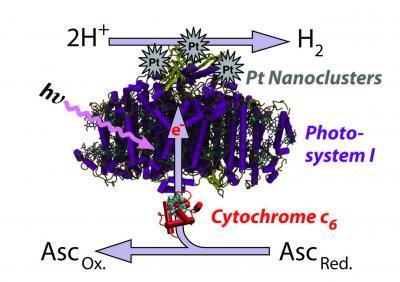
Creating Hydrogen From Algae By isolating the photosynthesizing parts of a certain thermophilic blue-green algae and catalyzing it with light and platinum, researchers have produced clean, sustainable quantities of hydrogen that could one day power our cars and reduce America's dependency on foreign oil. Barry D. Bruce/University of Tennessee, Knoxville

Algae get a lot of airtime as a possible future source of biofuels to wean us from dirty fossil fuels, but even biofuels don't go so far as to eliminate hydrocarbons (and their constituent carbon emissions) from our energy diet. But a different use for algae could prove a better solution to the future of fuel.

A new process that produces clean, sustainable hydrogen from photosynthesis in algae could change all that. The means of manufacturing clean, usable hydrogen has heretofore required a high-energy process that drastically dilutes the upside.

Researchers at the U. of Tennessee Knoxville and Oak Ridge National Labs found that in certain algae, the cellular workings that carry out photosynthesis can be coaxed into producing a clean, steady supply of hydrogen when exposed to light and a platinum catalyst. As far as bang-for-buck is concerned, the novel process could be a boon; compared to biomass sources of ethanol and biodiesel, the process turns out a much larger quantity of fuel with a much smaller energy input.

Previous efforts to produce hydrogen from algae were stymied by the high temperatures that exist in large sunlight-trapping systems, which render the process slow and inefficient. But the researchers found that a thermophilic blue-green algae that thrives at higher temperatures will carry out photosynthesis in environments up to an ideal 131 degrees Fahrenheit. The method also cuts out inefficiencies, like the amount of time it takes a plant to photosynthesize, die and fossilize, and the relatively high energy required to cultivate and process biomass into fuel.

Researchers are now tasked with scaling the process to meet energy demands that grow daily despite the fact that energy reserves are ever-depleting. Speeding the process at which algae produce hydrogen provides efficiencies that clear a path toward a sustainable hydrogen economy where vehicles emit no greenhouse gases and America's reliance on foreign oil is trimmed to nil. That doesn't just spell a scientific breakthrough, but a much-needed shift in the way we live our lives.

[Science Daily]

15 Comments

YES! YES YES YES! Awesome news!

It's been a dream of scientist to mimic photosynthesis for years because of its high efficiency, now they seem to have found a useful way to do that. This technique is new, usually new ideas once proven is the start of something much bigger when more work is done to improve the efficiencyand cost. However that being said, it took wind energy hundreds of years to get as efficient and economical as it is today, solar energy over 5 decades...

the word that the article missed was "cheap"
i just wonder how much cash does a gallon cost?
10?
20?
30?
this is all crap
nuclear energy does NOT get enough attention, it really is the only energy source that could even possibly take over from oil....someday people will realize all these "alternative sources" will triple their energy bill, i doubt they will support any of this, be it winf solar or algea

I have to comment on the person above me. Nuclear power got its attention when it was the best solution, the amount of waste nuclear fission produces is insanely large and we would never have the the space to fit it all even for 50 years of 100% dependence on it.
I lived for 5 years in upstate NY and we got much of our energy from hydro-electric plants in Canada and the price of it was SO cheap, we also had a windfarm installed and it went down further.
Personally I hope we can figure out how to squeeze out power from nuclear fusion but that'll take probably a few decades if even. Until then combination of increasingly efficient clean energy systems as well as better planned cities and power grids will be the best we can do.
The prices of alternative energies per unit of energy go down as the technology gets better, efficiency goes up, as well as demand.

I don't know exact number, but I believe internal combustion engines are around 10% efficient. Hydrogen fuel cells coupled with high-efficiency motors are bound to be more efficient than this, making hydrogen more energy-dense and therefore more valuable than gasoline. Now if we could only solve the problems of transportation and storage, I would buy a GM Hy-wire tomorrow.

hydrogen powered fire places.

that would be fun.

hybrid cars that run on li ion, water , and hydrogen emitting algae. actually with out the water, electrolosys would take too much energy to separate o from the h.

My guess is the reason why it is not cheap is because the alge doesn't live very long or some special fluid it has to live in..

Internal combustion engine is approx 35% efficient, hydrogen as a fuel for personal vehicles is not practical due to the efficiencies of transforming into energy and the major headaches of distribution. Probably better for electricity generation at a central plant and having vehicles fully electric. Read all about it here. www.withouthotair.com

actually they do have a hydrogen fireplace. it was in the popsci magazine a while back

Sure, electricty is most efficient for motor vehicles but there is a need to produce the electricity. Hydrogen is superior because it only produces water when it burns. I hail any inovation to produce it without proceses that produce gases that hurt the environment.

I have to add that hydrogen is the most abundant element there is and never could be surpassed by nuclear. We need to, and I stress need to, find a way to harness hydrogen to build a furture for our loved ones.

Why does everyone count the cost in $$$$. Man is the only creature that sells his labor. All other creatures give their labors for the survival of the species. If Hydrogen works then use it. The cost is irrelevant to the survival of our species. Only the fact that it needs to be done for us to survive should be considered. We are just to arrogant and greedy as a species to see this and it probably will eventually lead to our civilization's distruction.

@above
Actually all other creatures give their labor for the survival of themselves and their offspring. With a strong biological drive for behaviors that will benefit others of their own kind, which works out to help themselves and their offspring, so their genes are successfully passed on. Genes aren't necessarily smart, but they are quite efficient at producing complex behaviors that help to pass those genes on.

All creatures prefer to associate and help the most genetically similar to themselves, with less resources helping the more dissimilar. Because that benefits themselves and their offspring. Any creature that deviates from that, for example helping more genetically dissimilar at the expense of themselves and their offspring would quickly disappear. Though I've never heard of a species that would willingly do that except for possibly humanity.

Hydrogen would work well as a fuel source for a hybrid car. You would still want a battery bank to recover energy from breaking and likely to juice up from home.

If, however, like a Volt, a second fuel source kicked in to generate electricity, then hydrogen makes sense.

If this process creates hydrogen more efficiently, then great. That is one step in the right direction for hydro-hybrid cars. The second is distribution.

A universal coupling system (like that for propane), would be all that requires. Yes, a high pressure volitile gas is more dangerous than a liquid fuel, but even free hydrogen in the air is rather harmless, and rises out of the breathable air quickly.

Might the "ideal" 131 deg. F. growing temperature reduce the possibility of contamination from wild strains of algae and bacteria?


June 2013: American Energy Independence

Five amazing, clean technologies that will set us free, in this month's energy-focused issue. Also: how to build a better bomb detector, the robotic toys that are raising your children, a human catapult, the world's smallest arcade, and much more.


Online Content Director: Suzanne LaBarre | Email
Senior Editor: Paul Adams | Email
Associate Editor: Dan Nosowitz | Email
Assistant Editor: Colin Lecher | Email
Assistant Editor: Rose Pastore | Email

Contributing Writers:

Kelsey D. Atherton | Email
Francie Diep | Email
Shaunacy Ferro | Email

circ-top-header.gif
circ-cover.gif
bmxmag-ps