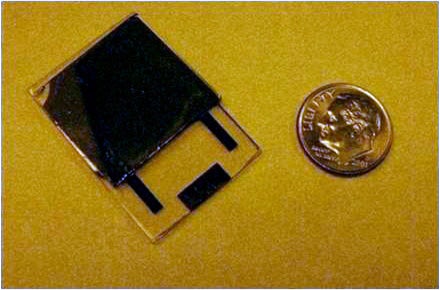
Nuclear power has long provided steady energy sources for everything from homes to deep space probes. Now researchers have begun developing a tiny nuclear battery the size of a penny that could provide power in a smaller, lighter, and more efficient package.
Most people probably think of nuclear power that involves fission and the splitting of atoms. But nuclear power can also come from the natural radioactive decay of isotopes such as plutonium-238 -- a much gentler process that has powered nuclear generators aboard spacecraft such as NASA's Cassini probe.
Nuclear batteries have also powered more familiar devices on Earth, such as pacemakers. The higher cost of the batteries represents the tradeoff for a long-lasting power source that provides more energy for its size than chemical batteries.
"The radioisotope battery can provide power density that is six orders of magnitude higher than chemical batteries," said Jae Kwon, an electrical and computer engineer at the University of Missouri.
Kwon and colleagues want to miniaturize such batteries to power micro-devices and nanotech systems. The batteries won't pose any fission-related threats, but engineers do face a challenge in preventing the radioactive decay from damaging sensitive parts of the batteries."The critical part of using a radioactive battery is that when you harvest the energy, part of the radiation energy can damage the lattice structure of the solid semiconductor," Kwon noted.
The researchers hope to get around that problem by using a liquid semiconductor rather than a solid semiconductor. Eventually they also want to boost battery power, shrink its size, and eventually end up with a battery thinner than a human hair.
138 years of Popular Science at your fingertips.
Each issue has been completely reimagined for your iPad. See our amazing new vision for magazines that goes far beyond the printed page
Stay up to date on the latest news of the future of science and technology from your iPhone or Android phone with full articles, images and offline viewing
Featuring every article from the magazine and website, plus links from around the Web. Also see our PopSci DIY feed
Science is reinventing play, from extreme sports to gamification to ridiculous roller coasters to the playgrounds of tomorrow, and this issue is chock full of fun. Also, on a less fun note: Did global warming destroy my hometown?
So this means we should be expecting cars with 100,000,000 miles per "charge?"
not quite, but the laptop witha 6 month battery life is well with reason
I think those type of applications would cost millions of dollars (even when this batteries are widely produced)!
Hah why would they put a dime in the picture and not a penny?
If it gives energy in relation to radioactive decay, it would be impossible to recharge, right?
why recharge?
it's not really a battery, it is a small bit of radioactive material contained in a curcuit that turns the radioactivity into electric, like a soler cell changes light into electric.
it will continue to produce a flow of power as long as it is radioactive.
early versions of this tech are rated at hundreds to thousands of years depending on the kind of material used.
the ones NASA uses have to work for decades, thats how long it took voyager to reach pluto and beyond and it continued to send untill they eather turned it off or it got to far away.
so 6 month battery? no! try lifetime supply soldered to the motherboard and never needs replacing or charging.
or better yet, a module you will keep year after year powering every notebook you own for you entire life.
but trust the battery companies to find a way to make us buy more :(
It is not entirely clear to me how this would work in say a laptop.
With a chemical battery the reaction only occurs when the circuit is closed. So no power is released unless it is needed.
With a radioactive 'battery' the decay rate the energy output should be constant. That leaves a conundrum, if the energy output is great enough to run a laptop then all of that energy would have to be dissipated when the laptop was off. (think abouthow hot some laptops get) The other option in to have the energy output less than that needed for operation, like a built in battery charger. This would work better but you still would need to dissipate heat when the battery was full.
This seems good for devices that perform a constant function but seems problematic for most interactive devices.
Another choice would be to just close the laptop lid and let it go into sleep mode. The power is still consumed. Or with the OLED monitors becoming more and more advanced, we don't need to turn it off at all, since the power consumption is so miniscule, that it's not worth the consideration. of course speaking in terms of atomic battery.
Hey, aren't the Lightsabers in Star Wars powered off of a compact nuclear power source?
Gentlemen, I think we've just taken our first step into a larger world.
This type of radioactive materials are produced artificially in a nuclear reactor etc.
I don't think they can be ever produced in enough amounts to power laptops and electric cars etc.
Even NASA is having really hard time now to find enough radioactive decay material for its deep space vehicles.
Does anyone else think that this could be a bad idea? ... 3 Mile Island and Chernobyl both come to mind...
Actually it is an idea that many people have been thinking for a long time, but change is slow. Base power use appliances and stuff at first, nothin computerised I think except small unix-posix, like maybe a microwave touch pad, not a laptop for a while. Houses might be next. As long as you can shield it away.
well, there again, with the new Tiny Core Linux, they'd have a good mini system manager..these guys might spawn a whole new generation of stuff. 'Never Die Doggie'
With a radioactive 'battery' the decay rate the energy output should be constant. That leaves a conundrum, if the energy output is great enough to run a laptop then all of that energy would have to be dissipated when the laptop was off. (think abouthow hot some laptops get) The other option in to have the energy output less than that needed for operation, like a built in battery charger. This would work better but you still would need to dissipate heat when the battery was full.
www.lipoaspiracao.org
Understandibly we might be able to get these into the cars, the only problems that we would be facing is the threat of an accident and the chemicals leaking out, along with sheilding the ocupants. The threat of terrorist buying a vehical of that sort would have it to use in thier IED bombs or other uses. Its a plausible idea but very controversal. If there are fail safes on the chemicals that cant be bypassed, mabye then we can get it correct. But even then for extra security, the levels could be monitered and reported, along with the condition and whereabout of it all. THose fail safe could be changes every year or so to keep hackers/theives from getting to it all, hence it may work.
I'd like to mention thats a dime next to it, not a penny.
I think it´s a bad idea, because of the radioactive material as a component of the battery. Only one accident and a second Chernobyl would happen, if the companies use these batteries in cars or other vehicle. When you look at the car accidents of the last 10 years, all our roads would be contaminated. Maybe the technology will be secure that no radioactive will come out of the battery, but where shall we "dump" all the contaminated battery parts. I don´t think that it will be stored properly. Did you know that nobody has the technology for a final storage of contaminated material? And imagine terrorist having some of these batteries and blackmail people, companies or governments. It would be a disaster. They should think of more green ideas that don´t have so many problems and don´t destroy our environment if a accident happens.
Some of you guys seem a little unclear on the power source of these things... Nuclear batteries usually use tritium, or in NASA's case, Pu238, to power their "batteries". Pu238 is NOT the plutonium used in nukes, that is Pu239, Pu238 is relatively safe, requiring only 2.5mm of shielding to protect from its radioactive emissions, and Tritium is an isotope of hydrogen, which only decays alpha and beta particles, and NEITHER of these isotopes are used in nukes. No terrorist potential there. Another point you guys seem to be confused on: NUCLEAR BATTERIES DO NOT USE NUCLEAR CHAIN REACTION LIKE NUCLEAR POWER PLANTS. Nuclear batteries use the radioactive decay of particles (usually by directly converting the captured beta particles into electricity in a process involving "betavoltaics") as power, not chain reactions like nuclear power plants (the chain reactions are the dangerous part). Nuclear batteries (aka radioisotope batteries) are almost perfectly safe! Tritium is used in hundreds of ways, youre exposed to it all the time (gun sights, watch dials, exit signs...)
You know I always knew that the world in that we live is dangerous but I didn´t know that it was so dangerous as you discribe it, Srt252. Did you know that you can make nuclear bombs with every radioactive material? And you can make every material radioactive if you bombard the material with neutrons. In a nuclear bomb you use a radioactive material wich you can fissionable very easily, so you have the maximum of fire power. If you use the batteries and stack the radioactive layers, you could build the nuclear bombs core. So there is your bomb. Oh and by the way some nuclear bombs are made out of TRITIUM. :)
think for yourself !!! :)
Guess we should recall all the gun sights, watch dials, and exit signs then before terrorists steal them all to make nukes. Oh and all those people with Pu238 powered pacemakers too, before the terrorists rip their hearts out :P (and even the radiation that leaks from those is less per year than the avg American receives naturally per year)
Oh and since you can make everything radioactive to use in fission bombs I guess you recall all the kittens in the world before terrorists turn them into fissionable materials for use in nukes. And all other matter for that instance.
Oh I´m sorry that everything is so dangerous to you. But usually terrorists don´t rip out hearts, you know. And by the way in the batteries the radioactive material is concentrated so the battery can produce more energy, so it is potentially more dangerous than hearts and if there is an accident with the battery you can´t stop the radioactivity of going through the air into your body. But every bit more radioactivity damages the DNA more and more and I think I don´t have to tell you what that is right, Srt252. Do you know how watch dials work? They use fluorescence materials that glow when you hold them for a while into the light. THEY DON´T USE TRITIUM.
WHY DON'T WE ALREADY HAVE THIS... Oh yeah, Bush and company... Well, now why aren't we starting to implement this?
false. tritium is used on watch dials. DO YOUR RESEARCH!
"Tritium paint on watches is a mixture of tritium and phospor. Tritium is naturally radio-active and needs no external source of light or charge to work. Tritium does not glow. As it decays, tritium emits beta radiation, which is a bunch of excited electrons that in turn excite the electron in the phosphor atoms making them emit photons, or light, as they return to their ground (non-excited) state: the phosphor GLOWS."
where did you get that?????????
The purpose of an OFF button is to conserve power. Once power is emitted as a constant there is no need for an OFF button for there is no need for conservation of the power source. Is this the future of disposing of nuclear reactor control rods?
And imagine terrorist having some of these batteries and blackmail people, companies or governments. It would be a disaster. They should think of more green ideas that don´t have so many problems and don´t destroy our environment if a accident happens.
www.batterydetail.com
from winlock, washington
firstly, if tarrorists want tritium they could just get it out of the ocean, secondly making a dirty bomb out of it would be rediculus.
as for computers without a off switch why not have a two part battery one half nuck other the more tradditional recahrgable, the nuck would fuel the other when not in use and the rechargable would run the compuers mor energy comsuming prosses.