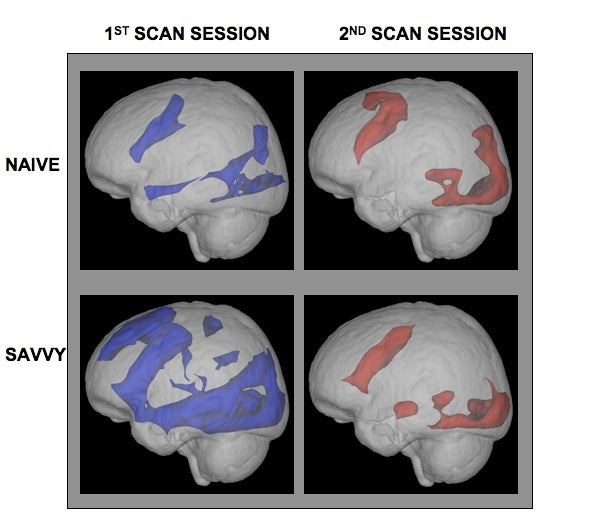
This is your brain on the Internet. Any questions? UCLA

Your grandma might think that the Internet is rotting your brain, but it's possible if she did a little face-time with Google that she could stay sharper in the noggin herself. In a new study, Internet novices who were instructed to search the web showed increased activity in areas of the brain associated with making decisions and memory in just two weeks, according to a poster presented today at the annual Society for Neuroscience conference.

The work comes from a UCLA research team including Gary Small, a professor of psychiatry, and builds off of a previous study we covered in the June issue of Popular Science. He had previously shown that people who already are using the Internet more have more activity in areas of the brain related to complex reasoning, but that study couldn't define what was cause and effect (maybe people with better complex reasoning skills are more drawn to the Internet).

The new study shows that having people use the Internet can actually change their brain function. The experiment involved 24 adults, between 55 and 78 years old. Half had scant experience on the 'net. The other, web-savvy half served as a control group. Participants underwent fMRI scans of their brains while searching the Internet, before and after a two-week Internet training period, when the participants searched the Internet for an hour a day for seven days total. When the naive group was scanned again while using the web, areas of the brain involved in decision making and working memory (things you quickly hold in your head, like a new telephone number you're about to dial) showed more activity.

"The Internet may be a form of brain exercise,” Small told Popsci.com. "Whether [the brain changes] translate to other aspects of life, we don’t know yet, but it’s certainly a possibility.”

13 Comments

This is interesting, but it makes me wonder how many more studies are going to show that this or that can stimulate brain change. Surely it's time to start focusing on which activities make for the most effective brain exercise.

The Michigan / Bern University study of last year seems to beat the rest hands down with its dual n-back working memory training, but I'd like to see a comparative study.

Martin
www.mindsparke.com

If da interwebz mak3s teh sm@rt den y doos peeps be talkin like dis?!

My mother, who has Multiple Sclerosis, actually largely credits the internet for keeping her mind sharp. Since she left work to live off of disability, she's had plenty of time to spend on the internet doing all sorts of things. She keeps her mind sharp by keeping up-to-date on medical news regarding her conditions, participates in (and even serves on the board of) non-profit organizations, plays tons of facebook games, and keeps in touch with family and friends. Compared to most people, I'd have to say that her mind is QUITE active, all day, every day. There are numerous studies out there that show that keeping your mind active is healthy and stimulating for the brain, whether you're a healthy person, or a person with a debilitating disease, or older folks who have memory problems & Alzheimer's. Because Multiple Sclerosis is a disease that directly attacks your neurons, memory loss and loss of functions is a characteristic of the disease. My mother feels that by constantly keeping active and "sparking" different memories and subjects in her brain, she is creating new connections throughout her brain to battle the onslaught of her immune system against her central nervous system. I have to say that from an outside perspective, I believe that she's completely correct and I can see how it helps her in her every day life and helps her to live a happier life.

Also, I believe the reason "peeps be talkin like dis?!" on the internet has more to do with education you're supposed to receive BEFORE operating a computer than it does experience you receive on the internet AFTER the fact. Unfortunately, our country is having trouble getting kids to learn basic English. One way or another, I also find it pretty annoying; Although, I wouldn't be surprised if they know proper grammar, but just don't give a crap about how correct they are and are more focused on expression. Could be a generational thing that teh internets has a lot to do with. I don't know. Oh, well.

synaesthee,

I think most of the time it's just for fun. I don't know anyone that writes like that when they are trying to be serious. Mostly just to goof around.

/\O
/\/
/\
/ \
LOL LOL

LOLLERSKATES!!!!!1

To REALLY learn about your brain, these are the folks who've done the most, and best, brain scans: www.amenclinics.com/ I just read Dr. Amen's "The Brain in Love" and women won't stay away! ;) He does recommend pharma...ceuticals among other things; I think we can find natural alternatives.

Well, of course the internet makes you smarter. The internet is used not only for social networking, but primarily as a source of information. More information goes into your brain - you gain more knowledge and become smarter. As far as stimulating the reasoning skills in your brain, anything you do that you have to use your brain for (i.e. reading an article on Popular Science) will stimulate your brain.

If that's the case, I am smarter than I was 6 month ago but this small research should not be conclusive. They only picked a small sample of 24 persons. I think drawing a larger sample with variant ages can yield better results and we can really say that internet sharpens one mind.
www.inspirationtext.blogspot.com

Um...I have to disagree with this study. The internet cannot..I repeat..cannot make you smarter. Smarts in general is your IQ. Your IQ. can only stay the same or go down due to dying brain cells. While the internet can make you more informed..But being informed has nothing to do with your IQ. Its is only possible that the internet can slow or pause brain cell lose...Due to stimulating the brain. So I believe this story to be false.

@cyclonexu:

The human brain has been shown to adapt and redevelop neural pathways throughout life.

I think that the conclusions drawn from this study are likely true. The more information a person takes in, the better their reasoning and judging abilities. Before the internet, this was achieved through books and newspapers. However, note that these reasoning abilities are in the context of modern western society.

Intelligence in other contexts is still provided by the intake of information, just of different types.

@borr3344:

I agree that not enough people were included in this study. Larger quantities of people should be involved, as well as different particulars as to what is being view on the internet. Does playing an MMO game have the same effect as reading news blogs? etc.

You miss the point....A person could have an off the charts IQ...and be left on an Island for their entire life isolated from all educational stimulus other than the need to survive...Thats the thing...You people don't get. IQ and acquired knowledge are not the same thing. Ok think of it like this your IQ is your processor...Acquired knowledge is your hard drive...Rain man could memorize a phone book. Steven Hawkins could not even do that....But sadly Steven Hawkins is smarter.

All you Armchair Neuro Scientists need to send your wetware back to the factory, you got gipped.
IQ and experience are intertwined.
I've had brocca's aphasia since I had my skull crushed as a child, 42 years ago. For those of you who only speak nerd-lish, that means I stutter and have trouble understanding the spoken word.
But since my brain re-wired itself, I haven't done bad. I've authored one or two of those computer languages you use. I've come up with some nifty AI's for the governemnt too.
Damaged processor, damaged hardware. Yet, I score in the top 2% of the population in a general IQ test and am off the charts with the software upgrades. I would have loved to had the internet to help. And see this development as very promising for those poor lads and lasses returning from war with their brains scrambled.

I have to wonder if it's just that the "naive" group is learning a new skill (i.e., search). What were they searching for? Did their search skills improve over that time frame? What does an fMRI look like if someone practices juggling for an hour every day for two weeks? And doesn't exercise (if the analogy can hold up) require increasing resistance over time? Is the article implying that search can increase a person's working memory? And if so, does that stop once someone knows how to effectively search?

The Sixth Sense - New GROUNDBREAKING Book in 2012! The Sixth Sense leads to Enlightenment
DNA Healing Code - Hardwired in ALL Humans

As an example of what I mean by “Groundbreaking” info that can be found in the 2012 release of my new book on The Sixth Sense (not yet titled )…..
There is a sequence required to communicate with Infinite Intelligence – to gain insight and/or much more complicated yet achievable, HolisticDNA Energy Healing. The sequence required is on multiple simultaneous levels, not just “step by step” like an instruction manual for assembling a piece of furniture.
The “Key” sequence has to do with applying known facts, beliefs, emotions and faith (not religious) – if not applied exactly as detailed, the Sixth Sense will remain dormant, and not be “activated”. As an example:

fact --
fact --
fact --
belief --
fact --
in theory --
belief --
fact --
belief --
Faith --
fact --
fact --
fact --
Faith

you won’t find this in any existing text, which is why The Sixth Sense is so rarely utilized and hard to confirm. This will allow the Scientific Community to experiment and confirm my claims — remember, just a few decades ago, it was impossible to have a Man walk on the moon. Time for the next impossible to be challenged and confirmed — real

Steve Meyer HolisticDNA


June 2013: American Energy Independence

Five amazing, clean technologies that will set us free, in this month's energy-focused issue. Also: how to build a better bomb detector, the robotic toys that are raising your children, a human catapult, the world's smallest arcade, and much more.


Online Content Director: Suzanne LaBarre | Email
Senior Editor: Paul Adams | Email
Associate Editor: Dan Nosowitz | Email
Assistant Editor: Colin Lecher | Email
Assistant Editor: Rose Pastore | Email

Contributing Writers:
Rebecca Boyle | Email
Kelsey D. Atherton | Email
Francie Diep | Email
Shaunacy Ferro | Email

circ-top-header.gif
circ-cover.gif
bmxmag-ps