Scientists find evidence that human involvement, not mere nature, led to Ice Age extinctions
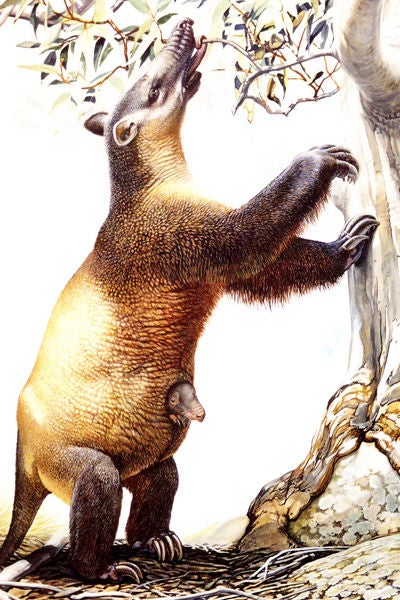
Giant Kangaroo Were humans responsible for wiping out this species? Peter Schouten

In middle school classrooms, the gist of the Ice Age is often explained as, "It got really cold and all the animals became extinct.” Recently, however, scientists have been taking a closer look at where and when human behavior affected the extinction of species, instead of climate change. Recent findings in Tasmania prove that certain ancient species, like the giant kangaroo and marsupial rhino and leopard, were still inhabiting the island when humans first arrived, leading the research team to conclude that the animals' extinction was due to human hunting, not the Ice Age.

The team of researchers from the UK and Australia, whose findings were published in the US journal Proceedings of the National Academy of Sciences, used sophisticated radiocarbon and luminescence dating techniques on fossils found in Mt Cripps in northwest Tasmania to determine that some species were in existence until at least 41,000 years ago. In other words, the megafauna clearly inhabited Tasmania when humans first arrived there 43,000 years ago. This discovery alters the long-held belief that the first humans to walk over from Australia on a temporary sand bar found an island bereft of giant animals. Voracious human appetites coupled with evidence that the climate was not changing drastically at the time places our ancient human counterparts back under suspicion for the extinction of some of Tasmania’s indigenous animals.

Scientists believe these findings will be applicable to other island nations, such as Great Britain, where they are also hoping to determine the exact role humans played in species extinction. Island environments remain a unique place to study competing hypotheses; their climate and animal populations tend to mimic those of the closest mainland, but the arrival of humans often occurs later.

Says Professor Chris Turney of the University of Exeter, lead author of the paper: "…150 years on from the publication of Darwin's seminal work The Origin of Species, the argument for climate change being the cause of this mass extinction has been seriously undermined. It is sad to know that our ancestors played such a major role in the extinction of these species – and sadder still when we consider that this trend continues today."

2 Comments

Is this really news? So many megafauna went extinct in North America at the time that humans became widespread, just after the end of the last Ice Age. Those megafauna -- giant bison twice as large as today's bison, mastadons, mammoths, giant sloths, dire wolves, sabre tooth cats, various camelids and horses, for starters -- survived previous ice ages, and survived this last one, but then disappeared pretty quickly after the ice age was over. There were ice age drawings of rhinos and lions in Europe. If these and other large animals could survive the ice ages, why couldn't they survive warmer climates with more prey?

For a while there were theories trying to show how diseases or changing climate or other things might have done the trick, but it really only takes steady hunting pressure over the centuries.

And now we're at it again. This time it is the commercial and perhaps the complete extinction of so many ocean species, as well as the threats to the more well known land species. Tigers and orangutans and rhinos in the not too distant future may survive only in zoos, if they don't go the way of some of the tiger species that have already become extinct. It isn't just hunting, but habitat destruction.

Most creatures can handle changes in weather and climate, it seems to me. Handling humans is a much more difficult proposition, even when they aren't hunting, but "only" destroying the forests and other habitats that creatures need to live.

At our rate we're killing every living thing, before causing our own extinction. Old news.


Download Our iPhone App

Stay up to date on the latest news of the future of science and technology from your iPhone with full articles, images and offline viewing


Follow Us On Twitter

Featuring every article from the magazine and website, plus links from around the Web. Also see our PopSci DIY feed


Become a Fan On Facebook

Share links with friends, comment on stories and more


December 2009: Best of What's New

In our December issue, Popular Science names the 100 best innovations of the year: bombproof wallpaper, self-parking cars, the fastest helicopter, and 97 more. Plus inventor profiles and videos.

Check out the best of what's new here.

Popular Science Photo Pool


Share your photos in the Pop Sci pool at www.flickr.com!
tags_sprite.png
POP_embeddedForm_cover_May09.jpg