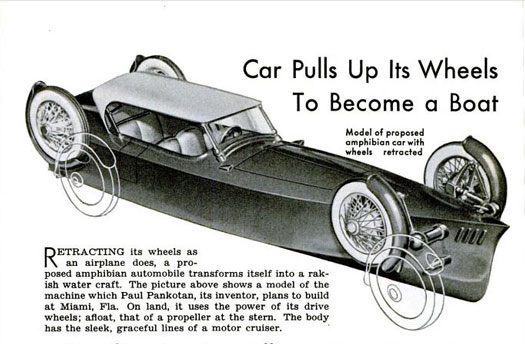
We’ve covered a fair number of amphibious craft over the years, most recently (and perhaps most memorably), a land-water ice cream truck that popped up on the Thames during Britain’s National Ice Cream Week. And while you won’t find any floating treatmobiles in our archives, the old-time amphibious vehicles we uncovered might prove just as charming.
Click to launch the photo gallery.
As a bonus, we threw in a couple of peculiar seaplanes from the 1930s, because who can resist an illustration titled “Air Conqueror of Tomorrow”? As goofy as some of these concepts look in retrospect (just wait until you see the amphibious bicycle), they’re not far removed from the amphibians in operation today. For instance, one French inventor designed an underwater tour bus similar to the ones used in Duck Tours, except that his could actually dip underwater.
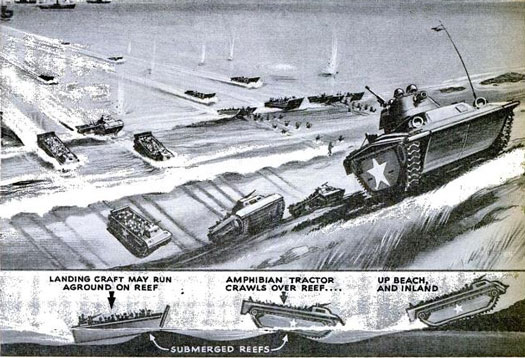
Meanwhile, Captain Frank T. Courtney suggested replacing a seaplane’s wheels with endless treads in 1932, and prophetically enough, a good number of amphibious vehicles employed by the military draw inspiration from tanks instead of jeeps. Out of all the vehicles outlined in this gallery, the military amphibians are most reminiscent of their modern-day counterparts. Yet for every no-nonsense tank, there’s an Arctic vessel equipped with a bladed hull and an airplane propeller, as well as a roly-poly combat vehicle outfitted with hemispherical wheels.
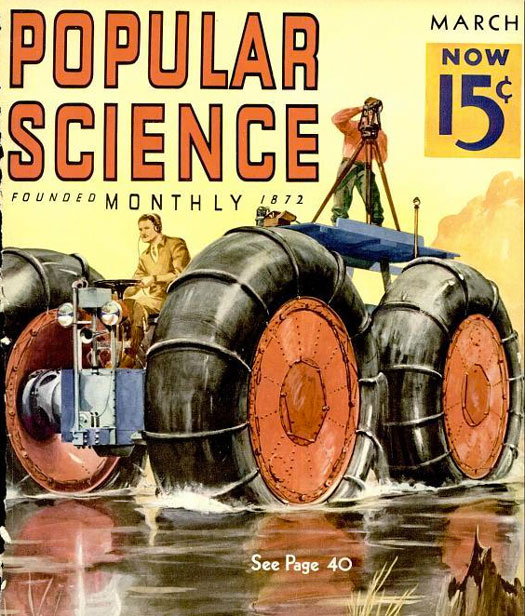
You might be asking whether these vehicles (excepting the military ones) are actually necessary. It’s hard enough to maintain a car the runs on dry land, let alone one that can double as a motorboat, but practicality aside, we’d love to have taken one of these vehicles out for a spin. Correct us if we’re wrong, but nothing says “August joyride” like a marsh buggy with jumbo-sized wheels.
Click through our gallery to read about the oil-hunting “tank,” the Arctic amphibian, and more amphibious vehicles collected from our archives.