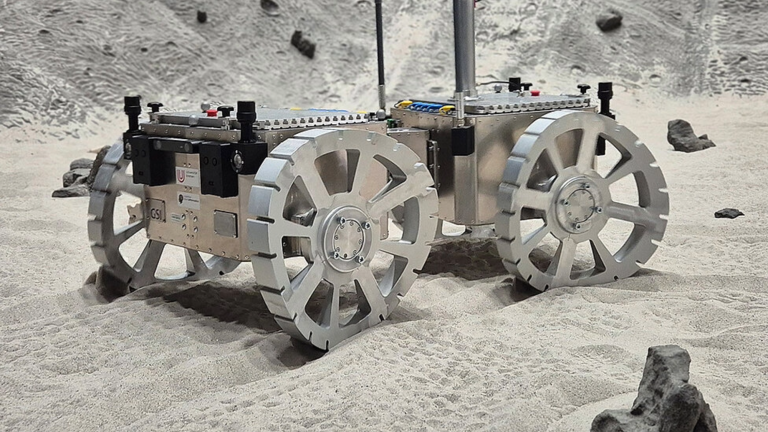
Hod Lipson, a roboticist and supervisor of Cornell University's Fab@Home project, is working towards a goal that, like so many others in the 3-D printing world, sounds simple, but is anything but. He wants to print a robot, all in one shot, and have it walk (or crawl, or slither) out of the printer, fully formed.
The project is actually not too far off; at this point, the Fab@Home team can create all of the individual components, including a battery and an actuator, in a 3-D printer--but they don't want to print these components separately and assemble them later. To print it all in one shot, from bottom to top, they'll need to be able to print several different materials at once.
The battery alone, though geometrically fairly simple, requires about five different materials, some of which are pretty nasty. "In an alkaline battery," says Lipson, "the most challenging [to print] is the separator layer, which in most batteries is essentially a piece of paper. Ironically, the one thing we can't print is paper." To solve that problem, Lipson ended up using a sort of gel to separate the anode and cathode, while still allowing ions to flow through. This final battery has about half the efficiency of a commercial battery, but that will improve in time.
The next steps are to print an actuator, a mechanical device that converts energy to motion. After that, it's getting the battery to power the actuator. And then comes the final problem: Printing all this stuff at the same time. But given the speed with which Lipson's team is moving, he predicts that they'll be able to print a simple robot that'll be able to crawl out of the printer "in the next year or two," he says.
[Pictured: the Model 2 Fab@Home printer]
These advances are just amazing. I want a 3d printer!
You know, Popsci, maybe you should just set up a simple system that allows regular users to correct your writing and factual errors for you. Let's face it, you don't do it yourselves.