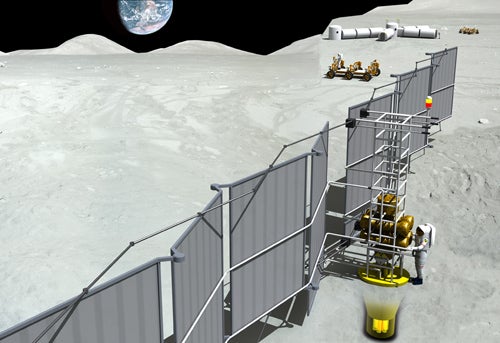
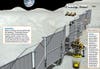
When lunar astronauts flick on their televisions after a long day of prospecting, they’ll have a trashcan-size nuclear reactor to thank for their nightly dose of prime time. NASA, looking past the already daunting task of simply getting humans to the moon by 2020, recently started considering proposals for ways to power lunar habitats. Batteries and fuel cells provide only short-term solutions. Solar power would be limited where a single night lasts as long as 354 hours. So space-agency officials have started making plans to go nuclear.
The outline for the Fission Surface Power (FSP) plan is fairly straightforward: An underground, uranium-powered nuclear reactor produces heat and drives a power converter to generate electricity. The nuke plant would churn out 40 kilowatts of electricity, enough power to provide life support to four astronauts with plenty left over to mine oxygen from lunar soil and run moon buggies.
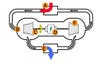
NASA is mulling two power-converter designs. Ohio-based SunPower has offered up a pressurized-gas-and-piston Stirling engine, which is going head-to-head with a Brayton-cycle engine that heats compressed gas to spin a turbine by the Colorado company Barber-Nichols [see illustrations below]. The Stirling engine is slightly more efficient at generating electricity, but the Brayton’s proven design stands less risk of breaking down. Within the next year, the space agency will select a power converter and, for the next five years, test the unit using an electrical-resistance heater in place of the nuclear reactor.
Whichever power converter emerges victorious, FSP is perfect for the moon, says Jim Werner, the reactor project manager at the U.S. Department of Energy’s Idaho National Engineering Laboratory. With most parts moving slowly and infrequently, it should run maintenance-free for eight years, he says. “You can put it in place, turn it on, and forget about it for the duration of the mission.”


Fission isn't the only out-there project NASA's working on these days. Check out the Aviation & Space winners of our Best of What's New awards to see more.
Stay up to date on the latest news of the future of science and technology from your iPhone with full articles, images and offline viewing
Featuring every article from the magazine and website, plus links from around the Web. Also see our PopSci DIY feed
Share links with friends, comment on stories and more
In our December issue, Popular Science names the 100 best innovations of the year: bombproof wallpaper, self-parking cars, the fastest helicopter, and 97 more. Plus inventor profiles and videos.
Check out the best of what's new here.
from Kent, WA
No issue at all concerning what to do with the nuclear waste in this set up. Just leave it right where it is at.
from Brooklyn, New York, New York
Why don't they just use solar panels. There is no atmosphere so more sun exposure. Also no need for nuclear material.
from Brooklyn, New York, New York
about the sun exposure, put the solar panels on the polls for shorter or no nights.
"where a single night lasts as long as 354 hours."
So if you locate the solar panels X distance away to a spot which has more frequent sunlight, you then have to run the power all the way from there to your lunar base, plus you need to have a large amount of batteries to store it in(which need to be replaced as well), etc, etc. So if you had the choice of 1 large piece of equipment (The above nuclear power source) or a bunch of large pieces of equipment (solar panels, solar panels, batteries, etc), I'd choose the nuclear powered one. Although I thought there were already some miniature nuclear reactors developed with no moving parts involved....I'm curious why NASA wouldn't choose that.
Since the moon has 1/6th the gravity of earth and no atmosphere, I see no reason we couldn't periodically send rocket capsules of nuclear waste to be incinerated in the sun
I hope they also foresee the prolonged stay for astronauts in the moon. The gravity is very different from Earth which means everything is supposed to weigh less which is nice but... since we're accustomed to earth's gravity all the time - this might pose as somewhat of a risk or hazard to the physical well-being of the astronaut.
Unless it would be only for a brief period of time (which would cost so much in resources sending astronauts back and forth unless there's some cheaper way to send people back and forth to the moon. ) or there's a gravity generator in the habitat that could mimic Earth's gravity.
Anyway, I know they've thought of this already most probably coz NASA engineers are far from being "chumps". Go NASA!!!
Brightblade81, you are correct about NASA already building and deploying a nuclear reactor without moving parts(called the SNAP-10A). The issue with using this design is that it is much less efficient(about the same as solar) at producing electricity than a Brayton or Stirling equipped system. Increased efficiency allows for a smaller reactor, thus, a lighter, cheaper to launch system overall.
Using nuclear power on the moon is a great idea. It was kind of funny how the article says that the test rig will use an "electrical-resistance heater" since all electric heaters I know of use resistance to generate heat(they could have just said electric heater). Astronauts would have to exercise a lot on the moon, not as much as in space but still a lot. Artificial gravity on the moon would be difficult beacuse the moon's gravity would interfere with it weather it was oriented vertically or horizontally. Also building a rotating habitat would be expensive, hard to transport and complicated to set up (plus it would take a lot of power).
from Kent, WA
There are patents pending (by me, actually) to lasso the moon loosely with a composite material cable similar to that envisaged for "space elevator" concepts. This cable, however would be a loose loop around the moon and would allow a habitat to orbit the moon at very low altitude, say 100 meters above the highest point on the moon's surface, constrained by a trolley system so that the habitat does not fly away from the moon. The trolley picks up and lays down again the moon-girdling cable as it orbits, obviating the need for a particular fixed anchor point--the anchor point is moving.
This system can provide a full 1-g habitat at a surprisingly modest orbital velocity and with a rather low energy requirement to maintain velocity. The major expense is laying down the cable around the moon, which can be down in one orbit by a spool of the miracle cable stuff, or in several orbits (with stops for splices) if we use a more conventional rope like nylon, which is much bulkier but retains both strength and flexibility in the cold of space.
Mike Cook, I fail to see how your suggestion has anything to do with supplying power to the moon base. Even if it was attached to the lasso, how would power be supplied, via a cable that is wrapped around the moon too?
Tell me, Mr. Cook, how much will a moon-girdling nylon rope weigh? Better make it of spider silk, or 100% unobtainium.
This new lunar base is a great idea. and is a step toward the future. Who knows we may someday have a colony of people living on the moon.
"I see no reason we couldn't periodically send rocket capsules of nuclear waste to be incinerated in the sun"
Because it takes more deltaV (change in orbital velocity, which means using fuel) to dump a package into the Sun than to accelerate that same package to solar escape velocity and send it out of the solar system.
You can't cheat Sir Isaac; at least we can't cheat physics yet.
OMG dude, I would move right in. That would be so cool to live on teh moon.
Hes
http://www.privacy.cz.tc
from Vienna, Virginia
On the lasso patent, just because you can patent it, doesn't mean you can build it, let alone have it be useful. Anyway, it wouldn't work. A free-floating base would not rotate at the same speed as the moon. This leads to three options:
1) The part wrapped around the moon would be literally dragged across the surface of the moon, creating insane amounts of friction.
2) The base crashes into the moon after spinning around it.
If you are having trouble visualizing this, take an analogy. Pretend the base is a yo-yo, the rope the string and the moon your finger. If you spin your wrist in a circle, then either the loop around your finger will rotate (#1), or the yo-yo will spin inwards and wrap around your finger (like a tether ball) (#2).
from Kent, WA
Thanks raggedjoe for the intelligent criticism. I didn't say it would be a free floating base. It would be powered in an unconventional way--by supply vessels arriving from the Earth at full velocity, not decelerating a bit. As these vessels whiz by the moon they snag a cable attached to the moon trolley system. The velocity of the arriving space loads is thereby transferred to the trolley, speeding it up considerably. This orbital energy could be harvested by spinning armatures to make electricity, but it is better to keep the trolley (which is also the 1-g habitat) moving fast to maintain artificial gravity. To maintain a constant velocity around the moon a nuclear power motor driving the trolley tires would suffice.
The rope girdling the moon would rotate at the same 29.?? day revolutions as the moon because it will be biting into the moon on the opposite side from the orbiting trolley and associated constrained loads. The worst operation problem will be, as ragged joe noted, the friction due to moon dust gumming up the rope, which then has to pass through pulley wheels on the trolley every revolution.
The expensive solution to that is to put the whole rope up on pilons girdling the whole moon. Then you might as well make the entire trolley track solid and the trolley itself holds on to it with C-clamp mag lev technology. Now this would be enormously expensive, but there is a very big plus. By building the whole track so that it circles the moon in the plane of the eccliptic, we can use the mag-lev track to launch loads to Jupiter, Saturn, and beyond, as per somebody else's patent. When not being used for such launches to the rest of the solar system, the 1-g habitat module would be keeping moon crews happy and healthy.
My patent actually relates to Phobos, a much easier thing to lasso, but once again the dust problem gives me headaches.
Mike, what if it misses the Tether? bye bye ship. I think you have to rethink your suggestion, there are too many issues to try to form them all into a short and well worded comment.
from Kent, WA
Yeah, missing the tether would be a real bummer, but what happens if you are on your way to work and your forget your car has a brake pedal? We give neophytes a driver's license when they could easily be killed by neglecting to turn the wheel when they come to a corner. Humans routinely do a lot of things while driving that take micro-second reflexes and dependable mechanical devices else disaster happens.
Everytime an airliner takes off we depend and trust that it will at the end of its journey be able to lower its landing gear. If not, airliners touching down at 180 mph can turn into balls of fire quite readily.
So, it's not a big deal snagging the cable loop attached to the trolley.
As for the yo-yo analogy, actually, that's the main purpose of lassoing any moon with a strong rope--once a spacecraft speeding by snags the cable tremendous friction will slow the spacecraft to what raggedjoe called a crash and I call a landing. My whole system is intended to allow faster transits from Earth to Luna or from Earth to any planet that has a moon without an atmosphere, because the spacecraft does not have to waste fuel decelerating, it can gently accelerate the whole way (say with a solar sail or ion engine) yet be able to rapidly decelerate without using any additional energy at all.
My biggest thought it, If you have a balloon filled with Helium tied to your finger and someone takes a stick and with a great speed hits the string attached to it, what happens?
That is what i see happening when you have a moon base catching space ship via a tether.
from Kent, WA
Well, my initial plan is to make the rope of woven nylon, which can handle extreme cold without losing either flexibility or strength. If you have ever seen the nylon lines that tie a ship to a pier stretch to the breaking point, they can triple their length and then they start actually smoking. Some years ago large boat at a Disney water attraction killed a tourist when its mooring line snapped--all that energy stored in a line came out the wrong way. I want to harvest the energy the right way.
Mmmmmmm .... a nuclear club house for a lunar golf course. Delicious! I think the folks at www.ootwo.com/moon.asp would be interested in this.
DONT BE FOOLED PEOPLE, EVERYONE USE YOUR BRAINS, 40 YEARS AGO, SPACE RACE TO THE MOON, LANDED THERE SUCCESSFULLY, YOU REALLY THINK THEY ABANDONED ALL THE ASPERATIONS TO GO AND COLONIZE THE MOON, EVEN IF FROM A STRATIGICAL STANDPOINT, WRONG!!! THEY LEAK STUFF LIKE THIS TO PEOPLE WHO THEY THINK ARE DUMB ENOUGH TO THINK THEY OUR ADVANCED GOVERMENT REALLY IS THAT INCOMPETANT AND MOVES THAT SLOW, WHEN WE ALL KNOW THAT BY THE TIME CERTAIN TECHNOLOGY OR ADVANCEMENTS REACH US, THEY HAVE ALREADY BEEN IN USE WITH OUR GOVERMENTS AND OUR MILITARIES FOR ATLEAST 7 YEARS, THE MILITARY FOR EXAMPLE CANNOT ACCOUNT FOR 25% OF THEIR BUDGET, IT MAGICALLY JUST DISSAPEARS, I CAN GIVE YOU THE REPORT THAT TALKS ABOUT IT IF YOU DONT BELIEVE, COVERT OPERATIONS LIKE THIS ON ON THE MOON IS WHERE THE MONEY GOES, THEY JUST CANT LET THE PUBLIC KNOW, BECAUSE IF WE KNOW, THE SO CALLED "ENEMY" KNOWS. THINK ABOUT IT PEOPLE!!!
FOR THOSE OF YOU THAT HAVENT WTACHED SECRET SPACE HERE IT IS
http://www.moviesfoundonline.com/secret_space.php
A feature length 2 hour documentary exposing the hidden history of NASA, and the organisation's links to The Illuminati network of Secret Societies. This film exposes NASA's secret space programme controlled by senior Occultists. We analyse UFO footage filmed by NASA astronauts whilst aboard the Space Shuttle and ask if NASA has secretly made contact with extraterrestrials."
Mr.Eastman
you really think that the military is wasting money for some "COVERT OPERATIONS"? there really is no way in hell that they could get a rocket up there without some other nation picking up the launch. and if they don't let the public know about this kind of stuff, how in the hell did you figure it out?
even if the enemy did figure out we had bases on the moon, what would they do about it? pull a moonraker and send commandos up there?
it's just like how i hear people say, "it wasn't the planes that took out the towers on 9-11, there were bombs planted at the base of it."
just another conspiracy theory.
>>No issue at all concerning what to do with the nuclear waste in this set up. Just leave it right where it is at.>>
I can't wait to one day look up at the Moon and know that it, too is now owned by and being exploited by rich people!
And that the Sun is now their trash can (although I like that idea better than making the Moon a toxic waste dump).
Would be nice to make it like Antarctica, a place with International Treaty and for science/exploration only.
Oh well, we shall see.
Or not!