Memristor could enable instant-on PCs, massive data storage and computers that think like humans
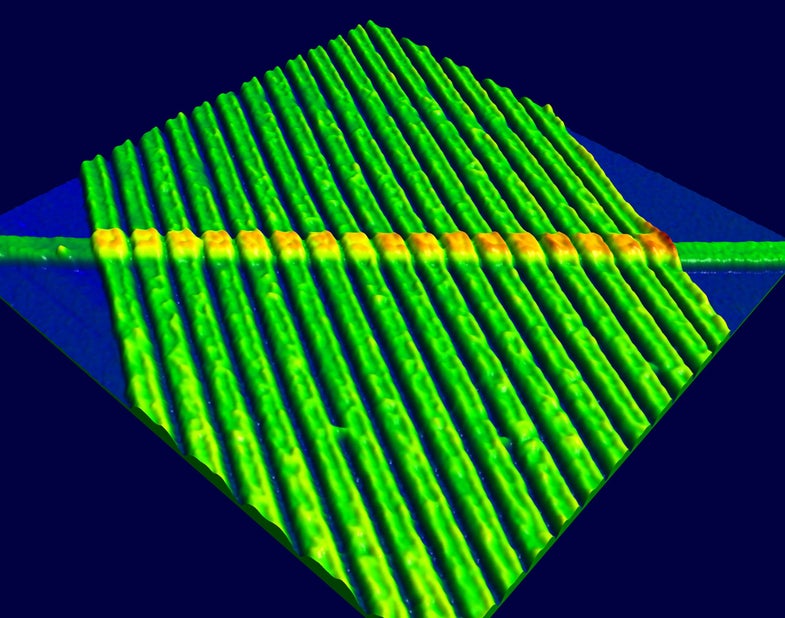
Memristor close-up An atomic force microscope image shows 17 memristors in a row. Each has a bottom wire that contacts one side of the device and a top wire that contacts the other. The wires in this image are 50nm, or about 150 atoms, wide. J. J. Yang, HP Labs

Silicon Valley is mostly a world of practical technology—applying principles from pure science to create handy gadgets. But today, Hewlett Packard announced a new electrical component born of theoretical physics. The device, a nanoscale component called a "memristor," requires no power to retain data, which it can store more densely than a hard drive and access about as fast as a computer’s RAM memory—potentially allowing it to replace both components in the future.

Memristors can function in either a digital mode, in which a memory cell is “on” or “off,” or in analog mode, in which each cell holds some value in between. These values grow every time the cell receives an electrical signal, mimicking the way neurons in the brain build stronger memories the more they are stimulated.

The memristor was theorized in the early seventies by an electrical engineer name Leon Chua, but it took decades before anyone could prove it exists. The process was similar to particle physics, in which mathematicians first propose a particle and then experimenters eventually find it—or don’t. (The hottest current example is the search for the theoretical Higgs boson, aka the “god particle.”) Chua’s mythical electrical component didn’t show up until recently when HP researchers were studying the electrical properties of nanoscale materials and came upon a few that acted suspiciously like the memristor. After some refinements, they invented exactly what Chua theorized.

First PCs

It’s a long path between proving something in the lab and selling it at Best Buy. Stan Williams, who leads the HP research team, expects memristors to first show up in the next few years as “cache” that sits between a hard drive and the DRAM memory in PCs. The hard drive could load key data, like the instructions to start up Windows, into the memristor cache, which can dump it into the DRAM far faster than transferring it straight from the hard drive—resulting in lightening-fast boot-ups and quick opening of large files.

But Williams has bigger plans to eventually replace both the hard drive and the RAM with one memory system that eliminates the need to store data on a relatively slow hard drive and then laboriously load it into fast DRAM before the PC can use it. He thinks a memristor can hold scads more data than a hard drive and access about as fast as DRAM. “You expand out both ways and try to eat the heart out of both the DRAM and the hard disk,” said Williams.

Then Androids?

Williams also wants to eat into the CPU. He says that many processes requiring fuzzy logic, like recognizing a face, are very hard to work out with that yes/no logic of a digital computer. But for an analog computer—like, say, the brain—it’s a piece of cake. So Williams proposes a CPU with multiple processing cores: Some digital for the number crunching that today's computers do so well, and others using analog memristors. Take facial recognition. Someone’s face can change from day to day, and definitely from year to year. But it’s not a drastic change that a yes/no digital system is good at figuring out. It’s a mild difference with some degree of change along a continuum that Williams says is perfect for an analog computer.

Could Williams take it even further—creating not just a PC that thinks a little more like a human, but an electronic mind that thinks exactly like one? “We’re not claiming we’re going to build a brain anytime in the next decade,” he says. But he’s not ruling it out for later on.

How it Works

The unlikely invention of the memristor took about 40 years. It started in the early 1970s when electrical engineer Leon Chua was looking at the interplay of electrical forces in the basic elements of circuits: resistors, capacitors and inductors. The same math that explained those three elements indicated that there should be a fourth, which he named the memristor (short for “memory resistor”) in a 1971 paper. A memristor would change its level of electrical resistance if charge were applied and retain or “remember” that resistance until another charge were applied. Like the Higgs boson “god particle,” the memristor made perfect sense on paper, but no one had ever seen one.

Not until the late 1990s, when researchers at Hewlett Packard Labs were studying the electrical properties of different nanotech materials and found several that looked pretty similar to Chua’s hypothetical memristor. Suspecting that Chua’s mythical circuit was real, HP researchers set out to invent one.

What they wound up with was deceptively simple: two layers of a semiconductor, titanium dioxide, sandwiched between electrodes. The bottom layer contains the standard material, which is virtually useless for conducting electricity. The top layer is missing a few oxygen atoms, creating positively charged “bubbles” that make it a conductor.

Running a positive charge through the electrode above this layer pushes some of the charged bubbles into the lower layer (where they stay, until another charge is applied), allowing it to conduct electricity and lowering the electrical resistance of the entire cell. A computer can read information in a memristor cell by measuring how much resistance it has.

Hitting the cell with relatively big zaps switches it from high to low resistance levels that correspond to zero and one for digital data. Using less power can give it some resistance value in-between the extremes. And the results are cumulative. The more often you charge the cell, the lower its resistance—in other words, the stronger its memory becomes. That matches the way neurons build stronger connections over time to make memories stronger (and explains why the more you practice something like piano, the better you get at doing it). Applying a negative charge to the top of the cell reverses the process—a lot of power switches a one to a zero in a digital system. Applying finer amounts of current causes a memory to fade.

HP’s memristors are tiny, about 15 nanometers across. That allows them to store data about as densely as a hard drive—100 gigabits per square centimeter. But HP thinks it can get them far smaller—down to four or even two nanometers. Even at 4nm, a square centimeter of memristor can hold one terabit.

The complete explanation is in a paper that HP published this morning in the journal Nature.

Want to learn more about breakthroughs in electronics, medicine, nanotech, and more?
Subscribe to Popular Science today, for less than $1 per issue!

17 Comments

This is almost scary.

I read this article and thought "Skynet"

Injecting large amounts of high speed storage directly into computational logic will drastically alter computer design. It'll change all aspects of hardware/software design methodology and the companies that do it.

If this comes to pass it will start a third era in computer design. The first being the invention of the transistor, the second being the design of the microprocessor. I can't wait.

Now this is Impressive....Time to start dreaming up cool uses..
Shssssh
If you listen closely, you can hear thousands of engineers all slapping their foreheads and making Homer Simpson sounds

so now i can store all of my porn in a square cenimeter or smaller? ... Lets get this goin HP.. good job.

I'm no EE, but if I'm recalling correctly then you use Ohm's Law to measure the resistance of a device. My ohmmeter does this by sending a known current through the resistance to be tested and measuring the voltage. V/I = R, and I know the resistance.

If the only way to measure the 'stored value' (resistance) is to send a current through the memristor, then any time you read this memory you'll reset it (to high resistance, I think). It seems like in my ignorance there's no way to have a current interact with the memristor without changing the 'stored' resistance, which means you can't read it without changing it.

Hehe nice thinking there appl.

Don't think in terms of static voltage (or difference of charge) though; think of a change-of-voltage. According to quotes from Williams and Chua (great article on EEtimes.com) the memristor passes a hysteresis loop; if you apply AC the change of resistance is basically zero after one period.

If you "give" it a certain resistance once, you can work with it applying AC and change it by superimposing a DC signal over it.

If this comes out, I swear I'll be one of the first to buy the computer that it is put in!!

"Running a positive charge through the electrode above this layer pushes some of the charged bubbles into the lower layer (where they stay, until another charge is applied), allowing it to conduct electricity and lowering the electrical resistance of the entire cell. A computer can read information in a memristor cell by measuring how much resistance it has."

So it sounds like you set the state or value with the charge on the upper layer and read the value with a charge on the lower layer.

This might be the missing link to EFFECTIVELY be able to produce huge arrays of artificial neurons and interconnections between them. Because that's what it takes to make something useful - large numbers of them, like millions.

I just can't picture myself how those memristors can learn though and how they can decide to what neighbour neurons they should connect.

But someone will (or already have) figured that out I guess.

/Ruben
RJJournal

I'd like to know more about how this material responds to zero voltage signals.

Basically if the power goes off, does this alter the memory (are we looking at a memory storage technology here like say an I-
RAM card whereby you must have power in order for the device to retain it's memory).

The way it's explained sounds like high current causes it to store some data, low current will cause it to loose it's data, but what about zero voltage? No power at all?

If the material will not change unless an external current is applied to the material in some controlled way then it sounds magnificient. How affected by electrostatic power it would be would be most important as in most electronics but what excites me about this technology is the potential to completely move away from 'magnetic storage' devices.

So when the Earths magnetic poles reverse there will not be dire consequences (not that this hugely blown out of proportion phenomena looks set to be a problem any time soon).

If retention of data could potentially last a lifetime unless acted upon by a changing current we are looking at a serious data storage upgrade here.

I'd like to know more about how this material responds to zero voltage signals.

Basically if the power goes off, does this alter the memory (are we looking at a memory storage technology here like say an I-
RAM card whereby you must have power in order for the device to retain it's memory).

The way it's explained sounds like high current causes it to store some data, low current will cause it to loose it's data, but what about zero voltage? No power at all?

If the material will not change unless an external current is applied to the material in some controlled way then it sounds magnificient. How affected by electrostatic power it would be would be most important as in most electronics but what excites me about this technology is the potential to completely move away from 'magnetic storage' devices.

So when the Earths magnetic poles reverse there will not be dire consequences (not that this hugely blown out of proportion phenomena looks set to be a problem any time soon).

If retention of data could potentially last a lifetime unless acted upon by a changing current we are looking at a serious data storage upgrade here.

from my limited research, it appears that no voltage=no loss. Applying voltages to either side of the memristor adjusts the "slider" of voltage between the two extremes. Using AC power, you can read the value without altering it.

Think one day well try and meld our minds with this?
and if so... how can you apply to try it out?

meika

from Cascades, Tasmania

Apparently someone else < a href="http://eprintweb.org/S/article/cond-mat/0807.0333">made one first out of polymers!

Spread the word.

PS
I've written a short < a href="http://spacecollective.org/meika/3836/Carry-Me-Home">story about memristors too.

the brain—it’s a piece of cake. So Williams proposes a CPU with multiple processing cores: Some digital
http://www.crazypurchase.com

Gena is absolutely correct here..
www.emailextractor14.com

If these can store values between 0 and 1, couldn't that completely change how programming is done? Currently, all languages are based on a bit of information being either on or off. If this technology can store more than just 0's and 1's, couldn't it increase storage capacity exponentially if a language was designed for it? Maybe I'm not understanding this fully, but it seems that by rethinking programming, we could squeeze a lot more out of these memristors.


138 years of Popular Science at your fingertips.

Innovation Challenges


Popular Science+ For iPad

Each issue has been completely reimagined for your iPad. See our amazing new vision for magazines that goes far beyond the printed page


Download Our App

Stay up to date on the latest news of the future of science and technology from your iPhone or Android phone with full articles, images and offline viewing


Follow Us On Twitter

Featuring every article from the magazine and website, plus links from around the Web. Also see our PopSci DIY feed


February 2012: The Future of Fun

Science is reinventing play, from extreme sports to gamification to ridiculous roller coasters to the playgrounds of tomorrow, and this issue is chock full of fun. Also, on a less fun note: Did global warming destroy my hometown?


circ-top-header.gif
circ-cover.gif
bmxmag-ps