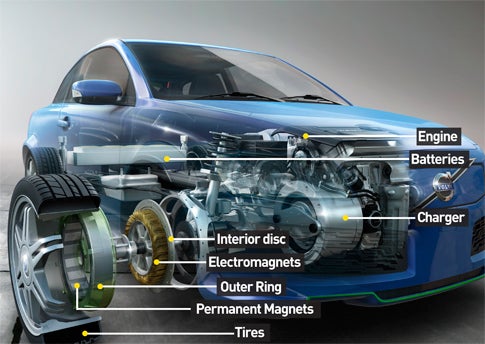
The ReCharge, Volvo’s concept plug-in hybrid, could squeeze 160 miles from a gallon of gas by tossing out the power-wasting transmission. It packs a small electric motor inside each wheel, so that no power is lost in the drivetrain. Here’s a look at the next generation of fuel-efficiency
Putting electric motors directly inside the wheels eliminates the transmission, which typically wastes 10 to 20 percent of the engine’s energy. An interior disc, mounted to the wheel bearings, contains a series of independently controlled electromagnets, which emit a magnetic field in response to an electrical current. Around that, an outer ring contains permanent magnets. Step on the accelerator, and a computer in the interior ring begins to rapidly switch the polarity of the electromagnets, repelling or attracting the permanent magnets. The faster the polarity changes, the faster the motor spins the wheels.
The challenge is controlling four independent motors—if one spins even slightly faster, the car could veer violently. The ReCharge team’s next big hurdle is refining the software that maintains precise control. As for performance, the car will have permanent all-wheel drive with no gearbox standing between your foot and the motors—in other words, it should go like a rocket.
Batteries power all four motors and the car’s electronics. Unlike most plug-in hybrids, the ReCharge uses a lithium-polymer (rather than lithium-ion) battery. This is not only safer—it uses sheets of plastic instead of a volatile electrolyte solution—but it also powers the car for 60 miles before the engine kicks in to recharge it. Small lithium-polymer batteries have started to show up in gadgets such as the iPhone, but Volvo gets its larger, experimental versions from an undisclosed manufacturer.
The engine charges the battery when the car isn’t plugged in. The concept design calls for either a 1.6-liter flex-fuel or turbodiesel engine, but since the engine doesn’t have to actually spin a drive shaft, a fuel cell or a second battery could do the job just as well. It would kick in to recharge the battery only after the battery was at 30 percent capacity, so the ReCharge could travel 160 miles on a single gallon of gas.
A charger feeds power to the battery when the car is plugged in at home. Eventually, the ReCharge will be equipped with an intelligent version that can automatically sense strain in your area’s electrical grid and either cut back its power consumption or feed electricity from its battery back into the system.
Tires must be as thin as possible since the motor makes each wheel bigger.The ReCharge uses specially designed Michelin tires with a soft, resilient surface that also reduces rolling resistance.
Stay up to date on the latest news of the future of science and technology from your iPhone with full articles, images and offline viewing
Featuring every article from the magazine and website, plus links from around the Web. Also see our PopSci DIY feed
Share links with friends, comment on stories and more
Inside NASA's astronaut bootcamp and the grueling new training regimen for deep space. Plus, ten young geniuses shaking up science today, one writer's quest to analyze every man-made chemical in her body and more.
Check out the issue's full contents online here
Great Idea! Wasn't this same idea on the cover about 20 years ago?
It seems to me that adding the motor drive mass to the wheel will result in a rougher ride. Is this so?
Wait...So you are going to charge the battery with a battery??
Seems to me that if thats the case you should just get a bigger battery! (If you are going to have the space taken up by the extra anyway)
Its great that Volvo is finally getting around to the innovative designs needed to bring fuel efficiency into the 21st century. I've been refining a similiar concept over the last 3 years, which should result in a 300 mpg efficiency.
I like that their concept will eliminate the Transmission and reduce wasted energy. With a few additional improvements, they should also be able to reduce or eliminate the brakes and use the Electro-magnet as both a motor powering all four wheels and as a power generator which could be used during braking and simultaneously re-charge the battery. Battery size/weight could also be dramatically reduced.
I hope they can bring to market sooner.
Great job guys, keep up the innovative approach.
At your service
Sincerely,
John Frei
Toms River, NJ
Love this design!
What about just having one motor ...in the middle of a solid drive shaft though? It would be simpler, less expensive and wouldn't require 'thin tires'.
Also, if it were put on the rear axle...even simpler!
Connect a solid rear and solid front axle...'twin-axle' drive.
from Wonthaggi, ACT
Not all batteries are the same. They have different characteristics in regards to the amount of power than can be drawn from them, how fast that power can be drawn out, how long the take to recharge, etc. It could easily make sense to have two or more banks of batteries, with different characteristics, one for powering the motors and another for holding large charges on a long term basis.
Myk
-----
Part of the inhumanity of the computer is that, once it is competently programmed and working smoothly, it is completely honest. - Isaac Asimov, 1920 - 1992
Volvo should be acknowledged for reviving some work done by the engineer R.G. LeTourneau. LeTourneau invented Electric Wheel Drive in 1950 for use in heavy equipment, earthmovers and the like. My father was an operating engineer in the 1950s, 1960s, and 1970s, and had occasion to use LeTourneau heavy equipment many times; he noted that operating the electric wheel driven equipment was very much easier than some of the other heavy equipment of the day.
Few folks realize, too, that the hybrid power system is not new. Every modern locomotive is a hybrid. Those massive diesel engines are there to drive generators to power the engines electric drive system. I find it refreshing that these old tried and true approaches, half centuries old, are beginning to be acknowledge for their versatility and economy. My only lament is that the automotive industry has taken so long to move out of their comfort zone and look at true innovation.
I've heard that heavier tires would be less efficient, and the suppression of a heavier bounce might be the reason.
The artical wasn't clear, on how the standard transmission was a cost of 10-20% of energy. Does that mean the energy soaked up by accelerating the extra mass, or the energy lost to internal frictions? An Electric Transmission will still have the burdens of Power Capacity, where an increase of force or torque will increase the diameter of the axle or conductor.
The problem of ballancing the motors sounds to be what Differentials are for, and those Permanent Magnets are going to demand some kind of virtual commutator. Nikolai, from what I understand, eventually worked out a simple three phase motor, using no commutator, by replacing those Permanent Magnets with Feromagnetism. Think of them as Dynamically Defined Permanent Magnets.
Trolley Busses are known for good hill-climbing acceleration, as well as regenerative breaking, but Turbines are known to have good characteristics in a narrow power band, so the rear wheels might kick the ground, electrically, but also drive the turbine for the front wheels, to eat the ground ahead, when running at speed. Rear Wheels for Acceleration, and Front Wheels to Stop and (really-really) Go.
Arawn
Do you hear what I hear, then you might be selling flowers too.
I have subscribed to this mag. for 20 years and I think this is the end. As long as the auto companies and big oil can continue the "see no evil, hear no evil and speak no evil", we will continue to be tied to petroleum.
Bugs to produce gasoline? Right, just partner with a oil producer and you will end up like ECD (Energy Conversion Devices) and bury the licenses and patents until they fossilize.
Ethanol? Why is it so hard to use switchgrass, instead of corn? My cornflakes have gone up. Venezuela has had it for years and in different blends, so they can sell us their crude, bad Commies.
Remember the EV1? All of them are crushed and landfill fodder, except for museum pieces that were disabled. How environmental of them.Couldn't own one if you wanted to. Ford was no different with the Electric Ranger. Only leased and had to return without a chance to purchase.
Now, our future is Hydrogen. Forget electric. Congress has spoken, we just play like the little monkeys, too. We haven't reached the point where our thirst for gasoline has destroyed our economy. We can't wait until 2015. Mister President, Mister Speaker of the House, Oil is the Everyman's Heroin. We're ALL addicted. We need DEA enforcement, now. On counseling or 12 step program can help us.We are beyond peak world production, not good till the last drop.
This publication has as much fantacy as it does fact, any more. I do not wish to gamble on my or anyone's future with your silly stock markets. I do hear-by wish to cancel my subscription. By the way, you owe me money with which I might purchase a gallon or 2 of sweet nectar from the gods of babylon.
Keith Missinne
check the subscriber list in one hour. I can't believe I had to join and log in just to clear my throat.
4000 pound vehicle to transport 150 to 400 pounds of people? Does that make good sense? Think we have to rethink concept?
Do you think we might be able to get a better deal on the purchase of oil if we tied our purchase price to the amount of financial aide we give the various countries that supply us. As the price of crude went up, the amount of aide would go down by a like amount. We could also add n "Oil Purchase Tax" to the goods we supply the countries we purchase crude from. That seems to be what they are doing.
‘K Missinne’ don’t give up yet. Take a look at this:
http://media.reliatech.us/media/WaterFuel.wmv
Good stuff guys.
“My only lament is that the automotive industry has taken so long to move out of their comfort zone and look at true innovation.” - rayblahblah
“Oil is the Everyman's Heroin. We're ALL addicted. We need DEA enforcement, now. On counseling or 12 step program can help us. We are beyond peak world production, not good till the last drop.” - K Missinne
Keith Lacey, Pender Island BC,
An interesting problem arises when going around a curve. All motors are not going at the same speed.
Maybe this is what Volvo means when it is saying that more software development is required.
Also regenerative braking doesn't work too well as the vehicle nears zero speed. Mechanical brakes would still be required.
Maybe I can solve their problems. Four 3-phase DC inverters with speed controlled by frequency controllers, amperage metering, and wheel spin (Hall effect) monitoring on each wheel. All very well known applied industrial technologies.
Keith Missinne
lnwolf41 Old concept just new technology to drive it, simpler to use motor on shaft so tires can be cheaper and hold weight
of car; so the average joe can afford to buy it.
I've subscribed to pop sci for 41 years now. I continue to find some inspiration in every new issue.
I understand Kieth M's frustration that few of these automotive technologies have gained wide acceptance but keep in mind that 20 years ago in the US, gas was about $1 / gal. while in Europe it was $4 / gal. Now that we are facing $4 / gal. gas, the public is willing to go out and buy a radically different kind of car if it will cost less to operate.
My 75 year old mother whirs around town in her Prius and she can't wait for the plug-in version to come out.
I remember a Pop Sci article about a guy who bolted a Phantom F-4 starter motor to the transmission of his opel GT and tossed in a bunch of lead-acid batteries. He had a Briggs and Stratton generator that would kick in as needed. His biggest problem was switching the electrical power. All of that current was burning up relay contacts.
There are a lot of steps between rough concept or crude prototype to finished product ready for market. In the end, there has to be a market and now finally, there is. That's how fantasy becomes reality.
Think of Jules Verne's fantasy stories that inspired Wernher von Braun to build a moon rocket, and Admiral Rickover to build an atomic submarine - The Nautilus.
Pop Sci has kept us inspired for all of those years and for that inspiration, I think Pop Sci deserves some of the credit for those new technologies that do in fact make it to market.
from Durant, Oklahoma
The use of hub motors on automobiles, electric hub motors, on all four wheels, was developed and produced by Doctor Fernando Porsche in 1898. The car was called a Matilda, four wheel drive, electric hub motors, and battery power on board. The automobile was produced in Vienna, Austria, and was very popular with the public.
Paul Conley
from Durant, Oklahoma
At the age of just 24, Porsche quite literally hit the headlines for the first time at the Paris World Exhibition in the year 1900, presenting a vehicle with an electrically driven wheel hub motor he had built on behalf of the Lohner Coach Factory in Vienna, a purveyor to the Austrian Royal Family. In the same year he also built the Lohner-Porsche Mixte, the first vehicle ever to feature a combination of gasoline and electric drive – and, therefore, the first predecessor to today’s cars with hybrid drive. And just shortly thereafter, Ferdinand Porsche introduced all-wheel-drive technology and the four-wheel brake system into the world of automobile production.
Paul Conley
from Durant, Oklahoma
The first standard electric school bus conversion was accomplished by the San Dimas School District, bus repair shop, San Dimas, California, in 1994. A 50 passenger Crown Coach School Bus, tandem rear axel, was converted to an all wheel electric drive by replacing the GM pancake 300 horse power diesel motor, drive lines, transmission, and fuel tank. The four electric hub wheel motors where developed for the US Army as a DARPA project. Currently Solomon Technologies, the company that developed the wheel motor is producing improved units for sail boat ancillary drives. The converted school bus was certified by the California Highway Patrol for use as a school bus. An electric stepper motor was used to support the bus airbrake system. A battery tray was developed so that a quick change out could be accomplished by lifting the bus and removing and replacing the battery tray. A small stand by diesel generator was available if the battery charge dropped.
The Electric Wheel device greatly reduces the complexity and number of parts in a self-contained motor/transmission device while providing redundancy and energy regeneration capabilities. The Electric Wheel is a ring/planetary/sun gear assembly that can be utilized as an infinitely variable transmission, eliminating the need for gear shifting, and greatly reducing the complexity and number of parts needed to construct a transmission. Coupled with two electric motors the device has high efficiency, can overcome dead loads, produce soft-starts and can regenerate energy thru unused torque.
The Electric Wheel may be constructed with one electric motor power input device and the second power input device being any suitable power input device, such as an internal combustion engine (I.C.E.).
The Electric Wheel can be incorporated into a wheel hub assembly or coupled to a drive shaft for vehicular applications. It can also be used in myriads of other applications where overcoming dead loads and soft-start capabilities are required. The Electric Wheel is a proven device that also provides redundancy and energy regeneration.
Paul Conley
Our Global Patented Hydro Assist Fuel Cell Kit retro fits any make, model, yr,of Gas or Diesel Engine. More Power, Longer Engine Life , reduced pollution and 30% to over 300% increse in Fuel Mileage And as soon as the EPA get's their act together we release the PICC as seen @ WIREC 2008 Show. 400 to 700% increase in MPG and No Pollution, Double or Triple your Engine Life and More POWER !
Dennis Drake President Better and Better Technologies
http://www.Rockin69.com Saving USA and the World <><
Thanks for the theme dear
---------------------------------------
Download Free Software and Sharewaresأفضل المواقع العربيةدليل المواقععيادة الطببرامجبرامج نتالعاب فلاشiphone آيفون منتدى برامج نت
Hi,
I also found these articles which are quite informative too.
How Does a Water Powered Car Work?
Run Your Car On Water
Gary.
I Love this design :)
http://www.arabstart.com/
I've studying hybrid cars about 6 months What I've read in this article Volvo can get some where close to 160 M P G
The use of the wheels and tires as a flywheel for each electric motor will increase the efficiency by 500%to600%
To use all four wheels to get the car rolling is wise Then,what most people don't know or didn't know is that,the electric motor when your not putting a current to it,it can be used as a generator.After the demand for horse power and torque The car wouldn't need four motor to get the car down the road Then two of the motors could become generators
I had recently confirmed this
Before finding this article I had been researching this and other ways to get high M P G for hybrid cars
With other cars, my thoughts had been that I could increase their mileage by 50%
Like Honda's car their going to produce next year .Saying they're going to get 44mpg
I thought I could achieve 66mpg
The only thing I see Volvo might have a problem with.Is if they build the front wheels to heavy .There might be some steering control problems
That is alright I've still got another idea in my mind pretaining to hybrid cars mileage
In the next couple of years everybody will be trying to build Hybrid Cars
from Santee, Ca
Someone already remarked on the extra unsprung weight, which would make for a rougher ride. Therefor I am going to ask if anyone is working on recovering the energy expended in controlling the suspension. Shock absorbers as linear generators anyone? Might as well use what's already there. It would also make it easier to conrtol ride quality. With today's economy the roads sure seem to be getting rougher!
The front brakes of the 1971 Subaru Star were mounted inboard against the tranny/differential. Half shafts and U/constant velocity joints carried go power and stoping force to the front wheels, Ala F1, for DECREASED unsprung weight. Are we going backwards here? How about inboard brakes/Motor-Generators at all 4 corners?
Ron