Gray Matter: Pretty penny
Turn your cheapest coins inside out using some hardware-store chemistry.
Looking for something more interesting to do with that jar of pennies than just cash it in? One word: acid.
In most years before 1982, American pennies were 95 percent copper. Then the price of copper went up until you could get $100 worth of pennies at the bank, melt them down, and sell the metal for more than $100. So the government started using a core of cheap zinc with only a thin plating of copper.
- Project: make a penny shell
- Cost: $5.01
- Time: 1 hour
- Difficulty: safe | | | | | dangerous (Editor’s note: 4/5)
The fact that pennies are made of two different metals opens up the interesting possibility of separating them. I learned how from a high-school student and family friend, Niels.
Achtung! Theodore Gray is a scientist trained in lab safety procedures. Do not attempt this experiment at home. For more information on Gray’s scientific pursuits, visit his website.
Hydrochloric acid (HCl), known in the hardware store as muriatic acid, is sold for cleaning concrete. But it will also dissolve the zinc core of a penny, leaving a foil of copper roughly a thousandth of an inch thick bearing the original image of the coin. This works because zinc is significantly more reactive than copper. In the presence of HCl it is rapidly oxidized—converted into zinc ions that dissolve in the solution.
Warning: Concentrated muriatic acid is available in most hardware stores, but that doesn’t mean it’s harmless. It should never be handled by children, even under adult supervision. Work in a well-ventilated area, wear gloves and ANSI-approved splash-proof safety goggles at all times, and read and follow all other safety instructions on the bottle.
What about removing just the copper to leave a shiny zinc penny? You can’t do that with acid, because any acid that dissolves copper will eat zinc much faster. I wasn’t sure it was even possible, but my chemist friend Tryggvi came through with a method involving cyanide and persulfate. It works, but it’s most definitely not something you should try at home (the process uses enough poison to wipe out everyone in a city block).
Together, these two methods let me prepare this real-life exploded view-proving that what the US Mint has joined together, an Icelandic chemist and an American teenager may put asunder.
How it works
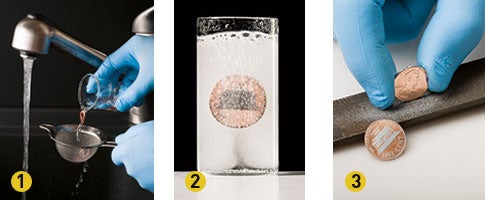
1. File around the edge of a post-1982 penny until you see white zinc.
2. Don protective gear, and drop the penny into a small bowl of undiluted hardware-store muriatic acid.
3. Wait 15 to 60 minutes until the bubbles stop.
4. With the faucet running, pour the acid into the sink through a strainer to catch the penny.
- Warning: Never pour water into acid—it can boil instantly and splatter acid in your face. Always pour the acid into water.
5. Run water through the strainer for several minutes to rinse the penny half-shells and flush out the acid.
This story has been updated. It was originally featured in the July 2007 issue of Popular Science magazine.