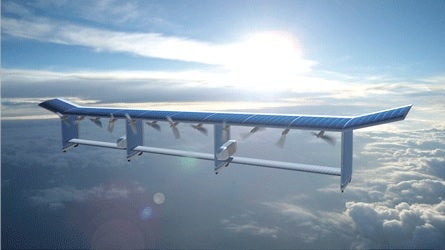
The highest-endurance aircraft currently flying is Northrop Grumman’s Global Hawk UAV, which can stay aloft for up to 40 hours. Now Darpa—which, to its credit, is never short on outlandish ideas—wants to beat that endurance record more than 1,000 times. The goal of Darpa's recently launched Vulture Program is to build a kind of atmospheric satellite that can stay aloft for five years at a time with little or no maintenance.
It must be able to haul a 1,0000-pound payload all the while, and operate at an altitude of 60,000 to 90,000 feet. How does one power a plane that’s going go fly for five years? Solar seems to be the most logical option, though fuel cells could work, too. It’s not clear what shape the craft could take, though the NASA ultra-endurance concept aircraft pictured here could give some hints. Darpa says it’s close to awarding contracts; then phase one of the three-part program, which will focus on figuring out what this kind of plane might actually look like, can begin. Once someone has built a full-scale demonstrator that can stay in the air for 12 months, a Vulture program aircraft will enter production.
Via Flight Global


Comments
from Vancouver, Washington
They comma'd 1,0000-pound wrong. I don't know whether seth Fletcher was trying to say 1,000 or 10,000 but either way, it's wrong.
3 out of 3 people found this comment helpfulAccording to the original article, the payload is 450kg or 1,000 lb, so the extra 0 is a typo. Not very hard to figure out.
0 out of 2 people found this comment helpful"Currently flying" being a key part of the sentence, as the Virgin Atlantic Globalflyer remained inflight without refueling for approximately 67 hours, landing in Kansas on 04 March 2005. It's at the Smithsonian now.
Again, As for UAV's I think the Boeing Condor could stay inflight for 80 hours, and that was in the late 80's. It's at the Hiller museum.
Question is, what purpose would this vehicle serve that could not be met with a satellite. DARPA = Defense Advanced Research Projects Agency and this is going to be an ISR vehicle. VULTURE = Very high altitude, Ultra endurance, Loitering, Theater, Unmanned, Reconnaisance, Element.
Also key was the mention of "autonomous material transfer" which might indicate the desire to swap out ISR packages while remaining in flight.
1 out of 1 people found this comment helpfulThe altitudes these fly at make them ideal for commercial applications like inexpensive voice/data communication networks, enhanced precision location services, broadcast services, ...
Platforms like these would allow for much more efficient uses of wireless and broadcast bandwidth. I can't wait for these to get airborne.
2 out of 2 people found this comment helpfulIt would be at the ceiling of big storms and thus vulnerable to lightning strikes and fierce wind currents. I suppose someone have to monitor the flight pattern.
What would be the contingency plan in the case of it spiraling out of control and falling to Earth?
Other than that it seems like an exciting project, with the prospect of eclipsing any other aircraft for flight time. Even if it only lasts 10% of the planned flight time, it would still be quite a conquest.
0 out of 0 people found this comment helpfulgenXer, I Don't see lighting strikes as a big deal as long as proper precautions are taken by putting discharge rods on the wings, when an airplane gets struck by lightning the conversation in the cockpit goes something like this
"what was that?"
"Lightning maybe"
"Yep"
0 out of 0 people found this comment helpfulThese aircraft could play a very important role in our military. We now know without a doubt that China could shoot down our satelites. If that were to happen, these aircraft could temporarily replace them and prevent the military from being blind in a time when we have become completely dependent on satelite images for everything.
0 out of 0 people found this comment helpfulThis would be an ideal platform for a solid-state laser, approx. 10KW yield, for use in terrorist occupied areas.
1 out of 1 people found this comment helpful