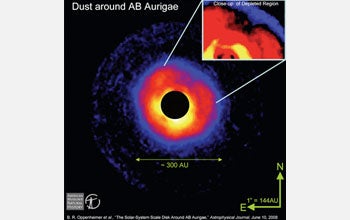
News of another extrasolar planet hardly grabs headlines anymore, now that scientists have pushed the count far above 200. But yesterday a group of astrophysicists says it may have uncovered evidence of a foreign planet being born.
The actual image they captured shows an absence of material around a young star, AB Aurigae. This void could be evidence of an object-in-formation that may be somewhere between 5 and 37 times the mass of Jupiter. Astrophysicist Ben Oppenheimer of the American Museum of Natural History suggests that it could be a planet or a brown dwarf—an object that falls somewhere between a planet and a star. But good looks at these extrasolar objects are hard to come by because their host stars—the ones they orbit about—outshine them.
"The image produced speaks directly to the biggest, unresolved question of planet formation—how the thick disk of debris and gas evolves into a thin, dusty region with planets," says Julian Christou of the National Science Foudnation. The work will be detailed in the June issue of Astrophysical Journal.
Five amazing, clean technologies that will set us free, in this month's energy-focused issue. Also: how to build a better bomb detector, the robotic toys that are raising your children, a human catapult, the world's smallest arcade, and much more.


Online Content Director: Suzanne LaBarre | Email
Senior Editor: Paul Adams | Email
Associate Editor: Dan Nosowitz | Email
Assistant Editor: Colin Lecher | Email
Assistant Editor: Rose Pastore | Email
Contributing Writers:
Rebecca Boyle | Email
Kelsey D. Atherton | Email
Francie Diep | Email
Shaunacy Ferro | Email
I recently read a 1995 article on the
LIFE SPECTRUM
http://mypage.uniserve.com/~ghatton/lifespec.html
If radiation makes up all different types of energy that run all all different frequencys and amplitudes, then there is polarity.
Particles spin in space, take in less dense particles into orbit and then build onto the inital object, it becomes larger, and larger and it wont stop. The Earth it self, is growing too by expanding, but to be created it must have been condensed from the elements, each element layered it self in density over time, like oil layers on water over soil. The planet, is still doing this today.
If this layering of the planet is true, then that would make sense why its a sphere, and why all other planets are, molecules, cells, and why I think this universe is a sphere.
This formation must exist with the balanced helical amplitude of energy.
Has Nasa ever looked for a Gamma Xray Sun? Something we would normally see right through?
If the universe was spherical, then it would be impossible to create two parallel beams of light. We know this not to be true, therefore the universe is not spherical. Also, there are a lot of scaling issues with your theory.