High Dive
Ride a rocket into space and then abandon ship? You’d need to be nuts—or desperate. Either way, space diving could be the future of reentry
**Scenario 1: Sport
**
Sixty miles up, you sit in a chair on the open deck of a small rocket, admiring the stars above, the Earth far, far below. The vacuum beyond your visor is cold, but it would boil your blood if your pressure suit failed. You give your parachute straps a reassuring pat. It’s utterly silent. Just you and your fragile body, hovering alone above the Earth. “Space Diver One, you are go,” crackles a voice in your ear, and you undo your harness and stand up. There’s nothing for it now: You paid a lot of money for this.
You breathe deeply and leap, somersaulting into the void. The mother planet is gorgeous from up here. You barely perceive that it’s rushing up toward you, and your body relaxes. You streak into the atmosphere at 2,500 miles an hour, faster than anyone’s ever gone without a vehicle. The sky lightens, the stars disappear behind the blue, and a violent buffeting begins. You deploy your drogue chute for stability; an uncontrolled spin in this thin air would rip you apart. The thick lower atmosphere slows you to 120 mph-terminal velocity. After a thrilling seven-minute plummet, you pull your main chute at 3,000 feet, hands shaking, and glide in for landing. A mile away, your rocket retro-thrusts its way gently to the ground.
Scenario 2: Safety
Sixty miles up, you float easily in the cabin of a small rocket, admiring the stars above, the Earth far, far below. Suddenly, alarms sound. Space debris has pierced the ship, and it begins to break apart. In seconds, the air is gone. It´s utterly silent. Pain gathers in your face. Your tongue and eyes seem to be boiling. The captain rushes over and flips down your visor, and you feel better. Then he screams “Go!” over the radio, and pushes you toward the door. There´s nothing for it now: You don´t want to die.
You close your eyes and leap, tumbling into the abyss. The curved horizon spins wildly. You let out a scream of terror as it rushes up toward you, and then you black out. Minutes later, a sudden jerk wakes you. This must be death, you think-your flesh meeting Earth at horrible speeds. But it´s the tug of your chute deploying at 3,000 feet. You realize you´re going to be all right. You glide in, touch down, and collapse in convulsions, traumatized. Through your tears you see your friends nearby, similarly undone but alive. You spot smoke on the horizon where, a mile away, your ship returned to the ground in an angry hail of twisted metal.
For sport or safety, hurtling to Earth from space without the protective shroud of a heavily engineered space vehicle seems like sheer lunacy-a hellish descent punctuated by intense heat and terminal, well . . . splatter. But believe it or not, the physics actually works out. With a heat-resistant space suit and the right kind of chutes, such a daredevil plunge should indeed be possible. And with the right people involved, it edges into the realm of the probable.
Two veterans of the space industry are working to make the idea real. While the rest of today´s space-bound private enterprises-Richard Branson´s Virgin Galactic, XCOR Aerospace, Jeff Bezos´s Blue Origin-are fixated on getting humans to space, a company called Orbital Outfitters is working on an innovative way of bringing them back, whether it´s done purely as a sport or as an emergency backup plan in case things go awry. Rick Tumlinson, a longtime civilian space booster who founded the Space Frontier Foundation and helped launch the X Prize Foundation, and Jonathan Clark, a former NASA flight surgeon who has a unique understanding of the extremes of spaceflight survival-his wife, astronaut Laurel Clark, perished in the space shuttle Columbia disaster in 2003-have begun to develop the equipment needed to return you from the heavens without a vehicle. And we do mean “you”: If you´re bold enough, Tumlinson hopes you´ll be Orbital Outfitters´s first space diver, pioneering what he calls “the most extreme sport in human history.” Even if you´d never volunteer to test their prototype, you might end up benefiting anyway, because when commercial suborbital flights become commonplace, Clark thinks the suits and chutes he and Tumlinson are developing could function as the first serviceable life jackets of the spacefaring age.
Together, the two plan to demonstrate a record-breaking 120,000-foot jump by 2009, and the truly unprecedented 60-mile space dive within two years-an audacious timetable. If all goes well, they´ll reach even higher. “Our ultimate goal,” Tumlinson says, “is to have individual human beings return from orbit alive.” That´s a drop from 150 miles-or more-involving increased heat and near-deadly Gs, essentially turning their divers into human meteorites.
Even that´s survivable, says NASA Jet Propulsion Laboratory engineer Robert Manning, who designs reentry systems for unmanned craft. Given the right protection-including thermal protection, oxygen, an aerodynamic heat shield and a control system-Manning says, a human being could, theoretically, fall to Earth from any height and survive. The question is whether Tumlinson and Clark can turn theory into fact, and whether anybody would be crazy enough to give their thrill ride a try.
Team Up
They´re an odd couple. Tumlinson is a space-obsessed entrepreneur with a colorful rsum. With his biker jacket and distinctly anti-corporate demeanor, he´s made a career of clever agitprop, bashing NASA in the press and in congressional hearings for being too timid. “My cause is to open space to the human species,” he says. “I believe it´s our time in history to make this happen.” Tumlinson loves grand rhetorical gestures, and he has the salesman´s gift of projecting a firm belief in what he´s selling. His great hope, he says, is that 60-mile death-defying plunges will grab headlines and “make space sexy to a much younger demographic.”
Although his enthusiasm is infectious, Tumlinson knows that his reputation–he describes himself as “the bad boy of rock ‘n’ roll in the space field”–doesn’t always help his cause. So when he met Clark in late 2006, he recognized a perfect counterpart: a man with a sterling CV who would help ground the effort in the legitimate realm of astronaut safety.
Clark is classic military-man–quiet and more clean-cut than Tumlinson–with an impressive resume. He’s a board-certified neurologist and a 26-year Navy veteran who completed parachute training with the Special Forces. He developed an expertise in extreme-environment medicine that suited him well as a flight surgeon at NASA, where he went when his wife Laurel, also a physician in the Navy, joined the astronaut corps as a mission specialist. At the end of her first trip to space, in early 2003, the shuttle broke apart on reentry. Clark is reticent about his loss, but his work since then says plenty.
Hoping to help avert future spaceflight fatalities, the widower has studied just about every high-altitude mishap in history, from balloons and skydives to jets, rockets and return capsules. He’s an encyclopedia of “all the ways you can die in space and on the way down from it,” he says. To a stranger, his aspect might seem flat. But after a few minutes of discussing the science of falling, it becomes clear that it is the dignified reserve of a man whose wife died a national hero, combined with a trace of continuing shell shock. “It’s just so weird that my life took this turn,” he says.
For Clark, building a space-diving suit is a personal mission, a way of exacting “payback from death,” he says. “My wife died in the pursuit of this, and a day doesn’t go by when I don’t think about how I can learn from this and help the next person do it safer.”
Clark and Tumlinson find complement, not conflict, in their differences. Likewise, the two prongs of the space-diver effort are intertwined: Adventure-sport space dives will provide a real-world testbed to develop the technology for safety. Through repeated dives, Clark will amass data on how various suits and chutes and humans perform through the whole descent profile. “It’s what the Air Force did in the ’50s and ’60s with test pilots and parachute jumps,” Clark notes. Validate the equipment and then systematically refine it until it´s reliable enough for emergency use.
Adrenaline-junkie space divers, therefore, constitute the project´s test pilots. Even better–they will be paying Tumlinson and Clark for the privilege. Money wasn´t much of a problem for the old Air Force when testing survival gear, but in the nascent civilian space field, it´s in many ways the greatest hurdle. However much commercial operators might want their passengers outfitted with space-diver life jackets, no one has the money to pay for testing. But it may take only one disaster for the FAA to require them.
Suit Up
There´s very little precedent for what Clark and Tumlinson are trying to pull off. The highest skydive on record is 102,800 feet, set by U.S. Air Force captain Joseph Kittinger, who jumped from a balloon in August 1960. His record has held for nearly 50 years–several other jumpers have attemped to break it but failed because of funding and hardware issues–yet Kittinger, now 78, doesn’t brag. “We were trying to gather information for the space program, not beat a record,” he says. “It doesn’t take a highly trained skydiver to survive. You just have to have the proper system.”
The 120,000-foot dive that Tumlinson and Clark propose for demonstrating their equipment is essentially the same feat as Kittinger’s, and whoever undergoes their initial tests will need no more equipment than he had: an oxygen supply to breathe, a drogue chute to prevent runaway spins, a main chute to land at survivable speeds, and a pressure suit. Exposing the human body to a near vacuum is an ugly business, something Clark can describe in gruesome detail. The same air emboli and nitrogen bubbles–”the bends”–that kill scuba divers can also kill people at high altitude. And if you go anywhere above 63,000 feet without a pressure suit, a worse fate will be yours: The water in your blood turns to gas in the low pressure. People refer to this as blood “boiling.”
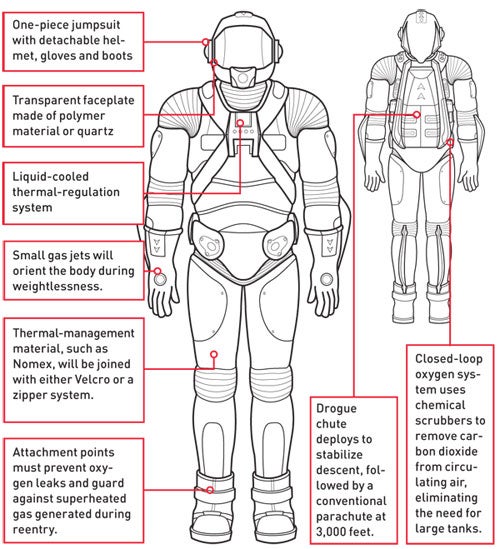
To develop the systems necessary for safe jumps from this and even higher altitudes, he and Tumlinson are pulling together a team of respected specialists. They will help Orbital Outfitters design space suits for their own dives and for other companies’ future space-tourist operations. Tumlinson has hired noted aquatic-dive and life-support specialist Bill Stone [see “Robot Subs in Space,” February] to create the internal thermal-regulation and breathing systems for the suits, as well as their data-acquisition systems. Chris Gilman, the founder of special-effects company Global Effects, will design the pressure suits. Gilman is an Academy Award-winning designer who has created replica space suits for movies, including Armageddon, as well as prototype suits for NASA. The actual engineering of the suits–that little save-your-life part–will be managed by Tomas Svitek, a NASA consultant and freelance program manager who Tumlinson has brought on to make Gilman´s designs technologically sound [see the graphic above for an annotated look].
Shoot Up
Although his company’s focus is on descent, Tumlinson can’t test his suits or entice paying customers without a vehicle to carry them high enough. He’s looking past balloons, which involve an hours-long ascent. (For one thing, he plans to sell a reality-show program to a television network to help fund the venture, and rocket launches are much more exciting than using balloons.) Tumlinson has approached both XCOR and Armadillo Aerospace, another company attempting to create its own manned space-launch system. These young, upstart space-tourist efforts tend to miss the timetables they set for themselves by grand margins, so Tumlinson is casting a wide net.
His longest-standing relationship is with entrepreneur John Carmack, the Texas-based creator of the Doom and Quake videogames who created Armadillo in 2001 to develop a rocket that could carry passengers into suborbital space. Carmack’s proposed single-stage system is a simple platform resting on top of two stacked modules, each containing four spherical fuel tanks powered by four engines. Far denser than a balloon, Carmack’s rocket–a smaller version of which has so far ascended to only 164 feet–can fly in less-than-ideal weather. That stability, combined with the slow acceleration of his liquid-oxygen and ethanol-powered engine, creates another compelling element of the space-dive experience: an open-air trip to altitude, strapped into the chair with the great outdoors washing over you at 250 miles an hour in the lower atmosphere. “It’s like being in a Formula One racecar without a windshield,” Carmack says with a smile.
Fall Down
If all goes well, a jump from 120,000 feet should be relatively peaceful. As the rocket gains altitude and the atmosphere thins, the sensation of speed diminishes to nothing, and during the initial plummet, heat and G-loads are minimal. In fact, you’ll hardly know you’re moving. The drogue chute should keep you stable, you won’t break the sound barrier, and the thicker lower atmosphere will slow you to a 120mph free fall. At 3,000 feet, you can pull your main chute just like a regular skydiver. And if Clark and Tumlinson succeed, the 120,000-foot jump record won’t stand long, because theoretically, jumping from 60 miles shouldn’t be much harder. “If Carmack delivers the vehicle and we deliver working suits on the 120,000-foot jump,” Svitek says, “that’s 90 percent of what you need for the 60-mile suborbital dive.”
The missing 10 percent, though, might mean the difference between living and dying. First, without anything to push off of, there’s no way to turn around in space. Once you’ve separated from the rocket, Svitek notes, “You need to worry about orientation.” He envisions a simple cold-gas jetpack built into the suit, “almost like aerosol cans,” he says.
Then, passing into the upper atmosphere from a greater altitude and at higher speed, several dangers present themselves. This is where Clark’s knowledge comes in. Among the known dangers are heat and G-forces, which arise when air friction slows you from 2,500 mph at the top of the atmosphere to 120 mph in the thicker lower air. The Gs are a sustained but manageable 4.4. The heat is a bit trickier. Temperatures of 464