Anatomy of a Solar Storm
The worst solar-storm season in half a century starts this year. These fiery explosions-which unleash as much energy as a billion hydrogen bombs-could, under the right conditions, black out cities and fry satellites. But new solar scopes can give us advance warning
Last December, a colossal wave swept across the entire solar surface within minutes, bulldozing everything in its path. The rare tsunami-like shockwave formed on the heels of a major flare that erupted from an Earth-size sunspot 15 minutes earlier. Though that storm didn’t have a major impact on Earth, we aren’t always so lucky.
The Earth’s magnetic shield protects us from the worst effects of solar storms (and even astronauts on the International Space Station can take cover in a heavily shielded module), but technology suffers greatly. Atmospheric and magnetic fluctuations that the storms cause can also disable satellites, burn out transformers, and take down power grids. One CME in 1989 left all of Quebec without power for nine hours.
The frequency and intensity of storms varies depending on the solar season, which waxes and wanes in 11-year cycles. We will soon be entering into a new season of high solar activity, and experts predict-by crunching data on the long-term behavior of the sun’s convection currents-that it will be the stormiest in half a century.
Though we can’t yet predict such storms, it’s only a matter of time. Space-weather forecasters use satellites and ground-based scopes to monitor sunspots for flares and CMEs but can’t tell with certainty if or when they will hit Earth. The STEREO satellites will help scientists determine whether a particular storm is headed for us and, hopefully, will give satellite and energy-grid minders enough warning to prepare for a hit.
** Read on for to learn how solar storms work, then launch the gallery here for a look at the satellites and observatories that are keeping us informed.**
- **Sunspots
**
Sunspots form where intense magnetic field lines twist and poke up through the surface. These knotted fields shut down the normal flow, or convection, of hot plasma from the sun’s interior to the surface, making the region cooler and darker than its surroundings. - **Field Lines
**
Sunspots explode when the field lines twist to the point of snapping, like a rubber band wound too tightly. They link up again to form a new shape, but not before releasing enormous amounts of stored energy and hot gas into the sun’s outer atmosphere, or corona. - **Solar Flare
**
The resulting eruption, called a solar flare, heats the surrounding gas to 180 million degrees Fahrenheit. The explosion accelerates subatomic particles to near light-speed and spews radiation (mostly ultraviolet and gamma rays and x-rays) into space. - **Plasma Burst
**
Flares are sometimes followed by coronal mass ejections (CMEs), in which billions of tons of the sun’s plasma are flung into space en masse. These huge bubbles of matter travel relatively slowly (1,000 miles a second); even the fastest ones take a day or so to reach Earth. - **Earth Impact
**
Eight minutes after a flare erupts, Earth’s atmosphere absorbs the radiation pulse. This pulse produces extra ions and electrons, causing the atmosphere to puff out. The expanded atmosphere increases drag on satellites and degrades radio and GPS signals. But the worst is yet to come. Potentially more destructive than a flare’s radiation pulse, CMEs boost the speed of the solar wind and create a shockwave of energetic protons. That shockwave distorts Earth’s magnetic shield, and the protons stream down on the poles creating geomagnetic disturbances like the Northern Lights. The shockwave can also destroy the electronics in satellites.
SDO
NASA’s Solar Dynamics Observatory will observe processes like convection and sunspot formation, with the goal of predicting solar storms weeks before they erupt.
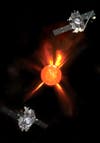
STEREO
A pair of satellites, the Solar Terrestrial Relations Observatory, will generate the first 3-D views of solar flares and coronal mass ejections and will predict which events threaten Earth.
SOHO
The Solar and Heliospheric Observatory’s spectrographs and cameras have provided much of what we know about space weather and solar physics today.
SOLAR SENTINEL
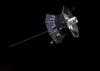
Four satellites in Solar Sentinel will fly in varying orbits around the sun, monitoring a solar storm’s path all the way to Earth. A fifth orbiter will watch the far side of the sun.