My Rocket is Going to Get You to LEO!
...and other rallying cries from the fringes of the final frontier.
UC Berkeley space scientist Greg Delory devoured Carl Sagan’s books as a kid; now he hunts for extraterrestrial water–and life–in the solar system.
Jeff Greason learned to pick locks at Caltech, from none other than Richard Feynman; now he burns LOX (liquid oxygen) in engines built by his California rocket company.
Alexander Poleschuk spent six life-changing months aboard the space station Mir; now this Russian ex-cosmonaut obsesses over his nation’s lofty space goals–and its inability to pay for them.
Three men, three visions of space exploration. As NASA scrambles to recover from the Columbia tragedy, the next phase of spacefaring has already begun. It’s an era marked by new philosophies and agendas–and, according to Rick Tumlinson of the Space Frontier Foundation, a space-travel advocacy group, by three types of space adventurer. There are the Saganites, who yearn to comprehend outer space; the O’Neillians, who want to colonize it; and the von Braunians–who just want to get there first. Welcome to their worlds.
The Saganite: Too Many Questions to Count
When Cosmos 1, the world’s first solar-sail-powered spaceship, launches, probably in late 2004, events should unfold something like this:
A modified Cold Warâ€era intercontinental ballistic missile, fired from a submarine, breaches the surface of the Barents Sea, with the Russian-built solar-sail craft aboard. The rocket gathers speed over Siberia and noses out over the Pacific. At the top of its trajectory, an engine kicks the craft into a high orbit, and there, at an altitude of about 500 miles, pneumatic tubes deploy its eight vast
triangular sails, which emerge like silk scarves from a magician’s hat. The sails are 44 feet long, 33 feet wide, and made of aluminized Mylar 1/20 the thickness of a human hair. Now that they are fully extended, the craft looks less like a celestial ketch than a giant daisy.
The spacecraft orbits Earth five, six, seven, up to 10 times. Then its presence is detected by the telemetry dish at UC Berkeley’s Space Sciences Laboratory. In the space operations center, Greg Delory and colleagues get a lock on the spacecraft’s coordinates: It’s where it should be. Data streams in, appearing on the screen of a PC. Delory, one of the scientists who tracks the craft’s position, is in constant contact now with both MOM and POP–that’s Mission Operations Moscow, headquarters of the Russian engineers who built the craft and will steer it, and Project Operations Pasadena, headquarters of the Planetary Society, the space-advocacy organization that is sponsoring this experimental flight. It is a big moment, foreshadowing the day–a “when” not an “if” now–that a craft of similar design leaves Earth orbit and ventures into the cosmos.
Dressed in cargo pants and a black T-shirt, Delory, 35, has the powerfully compact dimensions of a Hasbro action figure (spaceship sold separately) and looks a bit like a young John Glenn. He is an experimental geophysicist here at UC Berkeley, the kind of congenital whiz kid whose high school science project is chosen to fly on the space shuttle (as in fact Delory’s did, in 1991) and who never looks back. His day job includes developing low-frequency sensors to be sent into space to detect, among other things, deep subsurface water and the effects of solar eruptions on Mars and other planets. “Supergeek” might be an appropriate epithet, if he did not also hold a black
belt in karate.
Delory is tantalized by the notion of solar sailing, and who wouldn’t be? You start with an ancient technology that was central to opening up the globe–sailing–and then, as astronomer Carl Sagan’s widow Ann Druyan puts it, you “learn to ride the light the way we’ve learned to ride wind.” A solar-sail craft is driven forward by sunlight–photons–which strike the sail and bounce back. That change in the momentum of the photons is what transfers energy to the sail craft and gives it its “push.” (Because the intensity of sunlight decreases with distance from the Sun, some scientists have proposed, for long journeys, a solar-powered laser moored in orbit and pointed at the receding sail.) A solar-sail craft will, theoretically, gain speed the way a savings account accrues compound interest–making it faster, in the long run, than even the nuclear-powered Voyager 1, which since its launch 27 years ago has traveled eight billion miles, beyond the orbits of all the planets in our solar system, and is now the most distant human-made object in the universe. Some astronomers think solar-sail power has the most potential for deep-space missions, such as ferrying people and cargo to Mars, or even interstellar journeys.
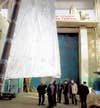
Cosmos 1 has already been accorded a place in the history of aeronautics: One of its sails hung in New York City’s Rocke-
feller Center during the Centennial of Flight exhibit last summer. Replicas of the Wright Flyer, Apollo 13 and a Redstone Rocket shared the space; the solar sail dwarfed them all.
The canonization, though, may be premature. Ever since Russian rocket scientist Fridrikh Tsander first wrote about solar sailing in the 1920s, nobody, including NASA, has been able to demonstrate that it works. So sensitive will Cosmos 1 be, up there in the near-vacuum, that atmospheric turbulence from solar flares, even outgassing from its own materials–the craft’s own breath, so to speak–could buffet it in unpredictable ways. And there’s no guarantee that the fundamental principle is sound. “Theoretically, sail pressure should be 10 times greater than drag,” Delory says. But there’s at least one scientist–Thomas Gold, a noted Cornell University astrophysicist–who thinks it’s hooey. Gold believes the solar-sailing concept violates the thermodynamic law of entropy–one of the prime laws of physics. In his opinion, photons wouldn’t move a craft forward.
But Louis Friedman, executive director of the Planetary Society, argues that sunlight pressure was proven by James Clerk Maxwell in the 1860s and has been measured and accounted for on many space missions. Hence, the upcoming test of Cosmos 1. This craft isn’t going far and has no particular destination in mind. It’s an experiment designed to show that sunlight hitting Cosmos 1 will exert a force strong enough to change its orbit. “People have this image of Cosmos 1 cruising out into the open ocean, when actually it’s more like setting out in a rubber dinghy in stormy seas,” Delory says. “You’ll reach shore just a little faster than you would by drifting. It’s like when Columbus set off–except we’re not getting out of the harbor.”Delory is probably best known for leading the design team that built the Mars microphone–a cigarette-pack-size sensing device that rode the Mars Polar Lander into oblivion five years ago. The device would have transmitted back to Earth the first-ever sounds of Mars–providing another sensory dimension to our “experience” of the Red Planet–had the lander not been lost. (It fell inexplicably silent moments before touching down near the Martian south pole in December 1999.)
In the tripartite division of space enthusiasts, Delory is a Saganite, a person infused with the space-exploration ethos of Carl Sagan, the astronomer who popularized space through his books, TV show Cosmos and film Contact. The adventure, Sagan believed, is not about flags and footprints; it’s an existential quest, an attempt to answer the big questions. The Saganites’ currency is wonder: They believe in exploring for exploration’s sake, and they don’t condone exploiting the universe for human gain.
“There’s no way we’d have gotten this far if profit was in the driver’s seat,” says Druyan, who’s carrying on her late husband’s legacy (her company, Cosmos Studios, is bankrolling Cosmos 1 to the tune of $4 million). “You have to fund things that don’t have an immediate or even obvious payoff, because, as anyone with even a casual acquaintance with science knows, very often when you’re looking for one thing, you find something else.”
The Cosmos 1 project is chock-full of Saganite elements: international cooperation, eco-friendly propulsion, and millions of people having a virtual exploration experience by tracking its movements on the Web. The swords-into-ploughshares element (the Russian rocket carrying Cosmos 1 was
once pointed at an American city) in particular would have delighted Sagan. Ultimately, though, even if Cosmos 1 succeeds, behind the answers it provides will lie more questions, too many to count–and Saganites, being Saganites, will surely embrace every one.
The notion of one day using a solar-sail craft to carry a provisioned human payload on an interstellar mission comes with many sets of problems–not least of which is the need for solar sails so large they would be vulnerable to being shredded by cosmic debris. That doesn’t deter Delory, though, because to him it’s not essential that humans charge into space en masse, at least anytime soon.
Saganites prefer unmanned to manned space travel in most circumstances as safer, cheaper and more practical. Human flight crews, as the astrophysicist James Van Allen put it somewhat controversially in a 1992 lecture, are “of dubious efficacy, and will probably be the technique of choice only in specialized subfields.”
“One day we will go to these places,” says Druyan. “But for the time being it’s silly not to send robots. We’re new at this. We’re a bunch of tyros, amateurs. The idea of risking lives in order to engage the public has too much of a gladiatorial disrespect for human life for my taste.”
Delory believes we haven’t begun to exhaust the potential of virtual exploration. “Take a look at Mars Pathfinder,” he says. “They used 3-D goggles to have a person navigate the rover. If we had enough time and money, we could add a microphone system that really does mimic the human ear and its response to sound –including our ability to sense sounds directionally. If you recorded from the surface and had a 3-D serial camera, you could then play back a virtual reality experience for a user on the ground.”
“There’s a tendency for proponents of human exploration to write off robots,” he adds. “They’re stupid, they’re slow, they have to be told what to do. And I think that’s not doing them justice.” Delory imagines a future space program in which human crews and robotic systems work together to efficiently explore the solar system. This human-robot synergy would maximize the scientific return: Robots would function as scouts to provide data on planetary environments, then humans would be dispatched on follow-up missions to conduct detailed studies of the most interesting targets. He does see humans venturing beyond the Moon, but only after robots have laid a scientific foundation. Would he go? Probably–in fact he has applied for NASA’s astronaut-candidate program. But in some ways the best vantage point on the big picture is right here, at the heart of imponderable unknowns.
“Who are we?” he asks rhetorically. “Are we part of a unique happenstance or are we part of a grander scheme?” His eyes settle on the Mars globe on his desk. “You know, rather than go to a place of worship on Sunday, I’d rather find out that there’s a microbe on Mars, and it’s pretty close to our DNA. And then you look at all those stars and you realize, There’s a bigger purpose here.”

The Saganite: Easy Does It
Power Players
Von Braunian: Open Society, Cl
by Jeff Minton
Power Players
Will It Fly?
The Oneillian: If We Build It
Power Players