When Is a UCAV Not a UCAV?
The Pentagon's plan for a low-cost, modest vehicle is bloated beyond recognition.
by Infographic: John MacNeill
Pilots often volunteer for the most difficult missions, but the Pentagon continues to press ahead with its plan to build an unmanned combat air vehicle, or UCAV, that could fly without risking a pilot’s life. A simple plan, but it’s become increasingly ambitious-though a proven, simple UCAV model exists: Predator. Originally built for recon, the Cessna-size Predator was fitted with Hellfire missiles in 2001 and has since carried out successful strikes in Afghanistan, Yemen and Iraq. The
Air Force is testing a bigger version, the MQ-9 Predator B, which carries 3,000 pounds of smart weapons (up from about 400 pounds) and whose 50,000-foot cruise altitude puts it beyond reach of the most common threats-guns and shoulder-fired missiles. A Predator B costs $8
million; the Pentagon’s planned UCAV has an anticipated price tag of at least $25 million.
That inflation means the Pentagon has lost sight of its goal, warns DARPA’s first UCAV program manager, Michael Francis, who’s now at Lockheed Martin. The UCAV as originally conceived, he says, “was designed to get us out of the death spiral”–the term for the trend in which each generation of military airplanes costs more and is built in smaller numbers than the one that came before it. If a next-gen UCAV costs three times as much as the current model, one has to wonder whether the military can afford such disposability.
Unmanned combat aircraft not only save lives; they don’t sleep and so can focus on a task indefinitely. But lacking a human brain–what one pilot calls “the five-pound shoulder-mounted computer”–they can’t be trusted to tell a Scud from a school bus without the help of an operator on the ground. If the radio link
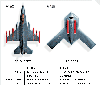
is lost, UCAVs go dumb. Given such limitations, how elaborate should unmanned combat aircraft be? The original 1999-era UCAV, the X-45A, was to cost around $10 million and carry 1,500 pounds of bombs. But the military is now mulling the X-45C, an F-16-size craft that would carry 2 tons of bombs. Plans revealed in March call for the Air Force to have 36 such combat-ready UCAVs by 2010. Pentagon officials insist the beefed-up specs are needed: Their new UCAV will be stealthy, which the Predator is not, twice as swift as Predator, and have greater range and endurance. Says UCAV program manager Col. Earl Wyatt: “If we can do the same thing as everyone else, the answer will be, thank you, no, I’ve already got it.”