Space Shuttle: The Next Generation
Even if it's fixed, the disaster-prone Shuttle may not be allowed to fly as long as NASA requires. The agency's plans to replace it are in disarray. But there are concepts on the drawing board.
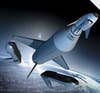
Illustration by Bob Sauls/Frassanito & Associates
Northrop Grumman’s proposal employs two liquid-fueled flyback boosters and a central rocket to push either a crew- or payload-carrying vehicle into orbit. The central rocket and fuel tank also return to Earth for future use, creating a completely reusable system. By contrast, the current shuttle’s external fuel tank burns up as it reenters the atmosphere after being jettisoned.
Last November, NASA took decisive action on its two-and-a-half-year-old plan to replace the aging space shuttle.
It cut the heart out of the project.
Abruptly and quietly, NASA scrapped the shuttle-replacement portion of its so-called Space Launch Initiative (SLI)–the latest in a string of development programs conceived in the wake of the 1986 Challenger disaster–and shifted most of the nearly $5 billion the agency had already earmarked for the program to pay for current shuttle improvements. Among them: safety upgrades that it hoped would let the shuttle fly accident-free until 2020 or beyond. And with plans for a new shuttle on hold, NASA announced that SLI would focus mostly on building an Orbital Space Plane, a modest, relatively inexpensive reusable vehicle that could hold a small crew (and little else) and would be launched by an expendable rocket. NASA hopes that when OSP is ready in 2010, it will serve as an interim, alternative transport, a “space taxi” until the agency can produce a next-generation shuttle.
NASA’s decision was a last resort. The agency’s latest estimates for designing and building a new shuttle had mushroomed from $6 billion to $35 billion. And even that was only a best guess, says Garry Lyles, NASA’s Next Generation Launch Technology program manager. The gap between the figures, Lyles says, reflects NASA’s difficulty with budget forecasts: “We need to develop a technology program that provides accurate data for our cost models.” While so much uncertainty surrounded SLI’s price tag, the shuttle’s cost–$500 million per launch–was at least a known quantity. Consequently, NASA officials believed they had no choice but to place yet another bet on the 30-year-old system.
But three months later, Columbia broke up on reentry, killing its crew of seven, and the agency’s decision to shelve the new shuttle program took on a troubling cast. The three surviving shuttles are now grounded, and when they fly again, they’ll cost more to operate than before. Safety, maintenance and inspection protocols will be added, and because there’s one fewer shuttle the total number of flights will be reduced while fixed personnel and infrastructure costs remain the same. The upshot: With so many economic and engineering questions weighing on the shuttle concept, NASA’s plans to fly it for another 20 years suddenly smacks of blind optimism.
Which means that NASA must face far sooner than ex-
pected the considerable challenge of what will replace the shuttle. There’s no shortage of ideas. The SLI and its precursor shuttle replacement programs were ended primarily because NASA insisted that any new system be a huge improvement over the shuttle instead of being merely more efficient and cost-effective. That often made these projects overly expensive and ambitious. But many of these proposals contained critical technological information that points to the feasibility of building a more durable, less complicated reusable spacecraft–with improved rocket engines, streamlined ground-support procedures and modern safety-enhancing diagnostic systems, among other things–for less money than the $35 billion figure NASA feared. “There’s been one proposal practically every year for a new space launch system like the shuttle since the shuttle first flew,” says Bob Parkinson, who managed the now defunct Hotol reusable launch vehicle project for British Aerospace in the 1980s. “And all of them would have been better than what we have.”
A Leap Forward, then a Fall
To grasp what’s wrong with the shuttle, it’s important to understand how it works. The Space Transportation System, as the shuttle is officially known, is an orbiter–the winged crew- and payload-carrying vehicle–mounted to a large external fuel tank that has a solid rocket booster attached to each of its sides. At ignition, both solid rocket boosters, which provide most of the thrust to lift the shuttle off the launchpad, and the orbiter’s three main engines fire; the rocket booster motors are powered by solid fuel, a mixture of ammonium perchlorate and aluminum, from their own canisters and the orbiter’s engines are driven by hydrogen and oxygen from the external tank. About two minutes after launch, when the shuttle is about 28 miles high, just above the lip of space, the solid rocket boosters run out of fuel and separate from the external tank. They parachute into the ocean and are recovered for use on future missions. The orbiter and the external tank continue rising for another seven minutes, and then the external tank separates to disintegrate in the upper atmosphere. The orbiter’s engines place the shuttle in orbit anywhere from 150 to 300 miles above Earth’s surface. At the end of the mission, the shuttle lands like an airplane.
When it was designed in the early 1970s, the space shuttle was a gigantic leap forward. It was the first reusable spacecraft, a vast upgrade over the expendable small-vehicle-on-large-launcher system of the Apollo era. And with a payload of up to 50,000 pounds, it could carry more equipment, crew members and cargo than any other manned space vehicle.
But the shuttle also had significant flaws, which have become obvious over time. To start with, it is more inefficient and expensive to operate than NASA had originally envisioned. It takes thousands of people to run a shuttle flight, in part because some of the technology choices initially made by shuttle engineers proved problematic. Consider the huge array of computers: Each on-board system–electrical, engines, avionics, communications, to name just a few–is a separate component and must be monitored by an individual on the ground. What’s more, hundreds of maintenance workers are needed during turnaround to inspect and repair everything from the old-fashioned solid rocket boosters–which because they use solid fuel cannot be shut off once they are ignited, and thus must be hardened before each flight against failure–to the fragile tile system that is supposed to keep the shuttle from burning up during reentry.
The excessive weight and size of the orbiter is also a drawback. When the system was built, the Pentagon insisted on the ability to snag disabled satellites and return them to Earth, which required a larger, sturdier orbiter. But the shuttle has hardly ever been used for that. And NASA’s goal was to send the shuttle into space 30 to 50 times each year on science and satellite launch-and-recovery missions for the public and private sectors. The agency figured the cost of maintaining the big payload and oversize orbiters would be more than offset by a long line of customers who would keep the shuttle and its crew busy. But in reality, the shuttle has averaged only five launches a year, with few paying customers; the economies of scale NASA had hoped for never materialized. “Rarely do you see an instance where state-of-the-art technology enters service,” says Keith Cowing, editor of Nasawatch.com. “You live with whatever moment in time you froze your design.”
As early as 1986 federal officials tried to replace the shuttle with a spacecraft called the National Aerospace Plane. This sleek vehicle was supposed to look like a plane and fly into orbit powered by an air-breathing engine called a supersonic combustion ramjet, or scramjet. That effort was canceled in 1993 when it became clear that the decision to pursue scramjet technology was a bit premature. Since then, there have been a number of other ideas under consideration (see sidebar, page 81) but SLI produced a series of designs that offered for the first time a fully formed picture of what the future shuttle is likely to be. Concepts were designed by Lockheed Martin, Northrop Grumman, Boeing and Orbital Sciences, among others. All of them use boosters to get payloads into orbit, but that’s where the similarities to the shuttle end. For instance, an intriguing design was the Boeing “bimese” reusable launch vehicle (RLV), which has two nearly identical winged rockets stacked together with the orbiter or payload container perched on top of the upper rocket. The reusable launch vehicle takes off vertically with all engines firing. When the fuel runs out in each booster rocket, it separates from the RLV and glides back to Earth to land on an airstrip. The advantage of the bimese approach is that because the two rockets are virtually indistinguishable, it’s only necessary to build, test, operate and maintain one winged booster design. With a single set of engines, landing gear, controls and other systems, it’s a much simpler spacecraft to manage than the shuttle.
Northrop Grumman was particularly busy during SLI. It proposed several vehicles, including a launcher that uses an enormous jet, equipped with six engines and an oversize wing, to carry the booster to 40,000 feet, where it would disengage and fire its rockets for the final hop into orbit. And Northrop’s collaboration with Orbital Sciences produced an RLV with two identical tank-shaped boosters seated below an orbiter-carrying, upper stage space plane. These so-called flyback boosters are fitted with jet engines that power them back to Earth after the boosters rocket the upper stage above the atmosphere.
The vehicle shown on our cover, Andrews Space & Technology’s Gryphon concept, is farther reaching. A plane-like launcher accelerates an orbiter to Mach 6 before a high-altitude release. Gryphon’s innovative propulsion system uses liquid oxygen, drawn and compressed from the air, as fuel.
What’s most significant about the SLI contenders is that the developers have engineered out all of the most gaping shortcomings in the current shuttle design. For one thing, the outdated solid rocket boosters–which require intensive reconstruction after each use–are gone, replaced by modern liquid-fueled rocket engines that mainly operate on hydrogen or kerosene; they’re much safer because they can be shut off or throttled back after they ignite. Another long overdue improvement: SLI engineers have eliminated the delicate and precarious heat-resistant tile system. Instead, they use lightweight “shingles” with nickel-alloy skins over ceramic-fiber insulating blankets to protect the orbiter and upper-stage boosters from the dangers of reentry. Unlike brittle tiles, the metal-skinned shingles can be bolted securely to the airframe.
The computers in the next-generation shuttles have also been entirely revamped. To reduce the huge workforce needed to monitor every tiny event in the mission on the ground, each instrument that measures temperature, pressure, strain or vibration, among other things, in SLI vehicles has its own built-in computer, which doubles as a node on a network extending throughout the RLV. This network is made up of expert systems. These programs can constantly read signals from each computer on the network, isolate problems in real time and predict failures. Coupled with escape systems that today’s shuttle lacks, the computers could possibly save the lives of the crew during an accident by signaling when to bail out or even by separating a crew capsule from other parts of the RLV that are in danger. “There are three levels to safety,” says Doug Young, Northrop Grumman’s space systems director. “The first is to make the vehicle more reliable. The second is to provide the crew with an escape system and the third is to make sure that the crew knows when to get out.”
In perhaps the greatest break with the shuttle, the new launcher and orbiter designs are much more appropriately scaled to NASA’s real needs–that is, for a slimmed-down and, at times, unmanned reusable launch vehicle. The current shuttle has rarely approached its full payload capacity and often a crew isn’t required. SLI concepts contain a smaller orbiter that travels without a crew if the on-board task–such as putting a satellite into orbit or conducting a science experiment remotely–can be automated.
**It’s the Accounting, Stupid
**
Whether NASA ever replaces the shuttle with a new vehicle will depend on the agency’s ability to improve its woeful budgeting skills. In a report on SLI issued last September, the congressional General Accounting Office chastised NASA for lacking any modern financial controls. It’s no surprise, then, that NASA cancelled the shuttle-replacement program not necessarily because it was too expensive but because the agency really had no idea what it would cost. “SLI was deceptively simple,” says Kevin Neifert, director for advanced space and launch systems at Boeing’s Phantom Works, “but there were very aggressive goals around safety and reliability
and operating costs.”
In proposing a shuttle replacement, NASA circumvented a basic rule of business school: “Quality, speed and cost–choose two.” Under NASA’s benchmarks for the program, which anticipated a new spacecraft within a decade, the agency wanted to guarantee that a crew would not be lost more than once in 10,000 flights–40 to 70 times better than the shuttle’s projected performance and 180 times better than what the shuttle has so far achieved. The agency requested an operating cost of only $500 million annually for a fleet of three or four vehicles launching every few weeks. That would be about the price of a single shuttle flight–a great idea but an impossible request. “Even a factor-of-two improvement in cost would be wonderful,” said Antonio Elias, general manager for advanced programs at Orbital Sciences, before SLI was cut back. “If NASA could reduce its $3 billion a year [shuttle budget] to $1.5 billion, it would justify the cost” of a new reusable launch vehicle.
Aviation experts contend that if NASA alters its business model and improves its understanding of the economics of a new shuttle, the RLV designs now afloat could be built for far less than the $35 billion the agency forecast a new shuttle would cost. For instance, instead of asking for an unrealistically flawless and overly reliable vehicle, which will add hundreds of millions of dollars to the RLV price tag, a better option might be for NASA to accept a much less expensive and easier to maintain computerized crew escape system. This would make the RLV safer than the current shuttle and less costly to build.
The truth is, NASA is preoccupied in the Columbia aftermath and continues to be vague about its intentions regarding the shuttle. The agency says that by next year there will be a decision on a shuttle-replacement schedule. One possibility might be a five-year effort to develop key components like lightweight fuel tanks and more advanced rocket engines. Then, in 2009, NASA could determine whether to go ahead with constructing a full-scale RLV based on those technologies; a replacement shuttle might fly by 2015. Alternatively, if NASA chooses to delay a new RLV for longer, it could spend the interim developing “broad-based, longer-range” technologies, such as improved composite materials and scramjets.
But NASA’s long-term hopes to replace whatever reusable spacecraft it has with an air-breathing, scramjet-propelled, single-stage-to-orbit vehicle–a new version of the proposed National Aerospace Plane–won’t bear fruit for many years. The agency is still very far away from overcoming critical technological hurdles like sustaining thrust at hypersonic speeds and developing composite materials that can withstand such high-stress applications. Because the scramjet isn’t likely to be the next RLV that the space agency builds, or perhaps even the one after that, space experts argue that NASA can’t afford to wait and risk being caught empty-handed, without any reusable space plane in its arsenal. “NASA needs to stop having fun,” says St. Louis University professor Paul Czysz, who has been designing hypersonic aircraft and space planes since the 1950s, “and build a vehicle.”
Bill Sweetman is a contributing editor at Popular Science.