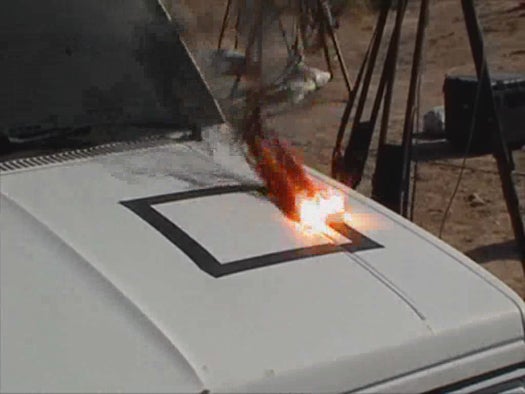
In a recent test at the White Sands Missile Range, a specially equipped C-130 plane fried a parked truck with a powerful laser. And while we still haven't seen evidence of the laser "defeating" a ground target, as Boeing puts it, a video of it scorching a direct hit on the hood of a truck is still pretty amazing.

As you can see, the laser beam burns right through the truck's hood, and then through the engine, "defeating" the vehicle. Called the "Advanced Tactical Laser" (ATL), this is the first time the megawatt-powered chemical laser has been used to engage a target in a combat simulation situation.

Now, to be fair, the car was parked by itself in the middle of the desert. So unless we've got a clean shot at Al-Qaeda's parking lot, the beam isn't ready for prime time. Plus, last year the Air Force Scientific Advisory Board said that "the Advanced Tactical Laser testbed has no operational utility."

Despite those reservations, Boeing is still confident that the laser will soon provide a weapon that can take out a target with little or no collateral damage.

Want to read more articles on the military, aviation, and space? Subscribe to Popular Science and enter to win $5,000!

41 Comments

Could I get it to light my camp fire for me?

It's accurate...

A cigarette lighter for billionaires

there are handheld laser pointers for like $500 that can light matches, paper, and cigarettes.

but if u used this on al qaeda, aim for his eyes and literally burn out his eye balls.

Hm looks somewhat underpowered Oo. Would've imagined something more impressive

They need those kids from "Real Genius" to help them out

Well its about freakin time, now I can get my sharks with lasers!

TheCommonCold

from Plainfield, IL

I think you'll have to stick with ill-tempered sea bass for the time being.

Aiming lasers at eye-balls is a strict international no-go (on par with chemical and biological agents). Blinding weapons are not allowed. Period.

For a laser to be workable, it needs to be able to do something conventional weapons cannot. Blowing up a truck is not such a task.

Now, if it had the ability to fire rapidly at multiple targets and eliminate them all swiftly and economically without having to carry tons of munitions, then it might be worth something. If it can pierce tanks equiped with anti-tankbusting tech (pre-exsplosive siding, etc), then it might have a purpose. If you can put this thing on a long burn to go deep into the ground as a hole puncher for later munitions, then it would have a purpose.

Of course, if you can put it into space and have it fire practically anywhere on earth from a satelite feed, then you have something cool, useful, and, once again, against international law.

While not good at taking out hardened targets, airborne lasers will do an excellent job of frying eyeballs.

We can imagine the future of war casualties to be a large proportion of sightless people.

I also fear that a cheap airborne laser could be used as a terror weapon to blind people who look at it at night. Likely the best way to quickly defeat such a device is to shoot it down with a laser.

Tomorrow the taliban will be driving around in mirror-covered vehicles.

I'm afraid most of the commentors here are missing the point. The airborne laser was not designed, nor would it be used, to take out tanks or any other minimally hardened targets. The use of a truck as a target, then putting out this video to the public, was kinda stupid on the part of BMDO.
The airborne laser was designed to be used on ballistic missiles during the boost phase. To reduce weight on the missile (and allow a more robust, heavier payload) the skin of missiles is thinner than the sheet metal on a normal truck. It is used for aerodynamics only, not strength. And right below this thin sheet metal is a delicate warhead(s), or delicate guidance systems, or better yet, delicate parts of the propulsion system. A laser that can burn through the thin outer layer then into any of the aforementioned interior systems will keep the missile from accurately finishing it's intended arc, thereby ensuring a failed attack. The missile may in fact fall back onto the land area of the nation that fired the missile, or explode in flight.
Luckily most of the missile scientists working for nations that would fire a missile at any US target (in CONUS, or US installations OCONUS) will see this video and understand that their missile PKs (probability of kill) just went down by a huge factor. That's pretty much all it's been built to do.

I've seen laser pointers from China that can pop a balloon. $30 a pop. Prolly light a match as well.

This video only shows the paint on the hood of a vehicle catching fire. It looks more like a fuse to a firework, than any kind of demo for an airborne laser. Nothing in the video shows it is more than "smoke and mirrors." C'mon PopSci, you can do better than this.

i don't think it even pierced the hood. it only got charred.

Airborne laser defenses in the boost phase are only effective if there is a flight of planes over the area where missiles are launched. This airborne laser is therefore only a weapon to support offensive operations if what is said above is true, that is after significant assets are already in theater.

I can see however other value for these lasers than just intercontinental missiles.

I too have a new toy, Mr. Bond.

Any idea the range of the laser or what the altitude of the plane was in this demo?

It's easy to tare apart a dvd burner to make a super laser pointer. There are just rules for such devices making them difficult to sell so just make your own. Ive been wishing I could get some hddvd burners cheep to make super blue laser pointers but I cant seem to find em.

I guess i'll just have a missile with mirrors... too bad the video doesn't show a moving target. I'm not yet impressed.

Apologies Diggs, but you're incorrect on the concept. the Airborne Laser (ABL) is one of several weapons platforms using lasers that the U.S. DD is working on. The ABL was a system using large Boeing B747-400 aircraft with a nose mounted laser (that, BTW, work on a different yet similar principle than the weapons being worked on at White Sands) that would be used for mid altitude missile defense.

The ABL was canceled by the U.S. Congress (death by budget cut) due to lags in progress and technical difficulties in developing the weapon.

This system utilizing the C-130 has a sole purpose of redefining conventional warfare. This laser system is meant to make missiles (and possibly large caliber rounds) obsolete in the battlespace due to the system's pinpoint targeting accucracy and minimal to zero collateral damage potential.

"Welcome! to the Federation Starship SS Buttcrack!!!"

Oakspar77777
>Aiming lasers at eye-balls is a strict international no-go (on par with chemical and biological agents). Blinding weapons are not allowed. Period.<

Actually the rule is a *low power* laser that will *only* blind people is a no-go. A laser powerful enough to kill or seriously maim is A-OK (on par with, you know, GUNS) even if aimed directly at the face. This prototype laser burns through metal - so the battle ready version will probably do more than blind, and hence be legal.

I want one for the next time that some jerk cuts me off!

tonnes,
this laser is a heat laser. mirrors only work on optical lasers. if the laser was aimed at the mirror, it burn right through.

Okay, since lasers only work by energy transfer, then just use a mirror covered, liquid cooled, armored skin, and you're all set. If you can dissipate the heat created by the laser (refraction by the mirror, and cooling by the cooling system) then you've got yourself a solid defense from a laser. Problem solved. Sort of.

tempest: SHHHHH!

Yeah, tough luck if the weather isn't cooperating either. While having the ability to silently disable vehicles, machines, weapons, and missles would be great, there are some operational concerns for sure. Like tempest said, if you reflect the laser's energy by a mirror, white paint, angled surface it reduces the effectiveness of the laser. The raised ridge of the hood could have been targeted because of the improved angle of incidence. The acrid smoke of the burning paint and underhood plastics isn't a benefit either. However, if a laser powerful enough to burn through an engine was pointed at the hood of the car I wouldn't expect much more of a show than we saw in the video. So who's to say how powerful it is.

Was the C-130 flying or was it parked? That does make a difference. Static tests are much easier.

tempest: And you don't think having "a mirror covered, liquid cooled, armored skin" will be prohibitively expensive/heavy on vehicles? How do you plan to keep your mirror reflecting in adverse conditions? How do you plan to keep cool the liquid? Not to mention this is an airborne laser, meaning you'd have to armor the top of the vehicle as well. You might as well claim a time machine is a solid defense.

How much space in the plane did the equipment occupy, and how much did it weigh? Like, did it fill all the cargo space?

And how many shots are available? That was the problem with making lasers airborne for missile defense. One shot exhausted the capability, and tons of refrigerating equipment were required to make it work.

This is why many educated people believe that the program was, is and will continue to be a huge waste of money:

1. The laser itself uses a chemical reaction to generate a beam. The thing takes up most of the aircraft and the chemicals are highly toxic. The waste which is leftover after the laser is fired is also toxic. It takes a long time to get the laser ready just to fire once. It's impossible to repeatedly fire it in a timely manner.

2. The whole system is outrageously expensive. It requires a great deal of technology and the chemicals to fire it are expensive. There is also a lack of technology to aim it accurately in all but the best of conditions.

3. There are a number of ways to defeat it. One is to launch dummy missiles at the same time as the loaded one. The weapon needs time to burn through a missile and too much time to reload. The operators won't know which missile to aim their one shot at. Another method is to have the missile detect the infrared beam and deploy a cloud of shiny metal chaff. Metal mirrors will reflect infrared. For that matter, a chemical smoke cloud could absorb most of the energy before it reached the missile.

If weight is the problem, cover the missile surface with mylar which is a light weight metal film. Have the rocket spin while in route. The laser won't be able to concentrate enough energy on one point long enough to burn through.

There were already plenty of ways to beat this laser weapon before one was even built. But, certain Congressional Representatives from the states where the system was engineered and constructed pushed an authorization through Congress because of the windfall they would receive from certain giant aerospace companies. Certain high ranking military officials also had a hand in it and now, retired, make a sizable income as "consultants" to those companies.

The whole program hasn't even produced a viable weapon because the right technology doesn't exist yet and it may never be created. This whole thing was nothing but a dog and pony show to distract the public from realizing how many billions of dollars were flushed down the drain during the "Star Wars" program.

If you trust the government and the military to tell the truth, you are in for some very disturbing revelations.

Snerdguy is absolutely right. This is why SDI never came close to making a working missile defense shield. You'd have to count on having an enemy stupid enough not to take advantage of the fact that the countermeasures to laser weapons are a lot cheaper than the laser weapons. We'd go bankrupt trying to make the perfect weapon to overcome decoys, spinning boosters, and reflective coatings.

Laser weapons that can destroy ballistic missiles are absolutely possible -- but in the real world, the other guy doesn't just sit still while you make weapons to try to overcome his nuclear deterrent. Instead, the "bad" guy figures you mean to use your "defensive" weapons to give you the ability to launch a first strike against him without fear of retaliation, so he employs countermeasures, produces more nukes, and the world gets a lot less stable.

In the end, mutually assured destruction is the only option scary enough to guarantee nuclear missiles won't be used, as the Cold War so aptly demonstrated. Until we mature enough as a species to eliminate all nuclear weapons, this imperfect means of keeping the peace is unfortunately the best way to make sure nobody is stupid enough to launch their missiles first.

we need to make a laser that can cause an explosion, like the one from Independence day. then it would be ready for Iraq. but for now we will just have to use the hand held laser and burn al quaedes eyes

yes powerful and accurate on stationary target, but what happens when you have a moving target faster than a bullet like missles, rockets....

Just like frying ants with a magnifying glass except the ants were a moving target. Watch out ants, your days are numbered.

Just another peopleunit...

Perhaps I should show a demonstration, Fire the "Lazer"!
Actually that was just footage from the movie Independence day, but the real laser would be a lot like that, yeah.
Dr. Evil

That quote kinda describes the article. Most of you were probably expecting more, than just a little smoke under the hood of a car. That's why putting lasers on the ground are more practical, because they are more powerful, and don't cost as much. Or you could just put one on the moon...
But thats just my opinion.

What a waste..they mounted
a laser on a plane, brilliant. it took them
until 2009 to do this? this is right up there
with the WWII V2 rocket technology that still
powers the space shuttle.

-all smoke and mirrors to keep the Pols writing
them checks..

speaking of, seems like smoke and mirrors
is all you would need to defeat a laser, no?

Have they made something that can track
a Russian Sunburn missile yet?

How about showing us all the electromagentic
weapons in the skunk works. if you tune
an electromagnetic beam right,
you can disassociate the molecular
bonds via resonance..or even heat up
that truck with magnetic induction
if your on a low budget and still
think in brute force terms.

Better yet, how about stop playing war
games all together and get us off the
planet?? It kinda turns to mush for a short
period during a pole flip. I'd rather
be in orbit at that time rather than
trying to figure out were the safe spots
are on the planet..

-the games humans play... *shrug*

-s

this laser will not be released and it has no burning through metal effect it just burned the paint

I think this is awsome

kamploopstrout

from Mission, B.C.

The US military is a firin' their lazers!

Response to Snerdguy:
"3. There are a number of ways to defeat it. One is to launch dummy missiles at the same time as the loaded one."
There are various techniques to separate the wheat from the chaff - the only way to create a realistic decoy is to duplicate the mass, shape, etc of the actual missile. At which point you might as well use an actual missile.

"The weapon needs time to burn through a missile and too much time to reload."
ICBM skins are rather thin - just enough to survive reentry. A powerful laser would burn through it nearly instantly. This laser was a 100 kilowatt laser - the power of the ABL is measured in the megawatts. In case you can't do math, that's at least 10 times more powerful.

"The operators won't know which missile to aim their one shot at."
They have more than one shot. This is all automated anyways, humans are too slow.

"Another method is to have the missile detect the infrared beam and deploy a cloud of shiny metal chaff."
Chaff is a countermeasure against radar, not infrared. We have the computational power for signals processing to filter out the chaff. The drastic difference in aerodynamic profile will also separate the chaff from the missiles.

"Metal mirrors will reflect infrared."
There's so many problems with this statement I don't know where to start. For one, all objects above absolute zero emit infrared radiation. Not to mention reflecting the infrared waves makes the object MORE visible, not less. Objects during re-entry will have a huge difference in temperature compared to the background.

"For that matter, a chemical smoke cloud could absorb most of the energy before it reached the missile."
I highly doubt you can get this "chemical smoke cloud" to stay with the missile as it comes down at Mach 4. The very idea of some smoke absorbing a powerful laser is ridiculous.

"If weight is the problem, cover the missile surface with mylar which is a light weight metal film."
Mylar is a plastic. It also will not survive re-entry due to atmospheric heating.

"Have the rocket spin while in route. The laser won't be able to concentrate enough energy on one point long enough to burn through."
Already addressed - the laser will pierce through nearly instantaneously.

Even assuming your "countermeasures" were feasible, they would require a complete refit of existing missiles. Your comment has betrayed your ignorance in basic physics, and although I haven't researched your claims of 1 and 2, given your wildly inaccurate claims in 3, I highly doubt if their merits.

Again this weapon makes O sense..A billion dollar weapons system to punch holes through 1980's Toyota pick-up trucks..REALLY? Whats the benefit? We are not fighting time traveling cyborgs here...NO we are fighting afghan hillbillies who live in mudd hutts and packing soviet era AK-47s and (maybe) a beat up RPG...To hell with lasers (cost to much) Whats the price tag on using a C-130 cargo aircraft to drop pallets of cinder blocks from 30 thousand feet? I would be a lot more afraid of a shower of cider blocks raining down around me than some stupid over priced laser that might work half the time.


Download Our iPhone App

Stay up to date on the latest news of the future of science and technology from your iPhone with full articles, images and offline viewing


Follow Us On Twitter

Featuring every article from the magazine and website, plus links from around the Web. Also see our PopSci DIY feed


Become a Fan On Facebook

Share links with friends, comment on stories and more


December 2009: Best of What's New

In our December issue, Popular Science names the 100 best innovations of the year: bombproof wallpaper, self-parking cars, the fastest helicopter, and 97 more. Plus inventor profiles and videos.

Check out the best of what's new here.

Popular Science Photo Pool


Share your photos in the Pop Sci pool at www.flickr.com!
tags_sprite.png
POP_embeddedForm_cover_May09.jpg