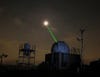
But perhaps even more impressive is the accuracy of the information the laser gathers. The Goddard laser is the first laser ranging effort to extend beyond low earth orbit, and it is able to measure the range of the LRO to within four inches. The microwave stations that are also tracking the LRO, by comparison, have a margin of error of about 65 feet. The accuracy provided by the lasers in turn allows researchers to know exactly where the LRO is in space, a critical component for creating accurate maps of the moon's surface.
The fundamentals behind the laser ranging are actually quite simple. A telescope on the ground at Goddard fires one-way laser pulses across space to the LRO. When the laser gets there, the LRO makes a record of each contact and sends it back to earth via its radio telemetry link. After that, good old-fashioned arithmetic is used to calculate the distance to LRO based on how long it takes the pulse to reach it.
But connecting with the LRO presents myriad challenges. Much as a quarterback must lead a wide receiver to connect with him in stride, the telescope must fire the laser in front of the orbiting LRO. But its timing must be much more precise than a quarterback's; because the laser receiver on the LRO is doing double-duty tracking both the Goddard signals and those from its own two-way range-finding laser aimed at the moon's surface, the pulses must be timed so the two lasers don't interfere with one another. One NASA geophysicist likens it to shooting at a spinning coin from a mile out and repeatedly hitting it on the edge.
The Goddard team does have a little bit of leeway though. After traveling a quarter million miles through space, the laser spot is 12 miles wide when it reaches the LRO, giving those on the ground some room for error. But given the range, and the LRO's 3,600 mph speed, let's just say that what Goddard is doing every day puts your laser tag exploits in perspective.
[PhysOrg]
Five amazing, clean technologies that will set us free, in this month's energy-focused issue. Also: how to build a better bomb detector, the robotic toys that are raising your children, a human catapult, the world's smallest arcade, and much more.


Online Content Director: Suzanne LaBarre | Email
Senior Editor: Paul Adams | Email
Associate Editor: Dan Nosowitz | Email
Assistant Editor: Colin Lecher | Email
Assistant Editor: Rose Pastore | Email
Contributing Writers:
Rebecca Boyle | Email
Kelsey D. Atherton | Email
Francie Diep | Email
Shaunacy Ferro | Email
Let me just do a simple math here. The LRO does 3600mph i.e 1 mile per second. During this time the Goddard laser can send 28 of such laser beams. Considering 12 mile range when it hits the LRO, the effective span of the laser in 1 second is 28 times 12 miles which is 336 miles.
So where the LRO covers 1 mile in a second, we have already covered a wide range of 336 miles in the same time. So this not seem impressive or highly accurate in finding its target.
It would be interesting to see the innovation that this experience leads to. What products could be improved with this kind of work? These are not eggheads who are working in a bubble--what they're doing could cause them to stumble onto something that will benefit us all.
----------
www.anamericanlion.com/
"So this not seem impressive or highly accurate in finding its target."
PopSci gets a smackdown.........AWWWWWWW
Who, Where, What, How, Why. Where's the why?
I think what would be really cool is creating a visible laser spot on the moon surface that people all over the world can see at night!
I wonder how powerful a red or green laser must be to do that?
A visible laser spot on the moon would be awesome!
But, then some of the people in the under developed parts of the world might see it, take is a bad omen, and then start sacrificing all the chickens and virgins in their immediate vicinity.
It could be an inspiration to at least some kids over there also hopefully. :-)
fb36, i can picture the marketing folks at many large corporations crunching the numbers now to see how much a giant golden M laser would cost :)
buck, yellow lasers? Now you're just talking silly.
"Let me just do a simple math here. The LRO does 3600mph i.e 1 mile per second. During this time the Goddard laser can send 28 of such laser beams. Considering 12 mile range when it hits the LRO, the effective span of the laser in 1 second is 28 times 12 miles which is 336 miles.
So where the LRO covers 1 mile in a second, we have already covered a wide range of 336 miles in the same time. So this not seem impressive or highly accurate in finding its target."
I think this is an accomplishment worth writing about, just look at the difference in the margin of error comparing microwave based tracking to laser, 4 inches to 65 feet. That is huge!
The comment of 336 miles is pointless,the LRO moves only one mile per second. The range covered in one second could be up to ~23.9999 miles not 336 miles.
Just wondering where NASA will go with this technolgy???Planetary communication??
I am sure the tracking works similar the global position system, where they are measuring how long it takes for a time coded light pulse to make it to the LRO from earth. A very small number, much smaller then 1/28 of a second, at the speed of light. So the accuracy is is more dependent on the response time of the receiver, accuracy of the time pieces. After that it is just minor rocket science to calculate the position on an object in orbit, if you know accurately where it was 1/28 th of a second ago.
ghq 28 times a second? I can't even write down my phone number once in that amount of time. And I cannot see how I'd send another pulse so it would not interfere with its moon business and still get in 27 more in a second. I'm impressed. Villa
It appears that deepak_ipru's calculation assumes the laser sweeps along the satellite track at 28 times the speed at which LRO travels in its orbit, and only hits LRO once per second.
I think the actual mode of operation has the laser tracking LRO, hitting it 28 times per second, so that in one second at that distance the beam sweeps an area 13 miles in length along track and 12 miles wide across track.
That's roughly equivalent to hitting the edge of a penny at a distance of 100 feet, not a mile, but still rather impressive.
--
FF
no no no dont shoot laser to the moon it will cause the moon to reproduce n misalign further n it will cause disaster on earth n more global warming