Chandra Space Telescope Snaps Grand New Shot of Milky Way
NASA today released a new, panoramic mosaic of the Milky Way, and frankly, it rivals anything snapped during the Hubble’s...
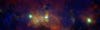
New Milky Way Panorama
NASA today released a new, panoramic mosaic of the Milky Way, and frankly, it rivals anything snapped during the Hubble’s early days. Taken by the Chandra X-ray space telescope, the picture shows the massive energy released by neutron stars and black holes more vividly than any previous picture.
Unlike the Hubble, which only records visual light, the Chandra can pick up the massive blasts of x-ray radiation released by dying super novas, spinning neutron stars and ravenous black holes. In the picture above, low-energy X-rays are colored red, medium energy green and high energy blue. The three turquoise spots represent sources of X-ray radiation. The center spot is the supermassive black hole Sagittarius A*, and the two flanking spots are stars feeding material into the black hole.
The image also commemorates the tenth anniversary of the Chandra telescope, which was launched on July 23rd, 1999. The third of four space telescopes that cover the range of the electromagnetic spectrum, Chandra was only slated to run for five years, but could continue operating until the next X-ray space telescope arrives in 2020.