A new image using data from NASA's Chandra X-Ray Observatory captures Stephan's Quintet in a new light
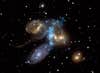
Stephan's Quintent, Colliding:  NASA
130 years ago, astronomers discovered Stephan's Quintent--a compact group of galaxies 280 million light years from Earth. NASA's Chandra X-ray Observatory has captured the X-rays generated by the interstellar collision, as one of the galaxies is sucked through the center of the group at 2 million miles per hour.

The ridge of blue in the center represent the X-rays emitted by the collision, as shock wave heats the galaxy's gasses.

[NASA]

Want to read more articles on the military, aviation, and space? Subscribe to Popular Science and enter to win $5,000!

13 Comments

Some pretty impressive stuff!

But, I couldn't help but notice that the center and upper left brown spheres appear to have smiley faces :). Mainly the center one. Guess the event isn't all that traumatic!

chat yes

Amazing photo! Stunning!

http://www.squidoo.com/TopDictionaries

It is astonishing how advanced we are these days - to take such beautiful photographs so far into space! Galileo should have loved to see this :)

Jen @ http://www.jobagencies.ca

View from 280 billion light years away is seriously breathtaking, but man I would not want to in that hot mess, that would hurt!!

How can we not be infinitely inspired to reach for the stars after seeing sights like that?

Beautiful!

[ www.ThePhenomenalExperience.com ]

It's amazing as to what goes on out there. It would be even more amazing to actually be there. And watch it happen.

you would NOT want be there when it happens!*ouch*...but if you really want to just wait around a billion years until the andromeda galaxy crashes into us :0

man just think about how long ago that happend because if it takes 7 min. for light to come from the sun just think how long it took us to see that for all we know the galaxies black holes crushed everything and there is no bundle of stars.

DarkFx

from Winnipeg, Manitoba

Spectacular.

It would absolutely be amazing to see it... too bad it happened 280 million years ago :-/

I'd be curious to see what the aftermath of this was.


Download Our iPhone App

Stay up to date on the latest news of the future of science and technology from your iPhone with full articles, images and offline viewing


Follow Us On Twitter

Featuring every article from the magazine and website, plus links from around the Web. Also see our PopSci DIY feed


Become a Fan On Facebook

Share links with friends, comment on stories and more


December 2009: Best of What's New

In our December issue, Popular Science names the 100 best innovations of the year: bombproof wallpaper, self-parking cars, the fastest helicopter, and 97 more. Plus inventor profiles and videos.

Check out the best of what's new here.

Popular Science Photo Pool


Share your photos in the Pop Sci pool at www.flickr.com!
tags_sprite.png
POP_embeddedForm_cover_May09.jpg