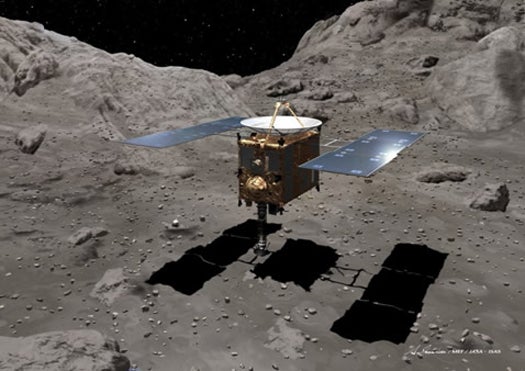
Asteroid Landing courtesy of JAXA

Some people may think locking some volunteers in a tin can for a couple of months is enough preparation for a flight to Mars, but the NASA panel reviewing the agency's manned space program envisions a more ambitious set of training wheels: docking with asteroids and a flyby of Venus.

In preparation for an August 31 report to the President on the future of NASA's human space flight program, the Review of U.S. Human Space Flight Plans Committee has recommended manned missions to asteroids and a manned mission to Venus to test out the equipment, training, and infrastructure needed to land on the red planet.

Committee member Edward Crawley, professor of Aeronautics and Astronautics at MIT, identified local asteroids and Venus as intermediary steps during a public meeting yesterday. Crawley said that traveling to either of those destination would require NASA to develop solutions to the problems of flying in deep space, such a exposure to cosmic radiation, but would give the agency more leeway in time and cost than a program that started with a trip to Mars itself.

During the same meeting, Crawley also proposed a manned mission to Mars' moon Phobos, the deployment of deep space refueling depots, and the possibility of testing Mars exploration equipment on our moon. However, at no point during the meeting did any committee member comment on the cost of this alternative plan.

It is important to keep in mind that any of these recommendations are part of a suite of options that the Committee will present to the President. That means it might be a while longer before we know for sure whether the U.S. is going straight back to Mars, or if we're going to make some pit stops along the way.

[via New Scientist]

Want to read more articles on the military, aviation, and space? Subscribe to Popular Science today, for less than $1 per issue!

12 Comments

It takes less fuel to land on mars than it dose the moon. We cant live on Venus without HUGE alterations to planet or huge amounts of gear. Mars is easier than the moon. It would require far less of a space suit it would probably resemble scuba gear more than apolo stuff. No armor for the habs would be needed because micro meters don't hell you could almost make them out of basketball material. They are talking about the possibility of there being ice water on the moon and exacting o2 from regolith, well mars has liquid salt water and miles thick water ice caps the soil is full of o2 and you could extract the o2 from a real atmosphere by adding energy to co2. I say forget venus and skip the moon lets do some real work.

as long as the asteroids dont kill us.
www.youtube.com/watch?v=hEUWrj7SyPk

I’m ready to go to Mars. But we’re working on the wrong problem. Locking people in tin cans for over a year is simply accepting that we’re going to use conventional propulsion systems to get us there and it’s going to take a very, very long space trip to do it.

That is unacceptable. It takes too long. The likelihood of something going wrong in a year of space travel is far too great. We would be condemning those brave souls to a one way science experiment.

The number one goal we should be focused on now is a new propulsion system. The President’s challenge to this nation should be to develop a propulsion system to put a man on Mars and return him safely to the Earth in less than 4 months.

Sound impossible?

So did putting a man on the Moon in the 1960’s. That technology did not exist until a President challenged a nation to make that technology exist.

All the money and research should be on propulsion. The ION engine was a pretty good leap forward in a less dramatic, acceleration with patience, kind of approach. Those are the kinds of ideas that will make locking people up for a year obsolete.

If propulsion is the main issue, maybe a return trip to the moon is a good next step, but use that mission to test a higher speed propulsion system - make it a goal to get from earth to the moon in 24 hours, for example, compared to the 4 days it took Apollo 11 to arrive there.

the tech behind drives like ION or plasma drives takes time to accelerate, they would be good for a mission to mars but would actually make a trip to the moon longer then conventinal rockets.
the distance to the moon would force them to begin decelerating long before the real speed of ion or plasma could be achived.
ION or plasma drives work at a constant low thrust building speed over a long time, rockets build up a lot of speed fast and then coast, if you start with ion drive from earth orbit it would take weeks even monthes to build up enough velocity to excape earth and reach the moon, rockets like apollo can do the same in days.
on the otherhand a rocket could be used as a booster stage for ion drive to give it a good starting velocity, an apollo type booster could provide enough boost to break away from earth orbit and begin the journy then ION drive could kick in to continue accelerating long after a chemical rocket would have run out of fuil.

Our technology is continuously innovating and it is unstoppable. Even our defense system is also progressing to its high-technology projects. Defense spending is known to need major cuts, especially now, when one of a new military pet project is called brain optimization. Brain optimization would literally mean affecting brain activity in order to enhance memory capabilities to recall key information at appropriate times – in other words, mind control. This is a project of DARPA, the Pentagon's far out research arm, who aim to equip troops with devices that will synch up brain waves. Defense spending, including projects like brain optimization, is responsible for the bulk of the national debt of the US, perhaps our Congress should start cutting these sorts of programs when Americans need no fax payday loans for basic medical care, housing, or in some cases, even food.
check this out for more info:
http://personalmoneystore.com/moneyblog/2009/07/29/brain-optimization-research/

animemaster - Did you even read the title of this article? They aren't considering landing on Venus, just a fly-by.

@FreddyH

The U.S. Government spends 4% of the gross domestic product on the U.S. military. That includes, military operations, mission support, logistics, employee benefits, along with research and development. Out of the total GDP only 4% out of 100% is used to accomplish incredible (yet terrible) things.

The point is that the majority of the money doesn't go to the military. It goes to other things such as economic stimulus, agriculture, national education, infrastructure, politics, humanitarian aid, etc.

Now, in the multi-sized slices of the GDP pie, NASA gets less than 1%. Through this it is able to carry out manned missions into low-earth-orbit and unmanned missions that stretch into the far reaches of space (space telescopes, probes, & satellites).

However, you are right on the money about cost. With the good and plenty NASA accomplishes with such a small budget, it is obviously clear that if the majority of the powers-that-be held the space program as a higher priority, more money would fund NASA's endeavors (not a measly less than 1%).

With our advancement in Technology, we could reach the Starship Enterprise level in no time. However, there are many things that have to be fixed with us (the human race) first before we can truly focus on stretching out into space and succeeding on this plight.

"Welcome! to the Federation Starship SS Buttcrack!!!"

while I am absolutely behind space exploration as it is the only chance at immortality humanity has been able to take to heart, I would say that NASA be forced into a new approach for it's funding. We need to get some real return on what we have spent already. We need to send a few good people out to get us an asteroid. We need to keep the things we have, or sell them. Period. Obama, please do not even consider the lunatic plan to de-orbit the ISS, I've given possible uses before, here is another useful one. Bolt-On Graveyard for space junk. Anything to keep from throwing 175 billion dollars away. Let the contractors continue to make things like shield generators, mass drivers, habitat modules, improved capacitors, beam technology for power transfer, or any of the other things that we are already close to or at in development. If Nasa cannot manage it's own finances, then it cannot be allowed to. This is no time to try to scrape more money off the backs of the middle class and the poor. We ain't got it to give up anymore. Almost 30 million people have yet to be paid their tax return at 17 weeks. This is no coincidence, because the government is broke. Even though the end number is the same because the money we had now belongs to Dick Cheney, and largely still here. Just not ours anymore, right? Next year at this rate tax evasion Will surpass auto theft-just look at the numbers of drop offs in small business taxes. Give Me A Job, not a half a week pay.

BUERACRATIC NONSENSE

they dont even have the guts for another moon mission and their talking about these kind of things?!!
NONSENSE I TELL YOU
ill give you my famous 20 year garuntee that NASA will get nowhere with its manned missions past the moon

@animemaster:

From the ESA website: "Atmospheric pressure at ground level is on average 0.7% that on Earth, equivalent to a pressure found about 35 kilometres above the Earth. Here's the link:

http://sci.esa.int/science-e/www/object/index.cfm?fobjectid=31030

While I'm certainly no expert, I don't think scuba gear will work as a space suit there. Further, there are temperature considerations.

@TechnoFreakF:

You wrote: "they dont even have the guts for another moon mission."

I'm a confused by that, and no, I'm not picking on you. I genuinely don't understand. We have astronauts staying aboard the ISS for months on end, and it seems to me that takes considerable courage. After all, even near-space is fraught with constant dangers. Orbiting space debris. Meteors. Cosmic radiation. Bone and muscle loss. Etc. etc. etc.

If you mean the present NASA leadership, well, Administrator Charles F. Bolden is a retired Marine Major General (no surprise, since he graduated from the Naval Academy at Annapolis). After completing training as a naval aviator, he flew over 100 combat sorties in Southeast Asia during the Vietnam War, not exactly a past-time for the faint of heart. A couple assignments later, he became a test pilot, another not-for-the-faint-at-heart sort of activity. And he served in Kuwait as a Deputy Commanding General during Operation Desert Thunder. And in the middle of all this, he served as an astronaut for 14 years, during which time he went up on the Space Shuttle four times, twice as commander.

Doesn't sound like a man short in the guts department.

As for his second-in-command, Deputy Administrator Lori Garver, she has shown her guts in a different way, not least by serving in a senior capacity at NASA previously, and such senior jobs take tough political infighting skills.

However, if I've missed something regarding either General Bolden or Ms. Garver, by all means, let us know. The same goes as far as the astronaut corps goes.

As far as "institutional guts" to go to the Moon, sure, it's there; after all, they pulled that off -- repeatedly -- starting 40 years ago.

Now, if you're talking about in Congress . . . well, that's a whole different story. General Bolten was not the President's first choice, but powerful Senators pushed Bolten hard (and I mean no disrespect to General Bolten at all). Why? Because it looked like under certain possible futures for NASA, especially any contemplated return to the Moon, their constituents might lose out, at least to a degree. The new Administrator is going to have his hands full trying to avoid becoming a pawn of their political interests. His service in the Marine Corps as a general will serve him in good stead on that front, considering that flag-rank politics can be every bit as dirty and ruthless as anything on the civilian side.

Do I personally want to see us go back to the Moon? Well, a resounding "maybe." My reservations revolve around suitability of the Moon as a launch pad for exploration further afield and what -- if any -- return on investment we might get from there (via mining, for example). If the Moon *isn't* the best choice as a starting point for exploring outwards AND there aren't any return-on-investment possibilities . . . well, I'd have to mull that over a good long while, particularly if there were an obviously far better alternative, perhaps an asteroid.

In the larger sense of "Should we continue space exploration?" my answer is a loud, deeply-felt, "YES! Of course!" I'm a rock-solid supporter of our space program, both human exploration and robotic missions. And I would like us to establish colonies, maybe on the Moon, perhaps more likely on Mars. I probably won't live to see that, but I hope it happens.

I'd also like to see NASA get a much bigger budget. Adjusting for inflation, it's running on a little under 55% of what it did during the glory days of the Mercury-Gemeni-Apollo missions.

(2&1/2 years late)I'm all for it!


June 2013: American Energy Independence

Five amazing, clean technologies that will set us free, in this month's energy-focused issue. Also: how to build a better bomb detector, the robotic toys that are raising your children, a human catapult, the world's smallest arcade, and much more.


Online Content Director: Suzanne LaBarre | Email
Senior Editor: Paul Adams | Email
Associate Editor: Dan Nosowitz | Email
Assistant Editor: Colin Lecher | Email
Assistant Editor: Rose Pastore | Email

Contributing Writers:
Rebecca Boyle | Email
Kelsey D. Atherton | Email
Francie Diep | Email
Shaunacy Ferro | Email

circ-top-header.gif
circ-cover.gif
bmxmag-ps