For a few years now, we’ve been excited about the possibility of a cable-based space elevator as an alternative to expensive rocket launchers. To date, though, the various attempts to make it happen–including annual contests and Japan’s recent initiative–have come up short. The problem? Space elevators have one major hang-up: most designs call for braided cords of extremely strong nanotubes, which unfortunately don't exist yet.
While we don’t have any breakthroughs to report on that front (sorry), we do have something better, or at least more promising: A team of scientists at Toronto’s York University have recently suggested that inflatable pneumatic modules (which do exist, and are already used in some spacecraft) could be assembled into a 15-kilometer-high inflatable tower that, placed atop a mountain, would bring us to the edge of the atmosphere. The modules in question are helium-inflated Kevlar-polyethylene composite tubes.
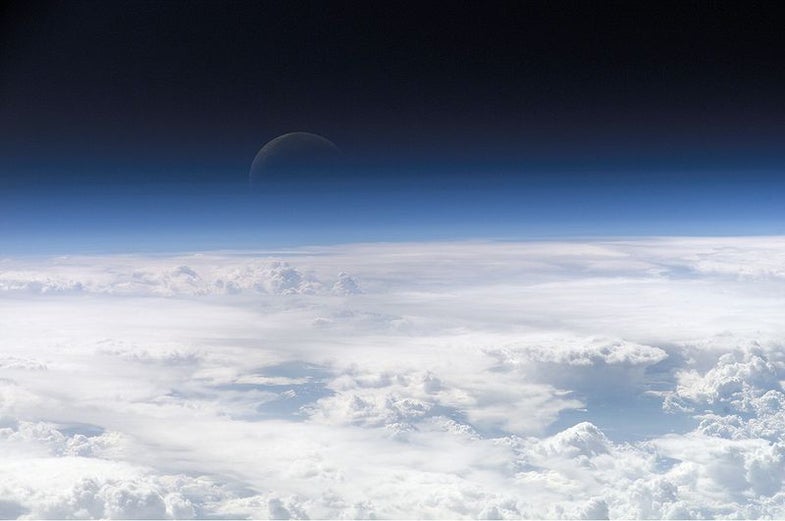
True, 15 kilometers up is not quite outer space, but at that altitude, we’ll still get a view of the upper atmosphere similar to that from space and a place for atmospheric study, telecommunications uses and a platform for sending things further up.
The Canadian researchers have already tested the idea, albeit at a smaller scale: their 7-meter model is composed of only six modules, whereas the 15-kilometer version would be made up of 100, and would weigh 800,000 metric tons when pressurized. Proportions aside, there are a few other kinks standing in the way of making the towers a reality. Still, it’s by no means a pipe dream.
Stay up to date on the latest news of the future of science and technology from your iPhone with full articles, images and offline viewing
Featuring every article from the magazine and website, plus links from around the Web. Also see our PopSci DIY feed
Share links with friends, comment on stories and more
In our December issue, Popular Science names the 100 best innovations of the year: bombproof wallpaper, self-parking cars, the fastest helicopter, and 97 more. Plus inventor profiles and videos.
Check out the best of what's new here.
I'll be excited when I see examples of phyical results and practical uses.
I like the thinking outside the nanotube box idea but I think they will run into many gravity and weather issues. Take that 7 meter model outside and just let a stiff breeze blow on it and you'll get the idea. The bigger and more robust you build the tube tower to combat swaying and sagging the heavier it gets and the less load it can carry. Replace the Helium with Hydrogen to get more lift but also more risks.
The traditional space elevator idea that has evolved has a cable from space that would be lowered and anchored to the ground or to a mass ship in the pacific where the weather is most favorable. A large mass in orbit would support the cable and counterbalance the elevators as they rose.
skepticism aside, I like the idea and would like to see more research continue. Ideas like this come forward and help push creativity and invention and will help to advance the concept.
from neverland
I'm working on the idea, how to produce a circular platform in the form of a donut, and filled with helium. In the middle of the platform would be installed launching ramp and rocket/spaceship with cargo. Platform would take off on the principle of the classic blimp, at a height of 35 km, it would launch the cargo, then it could return back to earth. At this altitude maybe a platform could attach to an even higher platform, which would raise the load, by cables in orbit, if speed could be coordinated. The whole system for launching platform, should be running on solar power.
This is a strange world we are living in, getting stranger all the time.Old ideas become new and well here we go again.. I think the point is Moot.. we should be shooting stuff into space on a Mag Rail system.. i liked the light powered idea.. but electricity is just as clean.. shoot up cargo containers with entry vehicles inside..
Don't you think a space escalator would be a more scenic rout. Wait rules of physics still apply maybe that's what the box is made of? I question the usefulness of 15km the Japanese can get balloons that high but whats the point in staying there indefinitely being in orbit is cheep to maintain compared to this.
from neverland
Rockets are cool, but have never been meant for space travel, in essence, we are constantly developing weapons. The real challenge was how to travel in space, based on natural laws, such as the laws of electricity, fluid dynamics, thermodynamics ,.... Planet's atmosphere is full of surprises, which we're only now discovering. Although we have long known the basic physical principles, new generation of transportation may now be developed, together with the development of technology and the latest knowledge. Nothing is ever really out of date. Instead, we try to push into space with all force, we could travel at stages, exchanging different natural principles, which could be used for propulsion and braking. The result could be a space flights with 0 pollution, optimal use of energy and multi-stage security, which is the final objective. I wonder, when will the aircrafts fly at least as well, as any ordinary bird or insect.
If it is inflatable hide the needles from the children.
But imagine the ad space on that sucker!
Stacking magnets to space? A solar array to power it up there, a reactor down here?
A gas powered supergun operating on hydrogen.
Now I got magnets and gyroscopes on the brain, lots and lots of them. Can't gyros alter a magnetic field? To shape it? Would it be predictable and dependable as long as it has charge? How would it interact with the planetary field?
Ive been pondering the idea of a two sided plaform, one part in space the other in low earth orbit that can be accesed by conventional aircraft to be used as a docking station for space transport. It would be connected to a larger station in earth orbit by a system of strong cables as well as multiple elevator sytems for towing up people and spacecraft. The concept is simple but in practice could be difficult to actually construct but im sure human inginuity can overcome all obstacles. of course the dual station would never maintain the same location because of the constant momentum of one part circling the globe which would prove to make for an interesting engineering task, but im sure its a possibility that is feasable to accomplish
Ooof humans traveling on the space elavator is unrealistic for the following reson: Being no expert, I dont know the oficial name but, in the atmosphere is a layer of high radiation. If you travel at the speed of a space elavator, you would die long before you reached the top. Shuttles travel through this layer at a high speed, limiting exposure. To keep out this radiation you would need at least several feet of sheer concrete around you wich to say the least would collasaly increase weight, far beyond what the elavator could lift. If you go into those kind of scales you might as well carry up a nuclear power plant along with the bunker :)
Well I dont know much about nanotubes, But if there small enough would it be possible to combine it with a kind of ferrofluid and use that combination with a gyroscope type magnit to give it stability and make an elevator out of that? Just somthing out of the box :D